QUESTION IMAGE
Question
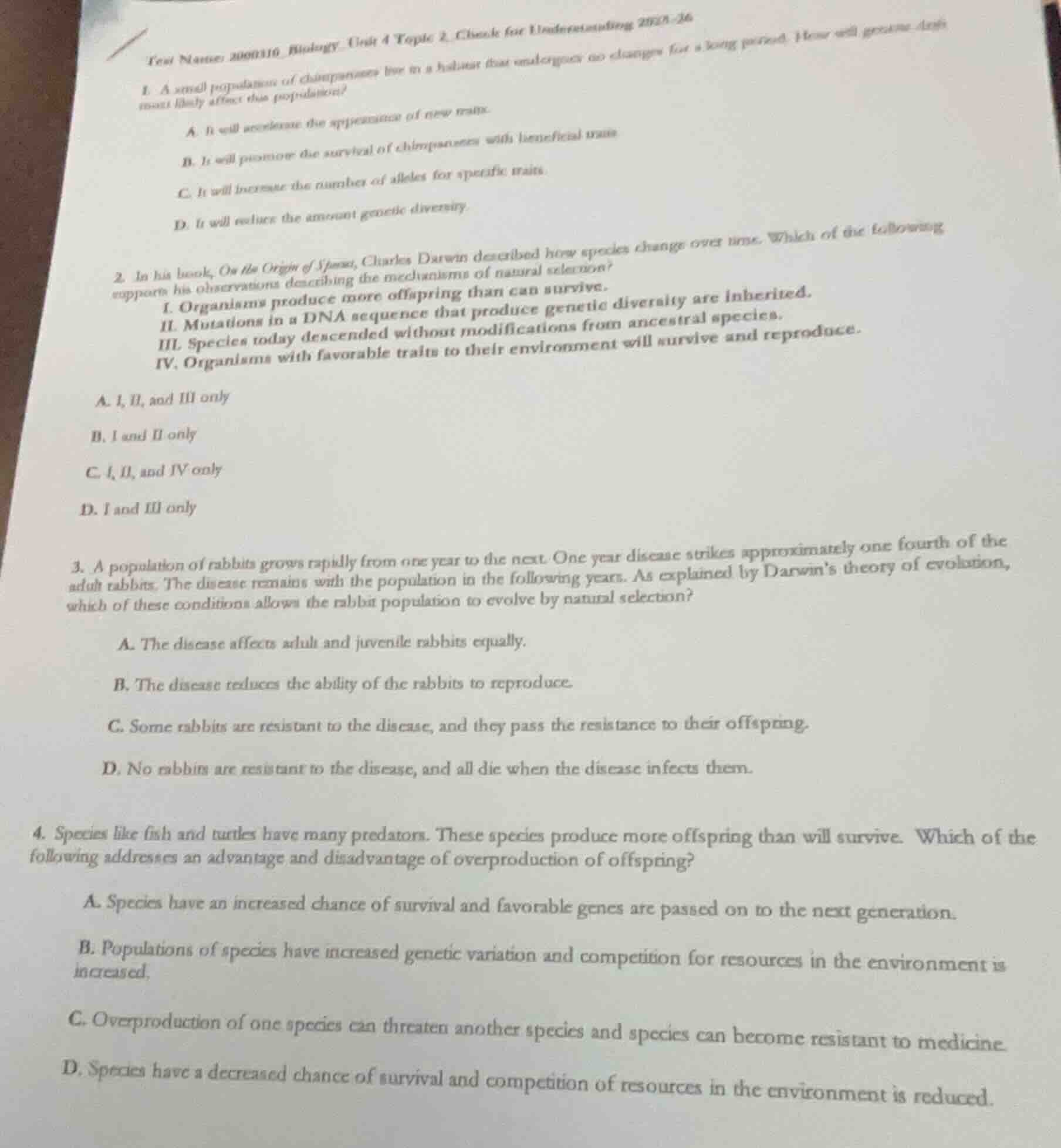
test name: 2000316_biology_unit 4 topic 2_check for understanding 2025 - 26
- a small population of chimpanzees live in a habitat that undergoes no changes for a long period. how will genetic drift most likely affect this population?
a. it will increase the appearance of new traits.
b. it will promote the survival of chimpanzees with beneficial traits.
c. it will increase the number of alleles for specific traits.
d. it will reduce the amount of genetic diversity.
- in his book, on the origin of species, charles darwin described how species change over time. which of the following supports his observations describing the mechanisms of natural selection?
i. organisms produce more offspring than can survive.
ii. mutations in a dna sequence that produce genetic diversity are inherited.
iii. species today descended without modifications from ancestral species.
iv. organisms with favorable traits to their environment will survive and reproduce.
a. i, ii, and iii only
b. i and ii only
c. i, ii, and iv only
d. i and iii only
- a population of rabbits grows rapidly from one year to the next. one year disease strikes approximately one fourth of the adult rabbits. the disease remains with the population in the following years. as explained by darwin’s theory of evolution, which of these conditions allows the rabbit population to evolve by natural selection?
a. the disease affects adult and juvenile rabbits equally.
b. the disease reduces the ability of the rabbits to reproduce.
c. some rabbits are resistant to the disease, and they pass the resistance to their offspring.
d. no rabbits are resistant to the disease, and all die when the disease infects them.
- species like fish and turtles have many predators. these species produce more offspring than will survive. which of the following addresses an advantage and disadvantage of overproduction of offspring?
a. species have an increased chance of survival and favorable genes are passed on to the next generation.
b. populations of species have increased genetic variation and competition for resources in the environment is increased.
c. overproduction of one species can threaten another species and species can become resistant to medicine.
d. species have a decreased chance of survival and competition of resources in the environment is reduced.
- For a small population in an unchanging habitat, genetic drift reduces genetic diversity over time, as small populations lose alleles more easily.
- Darwin's natural selection relies on overproduction of offspring (I), heritable genetic variation (II), and survival/reproduction of individuals with favorable traits (IV). Species do descend with modification, so III is incorrect.
- Natural selection requires heritable variation: resistant rabbits passing on their resistance means favorable traits are passed to offspring, driving evolution.
- Overproduction increases genetic variation (advantage, as more offspring mean more genetic diversity) but increases competition for limited resources (disadvantage).

Snap & solve any problem in the app
Get step-by-step solutions on Sovi AI
Photo-based solutions with guided steps
Explore more problems and detailed explanations
- D. It will reduce the amount genetic diversity.
- C. I, II, and IV only
- C. Some rabbits are resistant to the disease, and they pass the resistance to their offspring.
- B. Populations of species have increased genetic variation and competition for resources in the environment is increased.