QUESTION IMAGE
Question
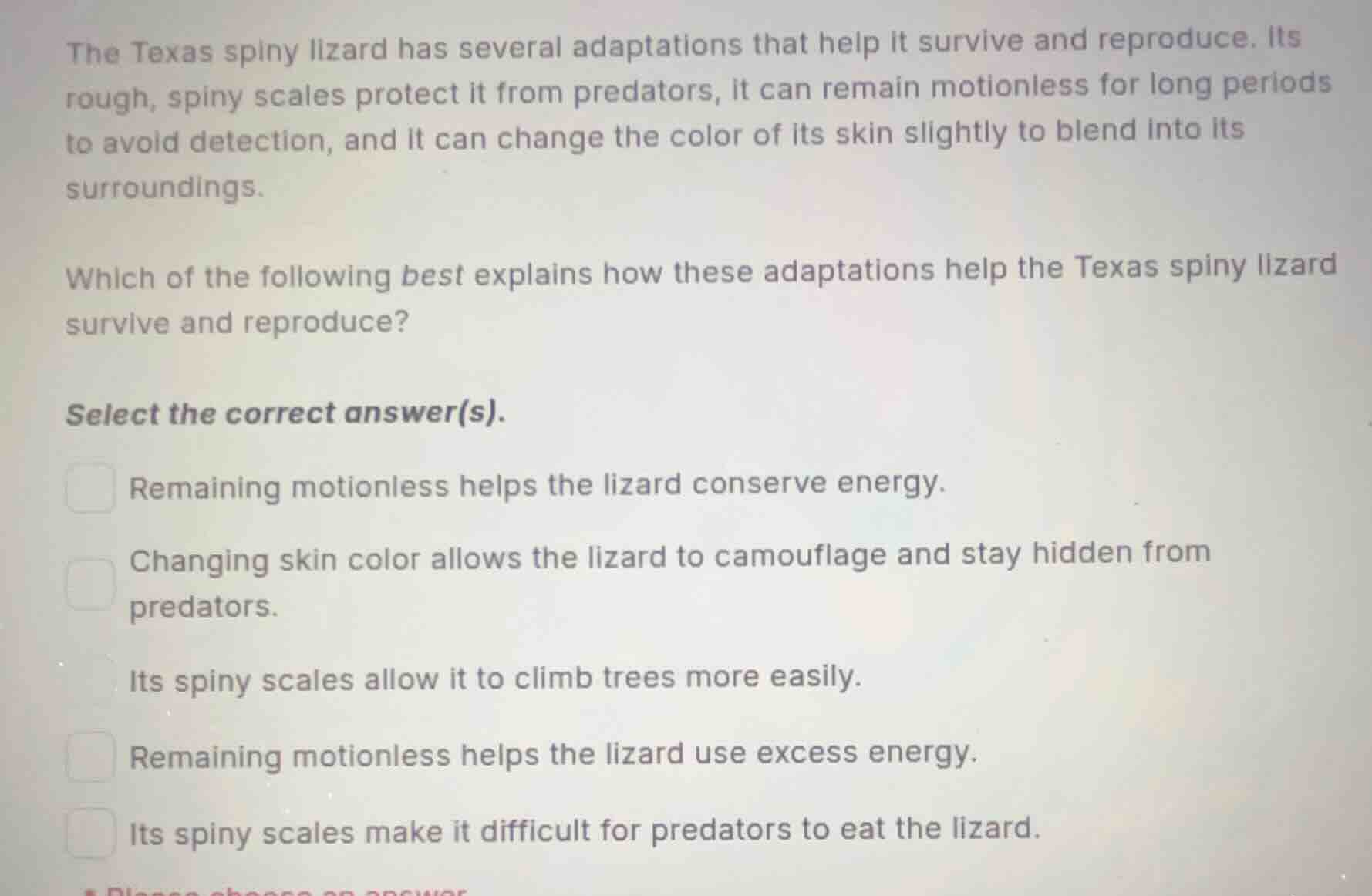
the texas spiny lizard has several adaptations that help it survive and reproduce. its rough, spiny scales protect it from predators, it can remain motionless for long periods to avoid detection, and it can change the color of its skin slightly to blend into its surroundings.
which of the following best explains how these adaptations help the texas spiny lizard survive and reproduce?
select the correct answer(s).
remaining motionless helps the lizard conserve energy.
changing skin color allows the lizard to camouflage and stay hidden from predators.
its spiny scales allow it to climb trees more easily.
remaining motionless helps the lizard use excess energy.
its spiny scales make it difficult for predators to eat the lizard.
- For "Remaining motionless helps the lizard conserve energy": Remaining still reduces movement, which lowers energy expenditure, aiding survival (as conserved energy can be used for other vital functions like reproduction).
- For "Changing skin color allows the lizard to camouflage and stay hidden from predators": Camouflage via color change helps avoid detection by predators, increasing survival chances to reproduce.
- For "Its spiny scales make it difficult for predators to eat the lizard": Spiny scales act as a physical defense, reducing predation risk, thus aiding survival and reproduction.
- The other options are incorrect: Spiny scales are for protection (not tree - climbing), and remaining motionless is for avoiding detection (not using excess energy).

Snap & solve any problem in the app
Get step-by-step solutions on Sovi AI
Photo-based solutions with guided steps
Explore more problems and detailed explanations
B. Changing skin color allows the lizard to camouflage and stay hidden from predators.
E. Its spiny scales make it difficult for predators to eat the lizard.
A. Remaining motionless helps the lizard conserve energy.