QUESTION IMAGE
Question
text 1
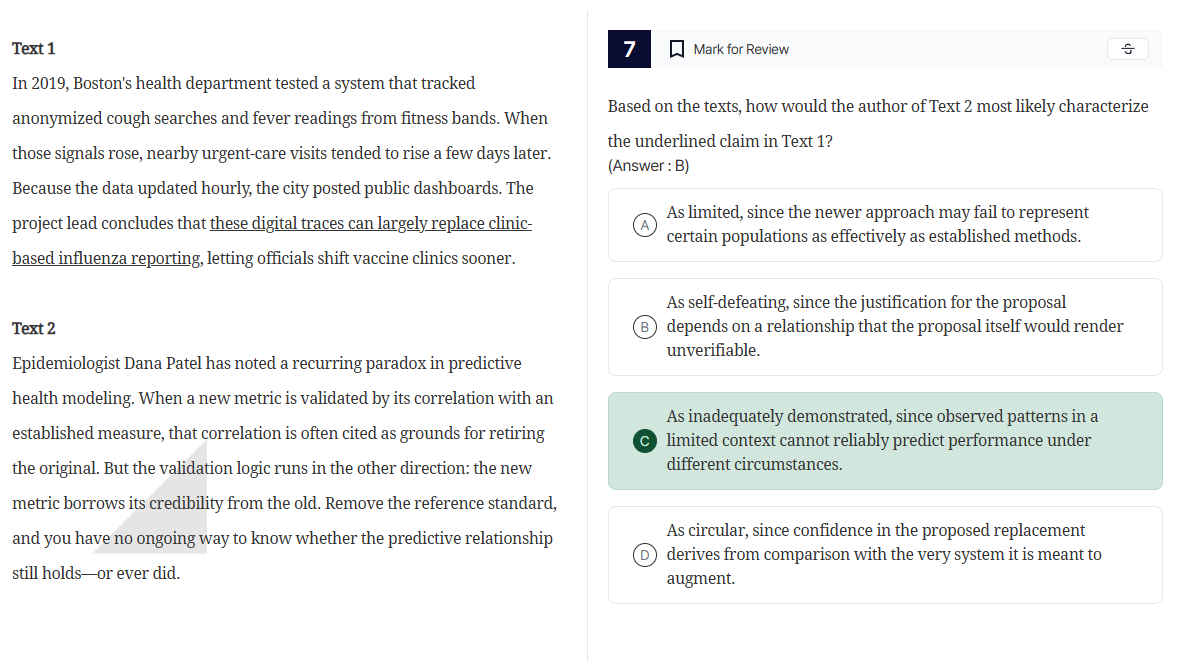
in 2019, bostons health department tested a system that tracked anonymized cough searches and fever readings from fitness bands. when those signals rose, nearby urgent - care visits tended to rise a few days later. because the data updated hourly, the city posted public dashboards. the project lead concludes that these digital traces can largely replace clinic - based influenza reporting, letting officials shift vaccine clinics sooner.
text 2
epidemiologist dana patel has noted a recurring paradox in predictive health modeling. when a new metric is validated by its correlation with an established measure, that correlation is often cited as grounds for retiring the original. but the validation logic runs in the other direction: the new metric borrows its credibility from the old. remove the reference standard, and you have no ongoing way to know whether the predictive relationship still holds—or ever did.
7 mark for review
based on the texts, how would the author of text 2 most likely characterize the underlined claim in text 1?
(answer: b)
a as limited, since the newer approach may fail to represent certain populations as effectively as established methods.
b as self - defeating, since the justification for the proposal depends on a relationship that the proposal itself would render unverifiable.
c as inadequately demonstrated, since observed patterns in a limited context cannot reliably predict performance under different circumstances.
d as circular, since confidence in the proposed replacement derives from comparison with the very system it is meant to augment.
To solve this, we analyze Text 2's argument. Text 2 talks about a paradox in predictive health modeling: a new metric's validity comes from its correlation with an established measure, but if the original is retired (as Text 1 proposes replacing clinic - based reporting with digital traces), the correlation (which justified the new metric) can no longer be verified.
- Option A: Text 2 doesn't focus on representing certain populations, so A is incorrect.
- Option B: The proposal in Text 1 (replacing clinic - based reporting with digital traces) relies on the correlation between digital signals and urgent - care visits (justification). If we replace clinic - based reporting, we lose the established measure (clinic - based data) that was used to validate the digital traces. So the relationship (correlation) that justified the proposal becomes unverifiable, which matches the idea of "self - defeating" as the proposal's own existence would make its justification unverifiable.
- Option C: Text 2 is not about the inadequacy of demonstrating performance in different circumstances, but about the loss of verification of the relationship, so C is incorrect.
- Option D: The proposal in Text 1 is to replace, not augment, and the logic isn't circular (circular would be using the thing to prove itself, here it's using a correlation with another thing), so D is incorrect.

Snap & solve any problem in the app
Get step-by-step solutions on Sovi AI
Photo-based solutions with guided steps
Explore more problems and detailed explanations
B. As self - defeating, since the justification for the proposal depends on a relationship that the proposal itself would render unverifiable.