QUESTION IMAGE
Question
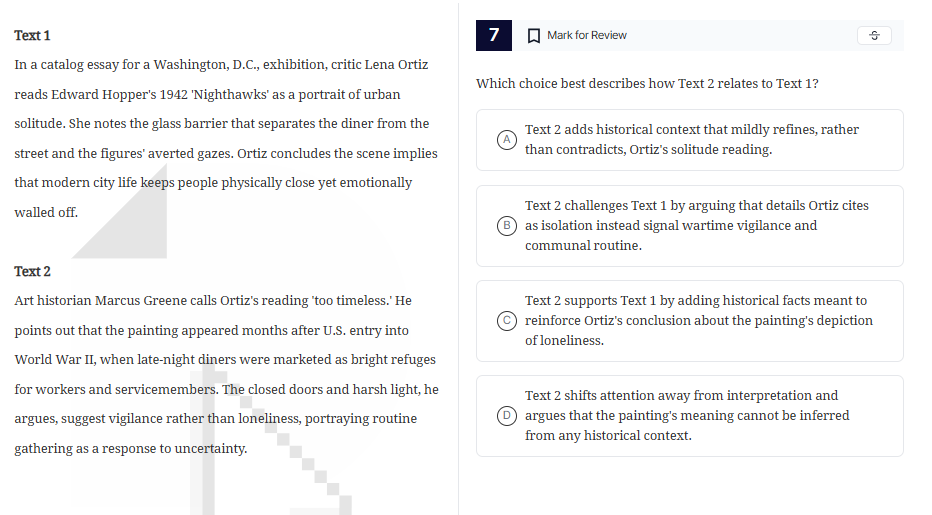
text 1
in a catalog essay for a washington, d.c., exhibition, critic lena ortiz reads edward hopper’s 1942 nighthawks as a portrait of urban solitude. she notes the glass barrier that separates the diner from the street and the figures’ averted gazes. ortiz concludes the scene implies that modern city life keeps people physically close yet emotionally walled off.
text 2
art historian marcus greene calls ortiz’s reading too timeless. he points out that the painting appeared months after u.s. entry into world war ii, when late - night diners were marketed as bright refuges for workers and servicemembers. the closed doors and harsh light, he argues, suggest vigilance rather than loneliness, portraying routine gathering as a response to uncertainty.
7 mark for review
which choice best describes how text 2 relates to text 1?
a text 2 adds historical context that mildly refines, rather than contradicts, ortiz’s solitude reading.
b text 2 challenges text 1 by arguing that details ortiz cites as isolation instead signal wartime vigilance and communal routine.
c text 2 supports text 1 by adding historical facts meant to reinforce ortiz’s conclusion about the painting’s depiction of loneliness.
d text 2 shifts attention away from interpretation and argues that the painting’s meaning cannot be inferred from any historical context.
To solve this, we analyze each option:
- Option A: Text 2 doesn't "mildly refine" but challenges. Greene's view is different from Ortiz's, so A is wrong.
- Option B: Text 1 (Ortiz) sees solitude; Text 2 (Greene) argues details (closed doors, harsh light) show wartime vigilance and communal routine, challenging Ortiz. This matches.
- Option C: Text 2 doesn't support; it challenges, so C is wrong.
- Option D: Text 2 uses historical context to interpret, so D's claim about meaning not inferable from context is wrong.

Snap & solve any problem in the app
Get step-by-step solutions on Sovi AI
Photo-based solutions with guided steps
Explore more problems and detailed explanations
B. Text 2 challenges Text 1 by arguing that details Ortiz cites as isolation instead signal wartime vigilance and communal routine.