QUESTION IMAGE
Question
text 1
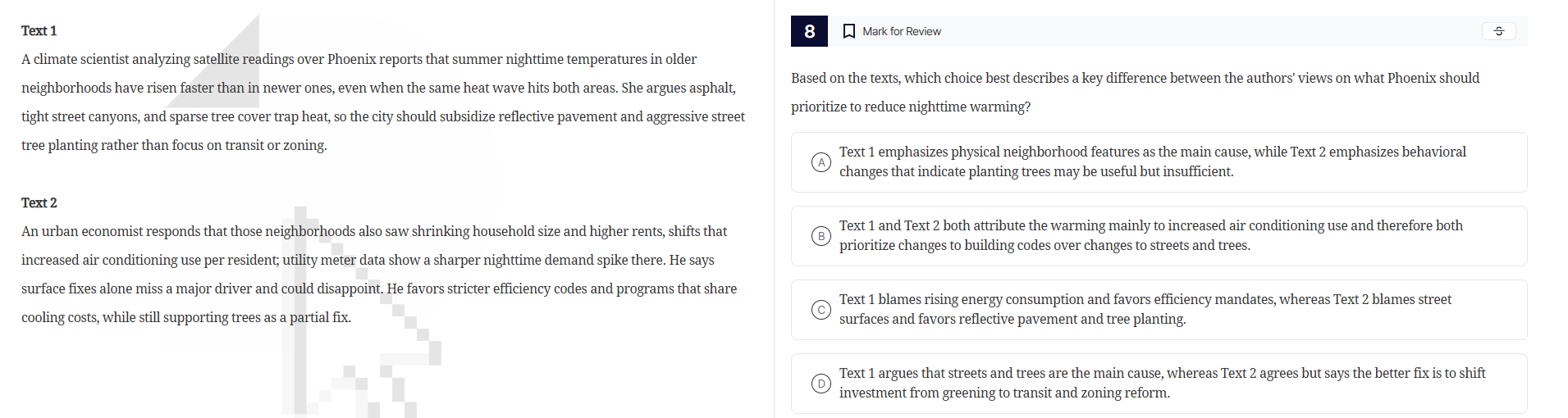
a climate scientist analyzing satellite readings over phoenix reports that summer nighttime temperatures in older neighborhoods have risen faster than in newer ones, even when the same heat wave hits both areas. she argues asphalt, tight street canyons, and sparse tree cover trap heat, so the city should subsidize reflective pavement and aggressive street tree planting rather than focus on transit or zoning.
text 2
an urban economist responds that those neighborhoods also saw shrinking household size and higher rents, shifts that increased air conditioning use per resident; utility meter data show a sharper nighttime demand spike there. he says surface fixes alone miss a major driver and could disappoint. he favors stricter efficiency codes and programs that share cooling costs, while still supporting trees as a partial fix.
8
mark for review
based on the texts, which choice best describes a key difference between the authors views on what phoenix should prioritize to reduce nighttime warming?
a text 1 emphasizes physical neighborhood features as the main cause, while text 2 emphasizes behavioral changes that indicate planting trees may be useful but insufficient.
b text 1 and text 2 both attribute the warming mainly to increased air conditioning use and therefore both prioritize changes to building codes over changes to streets and trees.
c text 1 blames rising energy consumption and favors efficiency mandates, whereas text 2 blames street surfaces and favors reflective pavement and tree planting.
d text 1 argues that streets and trees are the main cause, whereas text 2 agrees but says the better fix is to shift investment from greening to transit and zoning reform.
- For Option A: Text 1 focuses on physical features (asphalt, street canyons, tree cover) causing heat and prioritizes reflective pavement/tree planting. Text 2 focuses on behavioral changes (household size, rent, AC use) and sees tree planting as partial, not sufficient alone. This matches the key difference.
- For Option B: Text 1 does not attribute warming to AC use, and they don't both prioritize building codes, so B is wrong.
- For Option C: Text 1 blames physical neighborhood features, not energy consumption; Text 2 blames behavioral/AC - related factors, not street surfaces. So C is reversed and wrong.
- For Option D: Text 2 does not agree that streets and trees are the main cause, and Text 1 does not favor shifting to transit/zoning. So D is wrong.

Snap & solve any problem in the app
Get step-by-step solutions on Sovi AI
Photo-based solutions with guided steps
Explore more problems and detailed explanations
A. Text 1 emphasizes physical neighborhood features as the main cause, while Text 2 emphasizes behavioral changes that indicate planting trees may be useful but insufficient.