QUESTION IMAGE
Question
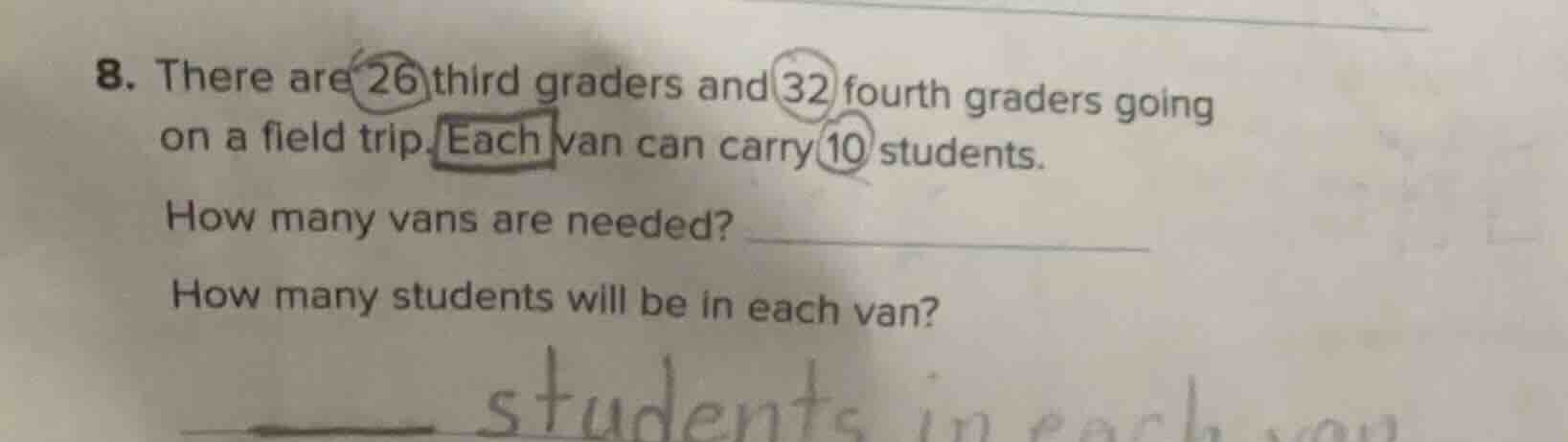
- there are 26 third graders and 32 fourth graders going on a field trip. each van can carry 10 students. how many vans are needed? how many students will be in each van?
First sub - question: How many vans are needed?
Step 1: Find the total number of students
We need to add the number of third - graders and fourth - graders. The number of third - graders is 26 and the number of fourth - graders is 32. So the total number of students $n = 26+32=58$.
Step 2: Calculate the number of vans needed
Each van can carry 10 students. We divide the total number of students by the number of students per van. $58\div10 = 5.8$. Since we can't have a fraction of a van, we need to round up to the next whole number. So we need 6 vans.
Second sub - question: How many students will be in each van?
Step 1: Find the total number of students
As before, the total number of students is $26 + 32=58$.
Step 2: Distribute the students into the vans
We have 6 vans. We divide the total number of students by the number of vans. $58\div6 = 9$ with a remainder of 4. But if we want to distribute them as evenly as possible, 5 vans will have 10 students and 1 van will have 8 students? Wait, no. Wait, the first part we found that we need 6 vans. Let's re - examine. Wait, the total number of students is 58. If we use 6 vans, $58=10\times5 + 8$. So 5 vans will have 10 students and 1 van will have 8 students. But if we consider the average number of students per van, it is $\frac{58}{6}=\frac{29}{3}\approx9.67$. But maybe the question is about if we fill the vans as much as possible. Wait, the first question is about the number of vans needed (since we can't have a fraction of a van, we need to take the ceiling of $58\div10$ which is 6). Then for the second question, if we have 6 vans, we can calculate the number of students in each van. Let's do it properly.
Wait, let's start over for the second question.
Total number of students $S=26 + 32 = 58$.
Number of vans $V = 6$ (from the first question).
Number of students per van on average is $\frac{S}{V}=\frac{58}{6}=\frac{29}{3}\approx9.67$. But if we are to distribute them, 5 vans will have 10 students and 1 van will have 8 students. But maybe the question is simpler. Wait, maybe I made a mistake in the first question. Wait, 26 third - graders and 32 fourth - graders. 26+32 = 58. Each van carries 10. 5 vans carry 50 students, and we have 8 left, so we need 6 vans. Then, for the number of students in each van: 5 vans have 10 students and 1 van has 8 students. But if we want to find the number of students in each van when distributing as evenly as possible, the answer is that 5 vans have 10 students and 1 van has 8 students. But maybe the question is asking for the number of students in each van when we consider the last van. Wait, the problem says "how many students will be in each van?" Maybe it's a trick question. Wait, no. Wait, maybe the first part: number of vans needed is 6. Then total students 58. 58 divided by 6 is 9 with a remainder of 4. But that's not right. Wait, no, 6 times 9 is 54, 58 - 54 = 4. Wait, I think I messed up the first question. Wait, 26+32 = 58. 58 divided by 10 is 5.8. So we need 6 vans. Then, if we put 10 students in each of the first 5 vans, that's 50 students, and the remaining 8 students go into the 6th van. So the number of students in each van: 5 vans have 10, 1 van has 8. But maybe the question is asking for the number of students in each van when you consider that you have to use 6 vans, so the distribution is 10,10,10,10,10,8. But if we are to find the number of students in each van (maybe the average or the number in each when filled as much as possible), but the problem might be simpler. Wait, maybe I made a mistake in the first step. Let's recalculate:
First question:
Total students: 26 + 32 = 58.
Number of students per van: 10.
Number of vans needed: $\lceil\frac{58}{10}
ceil=\lceil5.8
ceil = 6$.
Second question:
If we have 6 vans, and 58 students.
We can write 58 as $10\times5+8$. So 5 vans have 10 students and 1 van has 8 students. So the number of students in each van: 5 vans have 10, 1 van has 8. But if we consider the "each van" as in the number of students in each van when distributing all students, the answer is that 5 vans have 10 students and 1 van has 8 students. But maybe the question is asking for the number of students in each van…

Snap & solve any problem in the app
Get step-by-step solutions on Sovi AI
Photo-based solutions with guided steps
Explore more problems and detailed explanations
s:
- Number of vans needed: 6
- Number of students in each van: 5 vans have 10 students and 1 van has 8 students (or the average is $\frac{29}{3}\approx9.67$ students per van, but more likely 5 vans with 10 and 1 van with 8)