QUESTION IMAGE
Question
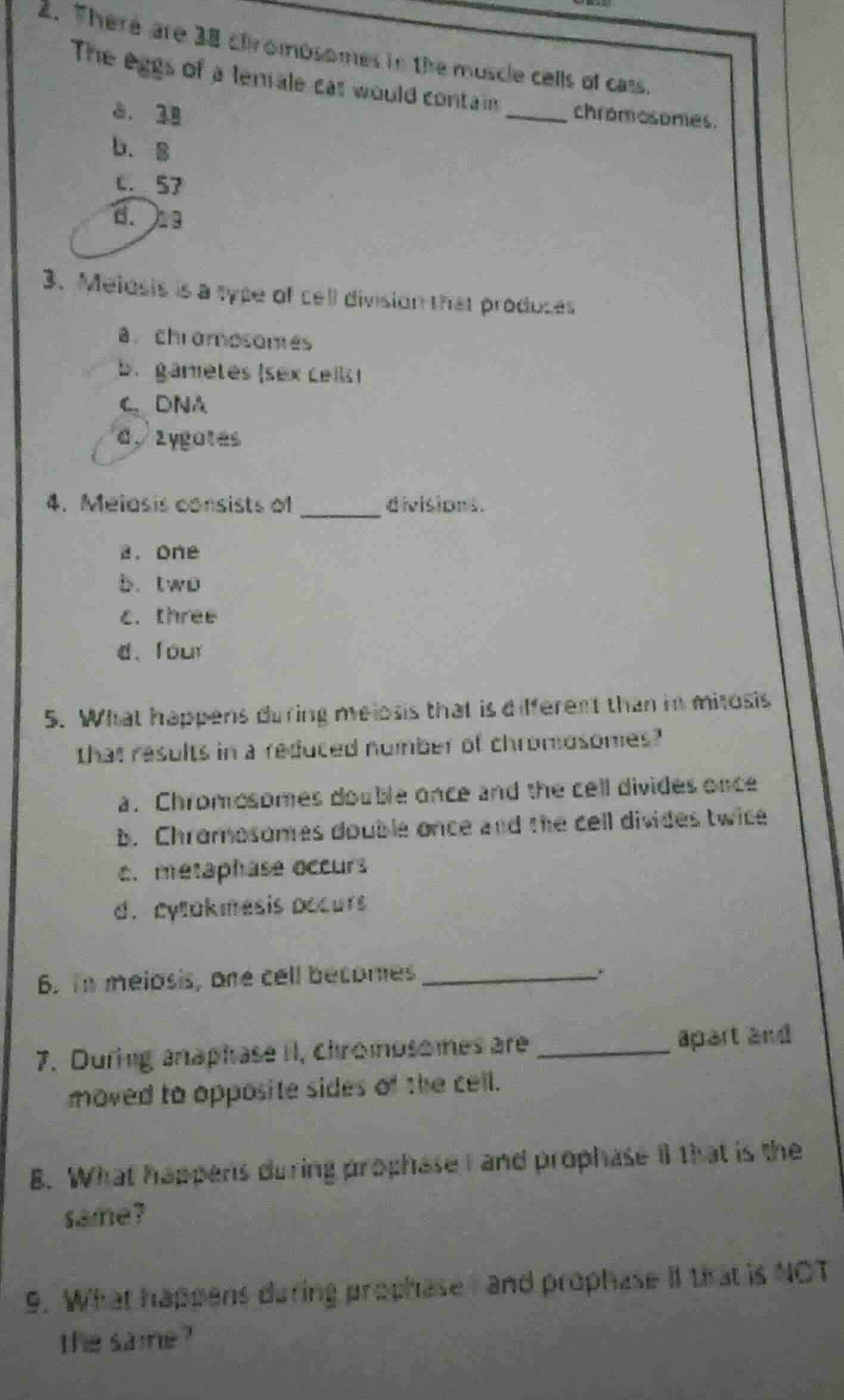
- there are 38 chromosomes in the muscle cells of cats. the eggs of a female cat would contain ____ chromosomes. a. 38 b. 8 c. 57 d. 19 3. meiosis is a type of cell division that produces a. chromosomes b. gametes (sex cells) c. dna d. zygotes 4. meiosis consists of __ divisions. a. one b. two c. three d. four 5. what happens during meiosis that is different than in mitosis that results in a reduced number of chromosomes? a. chromosomes double once and the cell divides once b. chromosomes double once and the cell divides twice c. metaphase occurs d. cytokinesis occurs 6. in meiosis, one cell becomes ____. 7. during anaphase ii, chromosomes are ______ apart and moved to opposite sides of the cell. 8. what happens during prophase i and prophase ii that is the same? 9. what happens during prophase i and prophase ii that is not the same?
Brief Explanations
- Muscle cells are somatic (diploid) cells; eggs (gametes) are haploid, so they have half the chromosome number.
- Meiosis is the cell division process that creates sex cells (gametes) with half the chromosome count.
- Meiosis has two sequential cell divisions: meiosis I and meiosis II.
- In meiosis, DNA replicates once, but two cell divisions reduce the chromosome number by half, unlike mitosis (one division after replication).
- Meiosis starts with one diploid cell and produces four genetically unique haploid gametes.
- Anaphase II separates sister chromatids, pulling them to opposite cell poles.
- Both prophase I and II involve the nuclear envelope breaking down, spindle fibers forming, and chromosomes condensing.
- Prophase I includes synapsis (pairing of homologous chromosomes) and crossing over, which do not occur in prophase II.

Snap & solve any problem in the app
Get step-by-step solutions on Sovi AI
Photo-based solutions with guided steps
Explore more problems and detailed explanations
- d. 19
- b. gametes (sex cells)
- b. two
- b. Chromosomes double once and the cell divides twice
- four genetically unique haploid gametes
- pulled
- In both prophase I and prophase II, chromosomes condense, the nuclear envelope breaks down, and spindle fibers form.
- In prophase I, homologous chromosomes pair up (synapsis) and undergo crossing over; these events do not take place in prophase II.