QUESTION IMAGE
Question
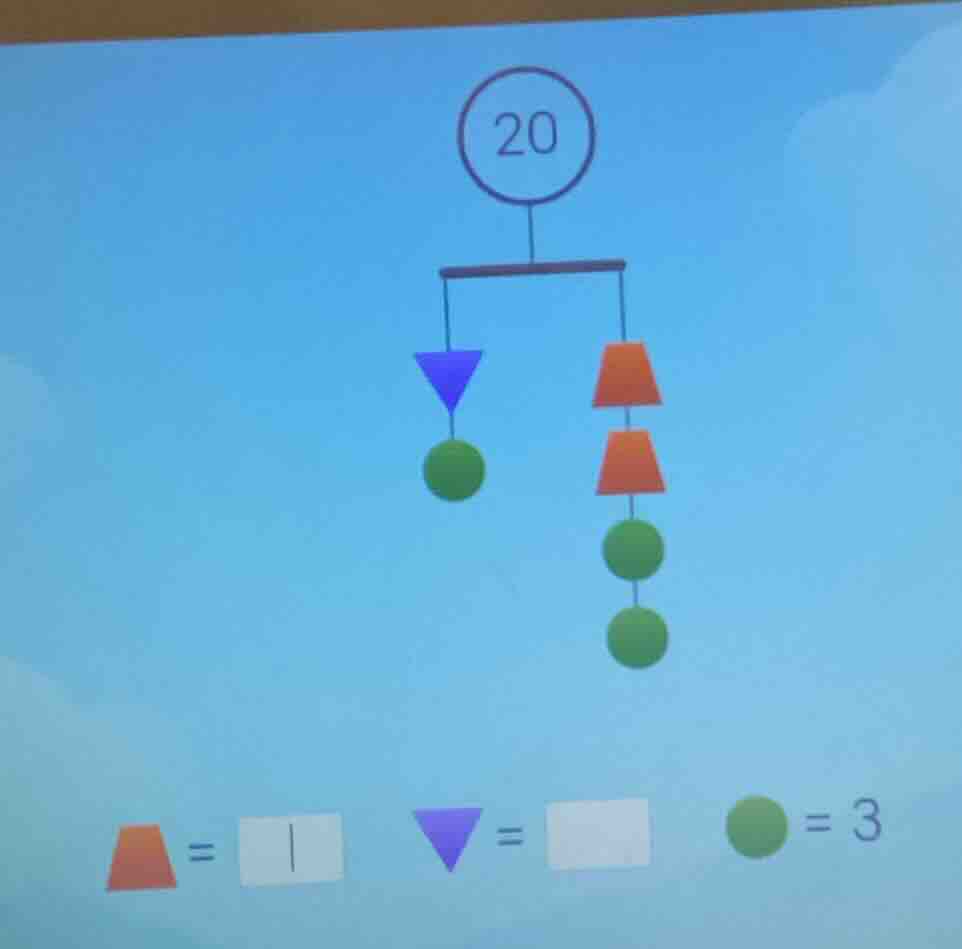
there is a balance diagram with a circle labeled 20 at the top. on the left side of the balance, there is a blue triangle with a green circle below it. on the right side, there are two red trapezoids, followed by two green circles. below the diagram, it is given that the red trapezoid (△) = 1, the green circle (○) = 3, and we need to find the value of the blue triangle (▽).
Step1: Calculate total value of green circles
There are 3 green circles on the right and 1 on the left, total green circles: \(1 + 2 = 3\)? Wait, no. Wait, left side: 1 green circle. Right side: 2 green circles? Wait, no, looking at the diagram: left branch has 1 green circle, right branch has 2 orange trapezoids and 2 green circles? Wait, no, the diagram: top is 20, left branch: blue triangle and 1 green circle. Right branch: 2 orange trapezoids, then 2 green circles? Wait, the given: green circle = 3, orange trapezoid = 1. Let's re-express the equation. The total value is 20, so left (blue triangle + green circle) + right (2orange trapezoid + 2green circle) = 20? Wait, no, maybe the left is (blue triangle + green circle) and the right is (2orange trapezoid + 2green circle), and they are equal to 20? Wait, the balance: left and right sum to 20? Wait, no, the top is 20, so the sum of left and right is 20? Wait, left: blue triangle (let's call it \( \triangle \)) + green circle (\( \bigcirc = 3 \)). Right: 2orange trapezoid (\( \square = 1 \)) + 2green circle (\( \bigcirc = 3 \)). So equation: \( \triangle + 3 + 2*1 + 2*3 = 20 \)? Wait, no, maybe left is \( \triangle + \bigcirc \) and right is \( 2\square + 2\bigcirc \), and their sum is 20? Wait, let's check the given values: \( \square = 1 \), \( \bigcirc = 3 \). Let's compute right side first: 21 (for two trapezoids) + 23 (for two green circles) = 2 + 6 = 8. Left side: \( \triangle + 3 \). Then total: \( (\triangle + 3) + 8 = 20 \)? Wait, no, maybe the top 20 is the sum of left and right. So left + right = 20. So left: \( \triangle + \bigcirc = \triangle + 3 \). Right: \( 2\square + 2\bigcirc = 2*1 + 2*3 = 2 + 6 = 8 \). Then \( (\triangle + 3) + 8 = 20 \)? Wait, that would be \( \triangle + 11 = 20 \), so \( \triangle = 9 \). Wait, but let's check again. Wait, maybe the right branch has 2 orange trapezoids and 2 green circles, and the left branch has 1 blue triangle and 1 green circle, and the total is 20. So:
Left: \( \triangle + \bigcirc = \triangle + 3 \)
Right: \( 2\square + 2\bigcirc = 2*1 + 2*3 = 2 + 6 = 8 \)
Total: \( (\triangle + 3) + 8 = 20 \)
So \( \triangle + 11 = 20 \)
Step2: Solve for blue triangle
Subtract 11 from both sides: \( \triangle = 20 - 11 = 9 \)
Wait, but let's verify. Alternatively, maybe the left and right are equal? No, the top is 20, so it's the sum. Wait, maybe the left is \( \triangle + \bigcirc \) and the right is \( 2\square + 2\bigcirc \), and their sum is 20. Let's plug in the known values:
\( \triangle + 3 + 2*1 + 2*3 = 20 \)
Calculate the known terms: \( 3 + 2 + 6 = 11 \)
So \( \triangle + 11 = 20 \)
Subtract 11: \( \triangle = 20 - 11 = 9 \)

Snap & solve any problem in the app
Get step-by-step solutions on Sovi AI
Photo-based solutions with guided steps
Explore more problems and detailed explanations
9