QUESTION IMAGE
Question
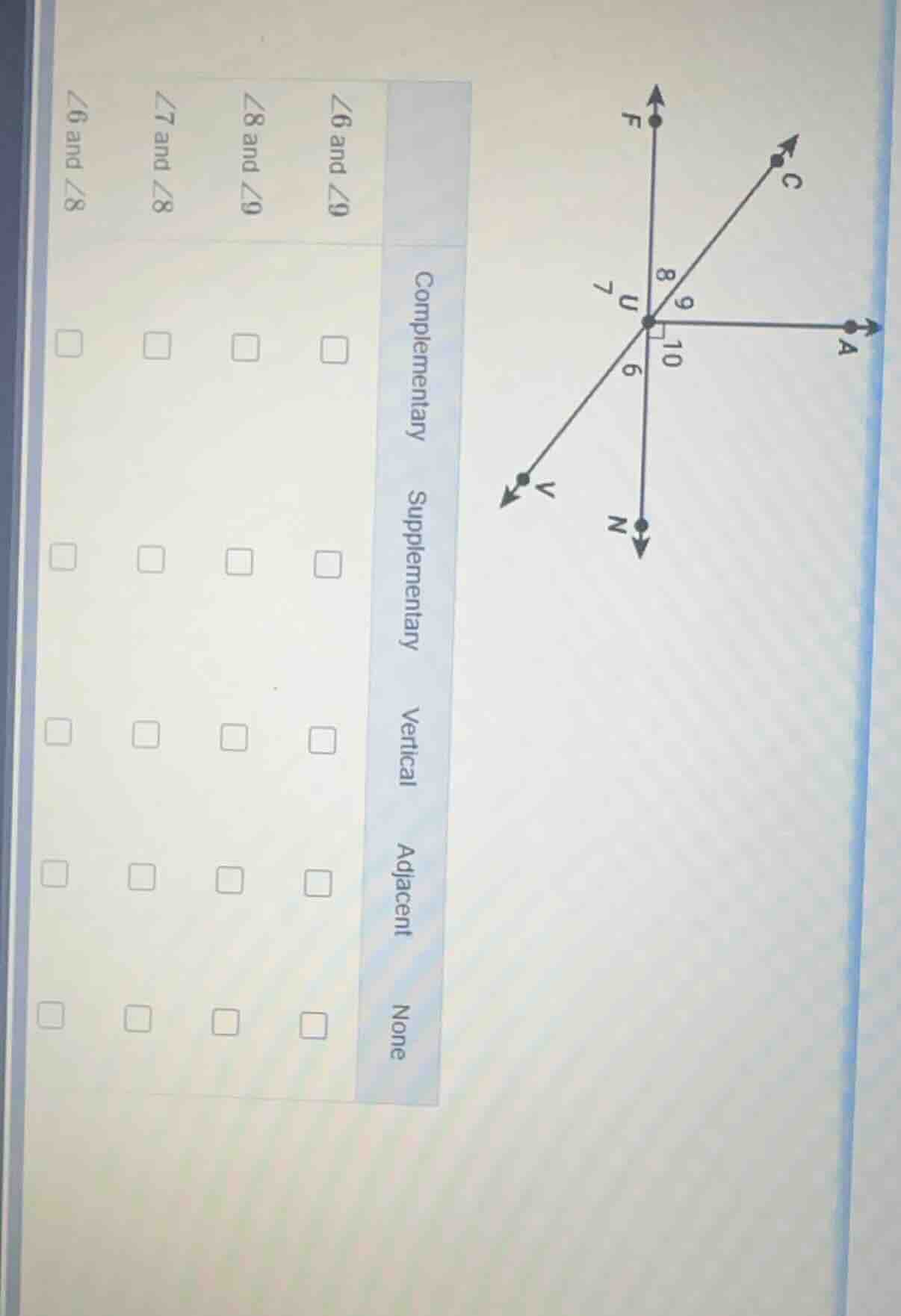
there is a diagram with lines intersecting at point u, forming angles labeled 6,7,8,9,10. there is a table with angle pairs (∠6 and ∠9, ∠8 and ∠9, ∠7 and ∠8, ∠6 and ∠8) and columns (complementary, supplementary, vertical, adjacent, none) with checkboxes.
To solve this, we analyze each pair of angles using the definitions of complementary, supplementary, vertical, and adjacent angles:
1. $\boldsymbol{\angle 6}$ and $\boldsymbol{\angle 9}$
- Complementary: Sum to $90^\circ$? $\angle 10$ is a right angle ($90^\circ$), but $\angle 6$ and $\angle 9$: $\angle 6 + \angle 9$? From the diagram, $\angle 6$ and $\angle 9$ – no, $\angle 9 + \angle 10 = 90^\circ$? Wait, $\angle 9$ and $\angle 10$ are complementary? Wait, no, let's re - examine. $\angle 10$ is a right angle. $\angle 6$ and $\angle 9$: Are they vertical? No. Adjacent? No. Supplementary? Sum to $180^\circ$? No. Complementary? No. Wait, maybe I made a mistake. Wait, $\angle 6$ and $\angle 8$ are vertical? Wait, let's go step by step for each pair.
2. $\boldsymbol{\angle 8}$ and $\boldsymbol{\angle 9}$
- Adjacent: They share a common side (the ray from $U$) and a common vertex ($U$), and their non - common sides are adjacent. Also, $\angle 8+\angle 9$: Do they sum to $180^\circ$? No. Complementary? No. Vertical? No. So adjacent.
3. $\boldsymbol{\angle 7}$ and $\boldsymbol{\angle 8}$
- Supplementary: They form a linear pair (they are adjacent and their non - common sides form a straight line), so their sum is $180^\circ$. So they are supplementary.
4. $\boldsymbol{\angle 6}$ and $\boldsymbol{\angle 8}$
- Vertical Angles: They are opposite each other when two lines intersect. So $\angle 6$ and $\angle 8$ are vertical angles.
Let's fill the table:
| Pair of Angles | Complementary | Supplementary | Vertical | Adjacent | None |
|---|---|---|---|---|---|
| $\angle 8$ and $\angle 9$ | $\square$ | $\square$ | $\square$ | $\checkmark$ | $\square$ |
| $\angle 7$ and $\angle 8$ | $\square$ | $\checkmark$ | $\square$ | $\checkmark$ (since they are adjacent and supplementary) | $\square$ |
| $\angle 6$ and $\angle 8$ | $\square$ | $\square$ | $\checkmark$ | $\square$ | $\square$ |
If we assume the question is to mark the correct relationship for each pair:
- For $\angle 6$ and $\angle 9$: None (mark the "None" column)
- For $\angle 8$ and $\angle 9$: Adjacent (mark the "Adjacent" column)
- For $\angle 7$ and $\angle 8$: Supplementary (and adjacent, but mainly supplementary as a linear pair) (mark the "Supplementary" column)
- For $\angle 6$ and $\angle 8$: Vertical (mark the "Vertical" column)
If we take a single pair, for example, if we consider $\angle 6$ and $\angle 8$:
Step 1: Recall the definition of vertical angles
Vertical angles are the opposite angles formed when two lines intersect. They are equal in measure.
Step 2: Analyze $\angle 6$ and $\angle 8$
In the diagram, the two lines (the one with $F - U - N$ and the one with $C - U - V$) intersect at $U$. $\angle 6$ and $\angle 8$ are opposite each other, so they are vertical angles.
Step 1: Recall the definition of supplementary angles
Supplementary angles are two angles whose sum is $180^\circ$.
Step 2: Analyze $\angle 7$ and $\angle 8$
$\angle 7$ and $\angle 8$ form a linear pair (they are adjacent and their non - common sides form a straight line). So $\angle 7+\angle 8 = 180^\circ$, which means they are supplementary.
Step 1: Recall the definition of adjacent angles
Adjacent angles are two angles that share a common side and a common vertex, and their non - common sides are adjacent.
Step 2: Analyze $\angle 8$ and $\angle 9$
$\angle 8$ and $\angle 9$ share the vertex $U$ and a common side (the ray from $U$), and their non - common sides are adjacent. So they are adjacent angles.

Snap & solve any problem in the app
Get step-by-step solutions on Sovi AI
Photo-based solutions with guided steps
Explore more problems and detailed explanations
For $\angle 6$ and $\angle 8$: Vertical Angles.
(If we consider $\angle 7$ and $\angle 8$: