QUESTION IMAGE
Question
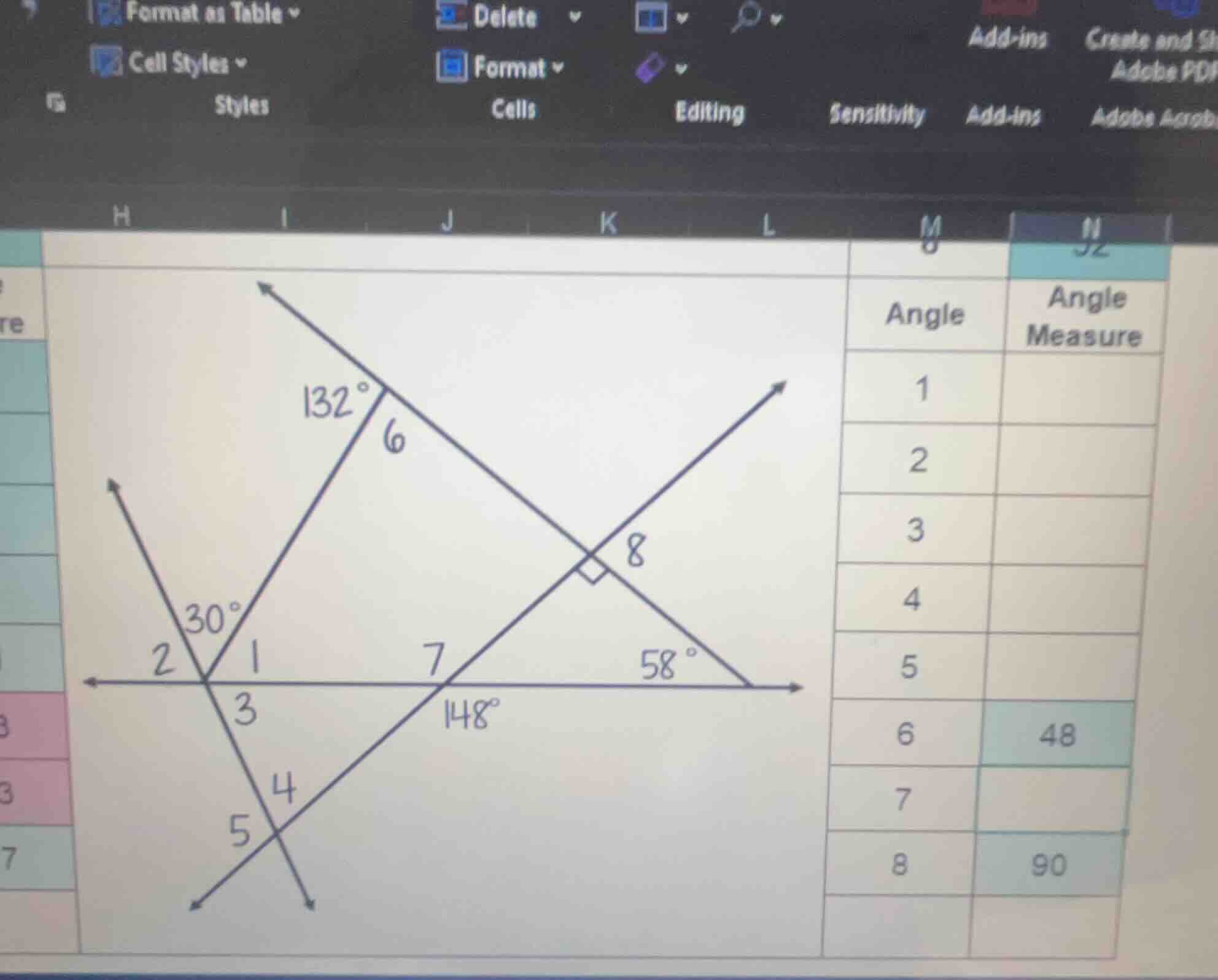
there is a geometric figure with angles marked as 132°, 30°, 58°, 148°, and angles numbered 1 - 8. there is also a table with columns angle and angle measure, where angle 6 has a measure of 48 and angle 8 has a measure of 90, and angles 1 - 5, 7 are to be filled.
To solve for the missing angle measures, we analyze each angle using properties of angles (supplementary, vertical, complementary, etc.):
Angle 1:
- Angle 1, the \(30^\circ\) angle, and angle 6 (\(48^\circ\)) form a triangle? Wait, no—actually, looking at the straight line and the angles around the vertex: Wait, angle 1, \(30^\circ\), and angle 6 (\(48^\circ\))? Wait, no, let's re - examine. Wait, the angle adjacent to \(132^\circ\) is angle 6, and \(132^\circ+ \text{angle }6 = 180^\circ\) (supplementary angles), so angle 6 is \(180 - 132=48^\circ\) (which is given in the table, but let's check angle 1). At the vertex with \(30^\circ\), angle 1, and angle 6 (\(48^\circ\)): Wait, maybe it's a triangle? Wait, no, the sum of angles in a triangle is \(180^\circ\), but maybe it's a straight line? Wait, no, let's see: The angle at the vertex with \(30^\circ\), angle 1, and angle 6 (\(48^\circ\))—if they are in a triangle, then \(30^\circ+\text{angle }1 + 48^\circ=180^\circ\)? Wait, no, that would be if it's a triangle, but maybe it's a straight line? Wait, no, let's correct. Wait, angle 1, \(30^\circ\), and angle 6 (\(48^\circ\)): Wait, actually, the sum of angles around a point? No, maybe it's a triangle. Wait, \(30^\circ+\text{angle }1+48^\circ = 180^\circ\)? Then \(\text{angle }1=180-(30 + 48)=102^\circ\)? Wait, no, maybe I made a mistake. Wait, let's look at angle 7.
Angle 7:
Angle 7 and \(148^\circ\) are supplementary (they form a straight line), so \(\text{angle }7=180 - 148 = 32^\circ\)? Wait, no, wait the \(58^\circ\) angle. Wait, angle 7, \(58^\circ\), and the right angle (angle 8 is \(90^\circ\))—wait, angle 8 is a right angle (\(90^\circ\)). In the triangle with angle 7, \(58^\circ\), and angle 8 (\(90^\circ\))? No, the sum of angles in a triangle is \(180^\circ\), so \(58^\circ+90^\circ+\text{angle }7 = 180^\circ\), then \(\text{angle }7=180-(58 + 90)=32^\circ\). Wait, but also, angle 7 and \(148^\circ\) are supplementary? \(32+148 = 180\), yes! So angle 7 is \(32^\circ\).
Angle 1:
Now, at the vertex with \(30^\circ\), angle 1, and angle 6 (\(48^\circ\))—wait, maybe it's a triangle with angle 7 (\(32^\circ\))? No, let's re - consider. Wait, the sum of angles in a triangle: If we have a triangle with angles \(30^\circ\), angle 1, and angle 7 (\(32^\circ\))? Wait, no, that doesn't make sense. Wait, maybe angle 1: Let's use the fact that in the triangle with angle 6 (\(48^\circ\)), angle 1, and \(30^\circ\), and angle 7 (\(32^\circ\))? No, I think I messed up. Wait, let's start over.
Angle 1:
We know that angle 6 is \(48^\circ\) (since \(132^\circ+48^\circ = 180^\circ\), supplementary angles). The angle of \(30^\circ\), angle 1, and angle 6 (\(48^\circ\)) are in a triangle (assuming the lines form a triangle). The sum of angles in a triangle is \(180^\circ\). So:
\[
30^\circ+\text{angle }1 + 48^\circ=180^\circ
\]
\[
\text{angle }1=180-(30 + 48)=102^\circ
\]
Angle 2:
Angle 2 and \(30^\circ\) are vertical angles? Wait, no, angle 2 and \(30^\circ\)—wait, if angle 2 and \(30^\circ\) are vertical angles, then angle 2 is \(30^\circ\)? Wait, no, vertical angles are equal. Wait, the angle opposite to \(30^\circ\) is angle 2? If so, angle 2 is \(30^\circ\).
Angle 3:
Angle 3 and angle 1 are vertical angles? If angle 1 is \(102^\circ\), then angle 3 is \(102^\circ\) (vertical angles are equal).
Angle 4:
Angle 4 and angle 7: Angle 7 is \(32^\circ\) (since \(148^\circ+\text{angle }7 = 180^\circ\), so \(\text{angle }7 = 32^\circ\)), and angle 4 and angle 7 are vertical angles? So angle 4 is \(32^\circ\).…
Step 1: Identify the relationship
Angle 7 and \(148^\circ\) are supplementary (they form a straight line, so their sum is \(180^\circ\)).
Step 2: Calculate angle 7
Using the formula for supplementary angles \( \text{angle }7+148^\circ = 180^\circ\), we solve for \(\text{angle }7\):
\[
\text{angle }7=180^\circ - 148^\circ
\]
\[
\text{angle }7 = 32^\circ
\]

Snap & solve any problem in the app
Get step-by-step solutions on Sovi AI
Photo-based solutions with guided steps
Explore more problems and detailed explanations
If we take angle 7 as an example, the measure of angle 7 is \(\boldsymbol{32^\circ}\). (The answer will vary depending on which angle we are calculating. For example, angle 1 is \(102^\circ\), angle 2 is \(30^\circ\), angle 3 is \(102^\circ\), angle 4 is \(32^\circ\), angle 5 is \(48^\circ\), angle 7 is \(32^\circ\))