QUESTION IMAGE
Question
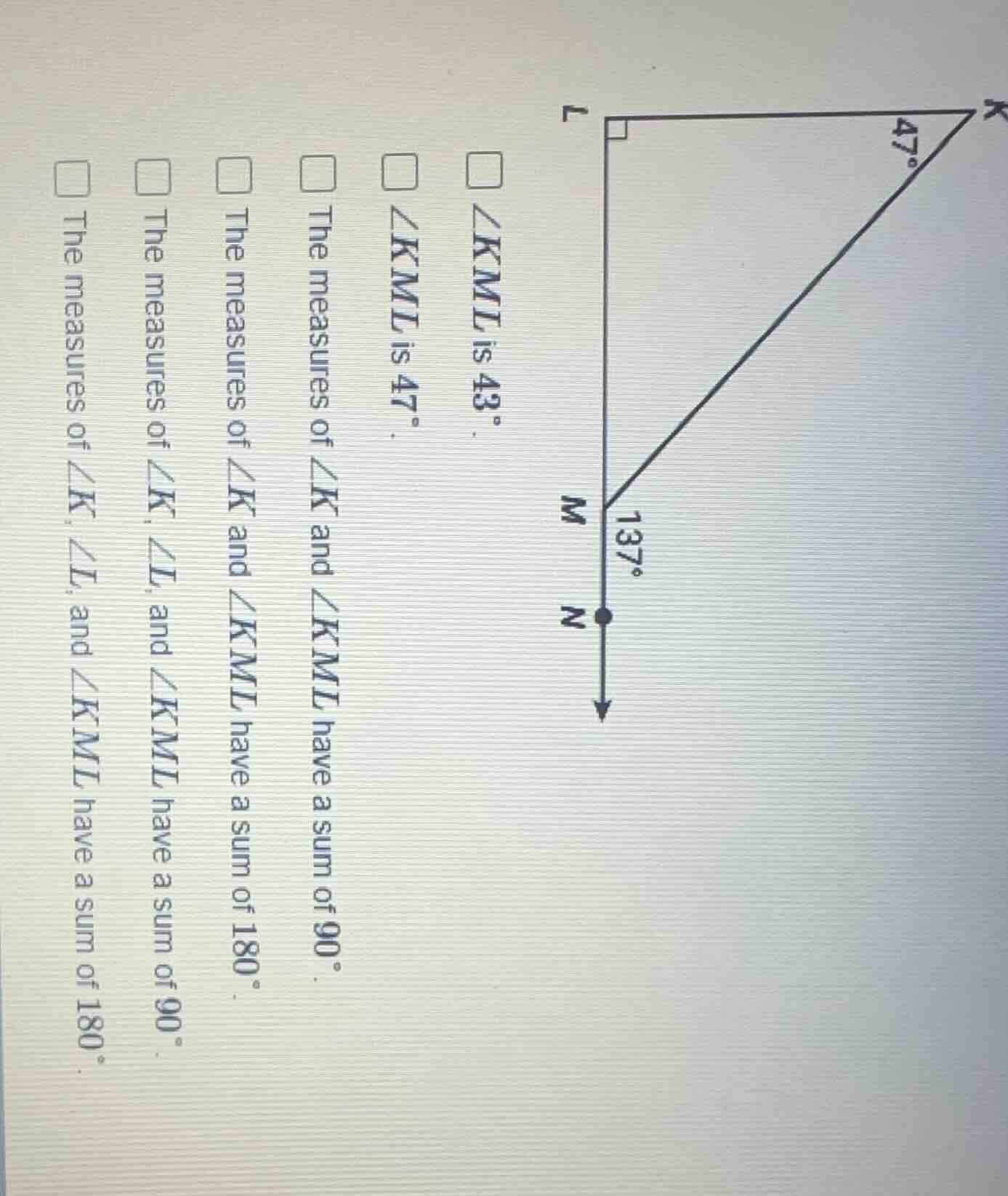
there is a right triangle k l m, with a right angle at l. angle at k is 47 degrees. there is a straight line m n, with m in the middle, and the angle between k m and m n is 137 degrees. then there are six options: 1. ∠kml is 43°. 2. ∠kml is 47°. 3. the measures of ∠k and ∠kml have a sum of 90°. 4. the measures of ∠k and ∠kml have a sum of 180°. 5. the measures of ∠k, ∠l, and ∠kml have a sum of 90°. 6. the measures of ∠k, ∠l, and ∠kml have a sum of 180°.
To solve this, we analyze the right triangle \( \triangle KLM \) (with \( \angle L = 90^\circ \)) and the straight line \( MN \) (so \( \angle KML + 137^\circ = 180^\circ \), hence \( \angle KML = 180^\circ - 137^\circ = 43^\circ \)). Also, in a triangle, the sum of angles is \( 180^\circ \). For \( \triangle KLM \), \( \angle K + \angle L + \angle KML = 180^\circ \), but since \( \angle L = 90^\circ \), \( \angle K + \angle KML = 90^\circ \) (because \( 90^\circ + (\angle K + \angle KML) = 180^\circ \Rightarrow \angle K + \angle KML = 90^\circ \)). Let's check each option:
- \( \angle KML \) is \( 47^\circ \): False (we found \( \angle KML = 43^\circ \)).
- \( \angle KML \) is \( 43^\circ \): True (from \( 180^\circ - 137^\circ = 43^\circ \)).
- The measures of \( \angle K \) and \( \angle KML \) have a sum of \( 90^\circ \): True (since \( \angle L = 90^\circ \), \( \angle K + \angle KML = 180^\circ - 90^\circ = 90^\circ \)).
- The measures of \( \angle K \) and \( \angle KML \) have a sum of \( 180^\circ \): False (they sum to \( 90^\circ \)).
- The measures of \( \angle K \), \( \angle L \), and \( \angle KML \) have a sum of \( 90^\circ \): False (triangle angle sum is \( 180^\circ \)).
- The measures of \( \angle K \), \( \angle L \), and \( \angle KML \) have a sum of \( 180^\circ \): True (triangle angle sum property).
Correct Options:
- \( \angle KML \) is \( 43^\circ \)
- The measures of \( \angle K \) and \( \angle KML \) have a sum of \( 90^\circ \)
- The measures of \( \angle K \), \( \angle L \), and \( \angle KML \) have a sum of \( 180^\circ \)

Snap & solve any problem in the app
Get step-by-step solutions on Sovi AI
Photo-based solutions with guided steps
Explore more problems and detailed explanations
To solve this, we analyze the right triangle \( \triangle KLM \) (with \( \angle L = 90^\circ \)) and the straight line \( MN \) (so \( \angle KML + 137^\circ = 180^\circ \), hence \( \angle KML = 180^\circ - 137^\circ = 43^\circ \)). Also, in a triangle, the sum of angles is \( 180^\circ \). For \( \triangle KLM \), \( \angle K + \angle L + \angle KML = 180^\circ \), but since \( \angle L = 90^\circ \), \( \angle K + \angle KML = 90^\circ \) (because \( 90^\circ + (\angle K + \angle KML) = 180^\circ \Rightarrow \angle K + \angle KML = 90^\circ \)). Let's check each option:
- \( \angle KML \) is \( 47^\circ \): False (we found \( \angle KML = 43^\circ \)).
- \( \angle KML \) is \( 43^\circ \): True (from \( 180^\circ - 137^\circ = 43^\circ \)).
- The measures of \( \angle K \) and \( \angle KML \) have a sum of \( 90^\circ \): True (since \( \angle L = 90^\circ \), \( \angle K + \angle KML = 180^\circ - 90^\circ = 90^\circ \)).
- The measures of \( \angle K \) and \( \angle KML \) have a sum of \( 180^\circ \): False (they sum to \( 90^\circ \)).
- The measures of \( \angle K \), \( \angle L \), and \( \angle KML \) have a sum of \( 90^\circ \): False (triangle angle sum is \( 180^\circ \)).
- The measures of \( \angle K \), \( \angle L \), and \( \angle KML \) have a sum of \( 180^\circ \): True (triangle angle sum property).
Correct Options:
- \( \angle KML \) is \( 43^\circ \)
- The measures of \( \angle K \) and \( \angle KML \) have a sum of \( 90^\circ \)
- The measures of \( \angle K \), \( \angle L \), and \( \angle KML \) have a sum of \( 180^\circ \)