QUESTION IMAGE
Question
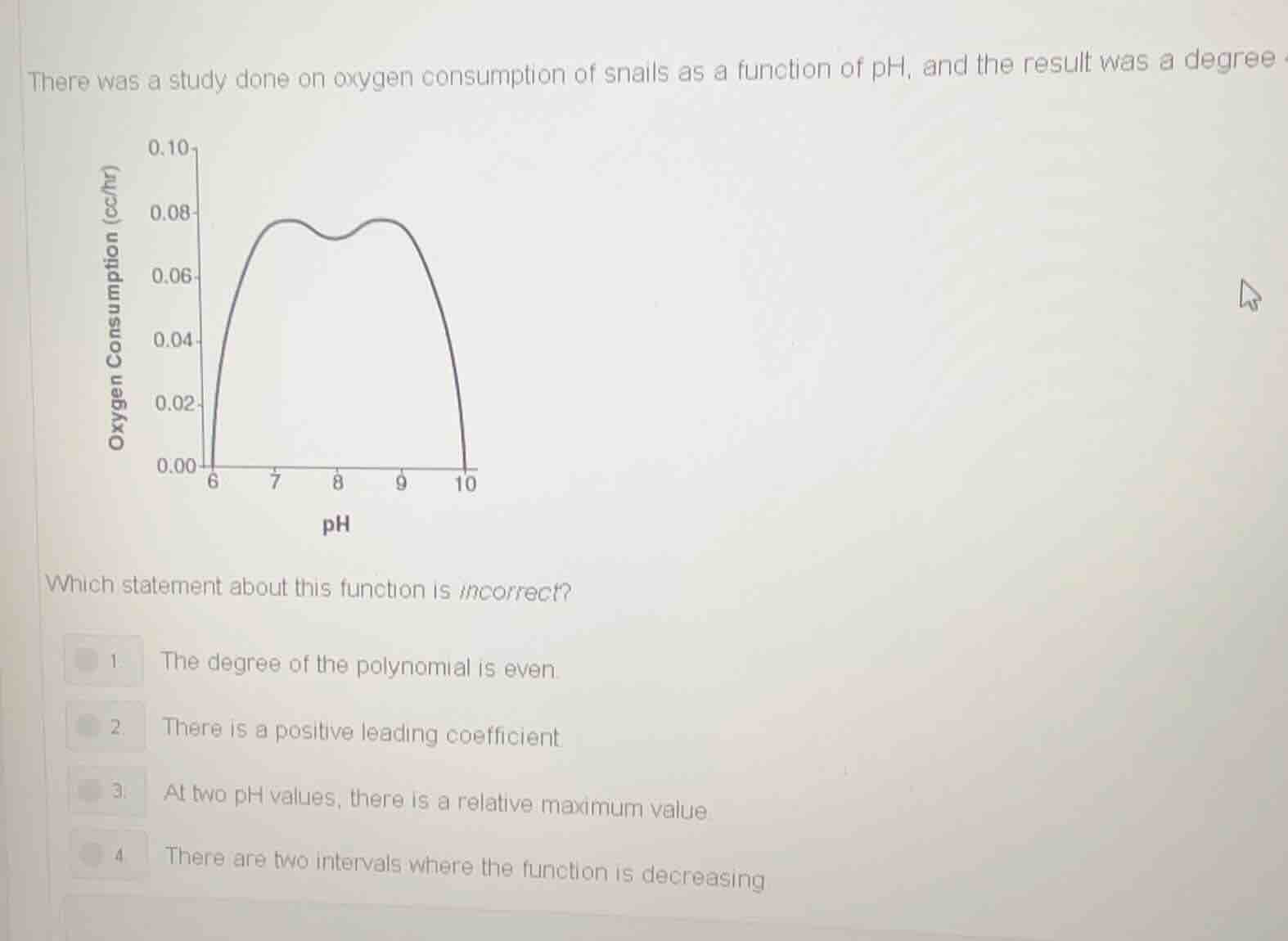
there was a study done on oxygen consumption of snails as a function of ph, and the result was a degree
which statement about this function is incorrect?
1 the degree of the polynomial is even.
2 there is a positive leading coefficient.
3 at two ph values, there is a relative maximum value.
4 there are two intervals where the function is decreasing
Brief Explanations
- For the degree of the polynomial: The graph has ends both approaching 0 (touching the x - axis at pH = 6 and pH = 10), so as \(x\to\pm\infty\) (but in our domain, we can infer the end - behavior from the shape), the leading term's behavior. If the degree is even, and the leading coefficient is negative (because the graph comes from below (but starts at 0) and goes back to 0, and in the middle, it has a "hill - like" shape with a dip, but the end - behavior for an even - degree polynomial: if the leading coefficient is positive, the ends go to \(+\infty\), if negative, to \(-\infty\). But our graph has a maximum in the middle and ends at 0. Wait, actually, looking at the end - behavior: as pH (x) increases beyond 10, the function value (y) would tend to 0 from positive values, and as x decreases below 6, y tends to 0 from positive values. So the graph is like a polynomial that has a positive leading coefficient? No, wait, no. Wait, the general shape: if we consider the polynomial, the left end (as x approaches 6 from the left) is 0, and the right end (as x approaches 10 from the right) is 0. The graph rises from x = 6 to a peak, then falls, then rises again, then falls to x = 10. So the degree: the number of turning points. The graph has 3 turning points (a rise, a fall, a rise, a fall? Wait, no: from x = 6, it rises to a maximum, then falls to a minimum, then rises to a maximum, then falls to x = 10. So 3 turning points. The number of turning points of a polynomial is at most \(n - 1\), where \(n\) is the degree. So if there are 3 turning points, the degree is at least 4 (even). So statement 1 is correct.
- Leading coefficient: For an even - degree polynomial, if the leading coefficient is positive, the ends go to \(+\infty\), if negative, to \(-\infty\). But our graph has y - values (oxygen consumption) non - negative, and as x moves away from the middle (towards 6 or 10), y approaches 0. So the ends (if we extend the polynomial) would tend to 0, but actually, the graph is bounded. Wait, no, maybe we should think about the shape. The graph has a "M - like" shape with two maxima and one minimum. The leading coefficient: if we consider the polynomial, when x is very large (beyond 10) or very small (below 6), the function value should follow the leading term. If the degree is even, and the leading coefficient is positive, then as \(x\to\pm\infty\), \(y\to+\infty\), but our graph has \(y\to0\) as \(x\to6^-\) and \(x\to10^+\). So the leading coefficient must be negative. So statement 2 (there is a positive leading coefficient) is incorrect.
- Relative maximum: Looking at the graph, there are two "peaks" (relative maxima) in the oxygen consumption vs pH graph. So statement 3 is correct.
- Decreasing intervals: The function decreases from the first maximum to the minimum, and then from the second maximum to pH = 10. So there are two intervals where the function is decreasing. Statement 4 is correct.

Snap & solve any problem in the app
Get step-by-step solutions on Sovi AI
Photo-based solutions with guided steps
Explore more problems and detailed explanations
- There is a positive leading coefficient