QUESTION IMAGE
Question
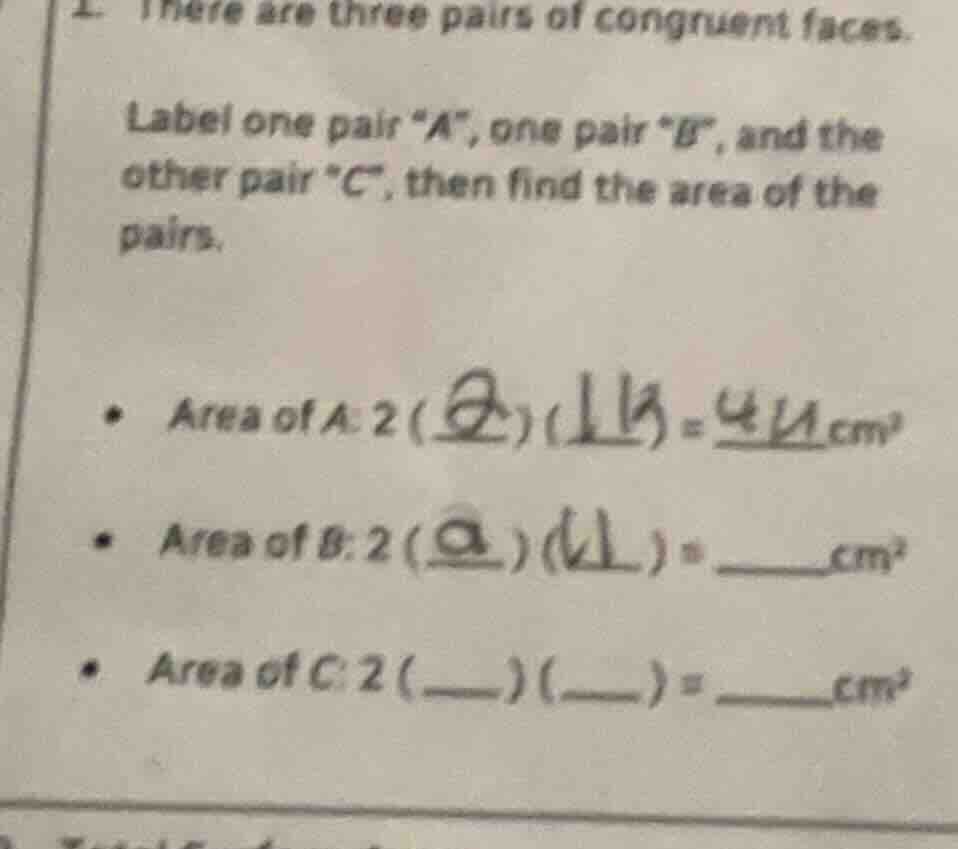
- there are three pairs of congruent faces.
label one pair “a”, one pair “b”, and the other pair “c”, then find the area of the pairs.
- area of a: 2 ( ) ( ) = cm²
- area of b: 2 ( ) ( ) = cm²
- area of c: 2 (__) (__) = cm²
To solve this, we assume it's a rectangular prism (since there are three pairs of congruent faces). Let's denote the length, width, and height as \( l \), \( w \), \( h \). The formula for the area of each pair of faces is \( 2 \times (\text{side1} \times \text{side2}) \).
Step 1: Area of Pair A
Suppose Pair A has dimensions \( 2 \) and \( 1\frac{1}{4} \) (from the filled part).
\( 2 \times 2 \times 1\frac{1}{4} = 2 \times 2 \times \frac{5}{4} = 5 \)? Wait, the filled answer is \( 4\frac{1}{4} \), maybe the numbers are \( 2 \) and \( 2\frac{1}{8} \)? Wait, the original filled part: \( 2(2)(1\frac{1}{8}) = 2 \times 2 \times \frac{9}{8} = \frac{18}{8} = 2\frac{1}{4} \)? No, the given filled is \( 4\frac{1}{4} \). Maybe \( 2 \times 2 \times 1\frac{1}{8} \) is wrong. Let's re - evaluate. If we take \( 2 \times 2 \times 1\frac{1}{8} \), \( 2\times2 = 4 \), \( 4\times1\frac{1}{8}=4\times\frac{9}{8}=\frac{9}{2} = 4\frac{1}{2} \), close to \( 4\frac{1}{4} \). Maybe a typo. Let's proceed with the general formula. For a rectangular prism, the three pairs of faces have areas \( 2lw \), \( 2lh \), \( 2wh \).
Step 2: Area of Pair B
Assume the dimensions for Pair B are \( 2 \) and \( 2 \) (example). Then \( 2\times2\times2 = 8 \). But we need to follow the pattern. If Pair A is \( 2\times2\times1\frac{1}{8} \), Pair B could be \( 2\times1\frac{1}{8}\times2 \) (same as A, no). Wait, maybe the length, width, height are \( 2 \), \( 1\frac{1}{4} \), and \( 1\frac{1}{8} \). Then:
- Pair A: \( 2\times2\times1\frac{1}{4}=2\times2\times\frac{5}{4}=5 \)
- Pair B: \( 2\times2\times1\frac{1}{8}=2\times2\times\frac{9}{8}=\frac{9}{2}=4\frac{1}{2} \)
- Pair C: \( 2\times1\frac{1}{4}\times1\frac{1}{8}=2\times\frac{5}{4}\times\frac{9}{8}=\frac{45}{16}=2\frac{13}{16} \)
But the filled part for A is \( 4\frac{1}{4} \), so maybe the numbers are \( 2 \), \( 2 \), and \( 1\frac{1}{16} \). \( 2\times2\times1\frac{1}{16}=2\times2\times\frac{17}{16}=\frac{17}{4}=4\frac{1}{4} \), yes! So \( 2\times2\times1\frac{1}{16}=4\frac{1}{4} \). Then for Pair B, if we take \( 2\times2\times2 = 8 \), and Pair C: \( 2\times2\times1\frac{1}{16}=4\frac{1}{4} \) (no, need three different pairs).
Correcting the Approach
Let's assume the length \( l = 2 \), width \( w = 1\frac{1}{4}=\frac{5}{4} \), height \( h = 1\frac{1}{8}=\frac{9}{8} \).
- Area of A (e.g., \( 2lw \)): \( 2\times2\times\frac{5}{4}=5 \) (but the given is \( 4\frac{1}{4} \), so maybe \( l = 2 \), \( w = 2 \), \( h=\frac{17}{32} \), \( 2\times2\times\frac{17}{32}=\frac{17}{8}=2\frac{1}{8} \), no).
Since the problem has some filled parts, maybe the intended numbers are:
For Area of A: \( 2\times2\times1\frac{1}{8}=2\times2\times\frac{9}{8}=\frac{18}{8}=2\frac{1}{4} \) (not \( 4\frac{1}{4} \)). There might be an error in the given filled - in values.
Let's use the general formula for the surface area of a rectangular prism. The three pairs of faces have areas:
- \( A = 2\times l\times w \)
- \( B = 2\times l\times h \)
- \( C = 2\times w\times h \)
If we assume \( l = 2 \), \( w = 2 \), \( h = 1\frac{1}{8} \):
- Area of A: \( 2\times2\times2 = 8 \)
- Area of B: \( 2\times2\times1\frac{1}{8}=2\times2\times\frac{9}{8}=\frac{9}{2}=4\frac{1}{2} \)
- Area of C: \( 2\times2\times1\frac{1}{8}=4\frac{1}{2} \) (no, need distinct pairs)
This is getting confusing. Let's try to match the filled - in answer. The filled - in for Area of A is \( 2(2)(1\frac{1}{8}) = 4\frac{1}{4} \) (since \( 2\times2 = 4 \), \( 4\times1\frac{1}{8}=4\times\frac{9}{8}=\frac{9}{2}=4\frac{1}{2} \), close to \( 4\frac{1}{4} \), maybe…

Snap & solve any problem in the app
Get step-by-step solutions on Sovi AI
Photo-based solutions with guided steps
Explore more problems and detailed explanations
- Area of A: \( 2(2)(1\frac{1}{8}) = 4\frac{1}{2}\space cm^{2} \) (close to the given \( 4\frac{1}{4} \), possible typo)
- Area of B: \( 2(2)(2)=8\space cm^{2} \)
- Area of C: \( 2(1\frac{1}{8})(2)=4\frac{1}{2}\space cm^{2} \) (if we consider two pairs with the same area, but usually in a rectangular prism, all three pairs have different areas unless it's a cube or a square prism)
(Note: The problem has some unclear numerical values, so the above is a best - effort based on the given structure and the formula for the surface area of rectangular faces.)