QUESTION IMAGE
Question
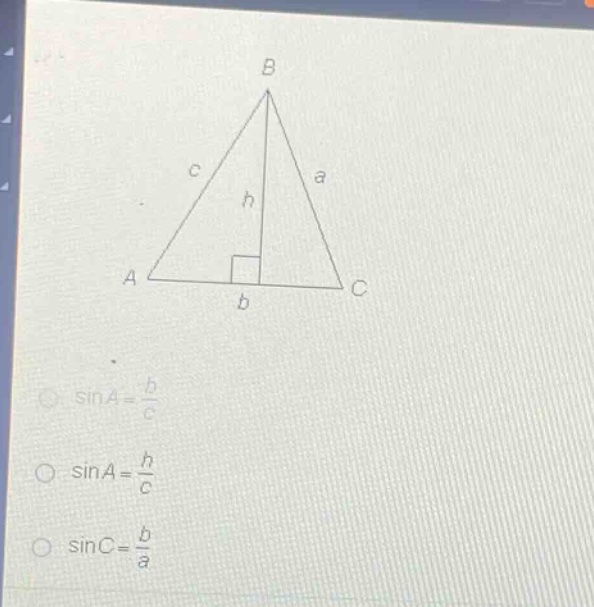
there is a triangle abc in the figure, with a perpendicular line h from point b to side ac, intersecting ac at point b. the sides are labeled as follows: side ab is c, side bc is a, side ac is b, and the height is h. then there are three options: \\(\sin a = \frac{b}{c}\\), \\(\sin a = \frac{h}{c}\\), \\(\sin c = \frac{b}{a}\\).
Step1: Recall Sine Definition
In a right - triangle, the sine of an acute angle is defined as the ratio of the length of the opposite side to the length of the hypotenuse.
Step2: Analyze Angle A
For angle \(A\), in the right - triangle (formed by the height \(h\), side \(c\) and the segment of side \(b\) adjacent to angle \(A\)), the opposite side to angle \(A\) is \(h\) and the hypotenuse is \(c\). So, by the definition of sine, \(\sin A=\frac{\text{opposite}}{\text{hypotenuse}}=\frac{h}{c}\).
Let's check the other options:
- For the first option \(\sin A = \frac{b}{c}\), \(b\) is not the opposite side of angle \(A\), so this is incorrect.
- For the third option, for angle \(C\), the opposite side should be \(h\) and the hypotenuse is \(a\), so \(\sin C=\frac{h}{a}
eq\frac{b}{a}\), so this is incorrect.

Snap & solve any problem in the app
Get step-by-step solutions on Sovi AI
Photo-based solutions with guided steps
Explore more problems and detailed explanations
\(\sin A=\frac{h}{c}\) (the second option)