QUESTION IMAGE
Question
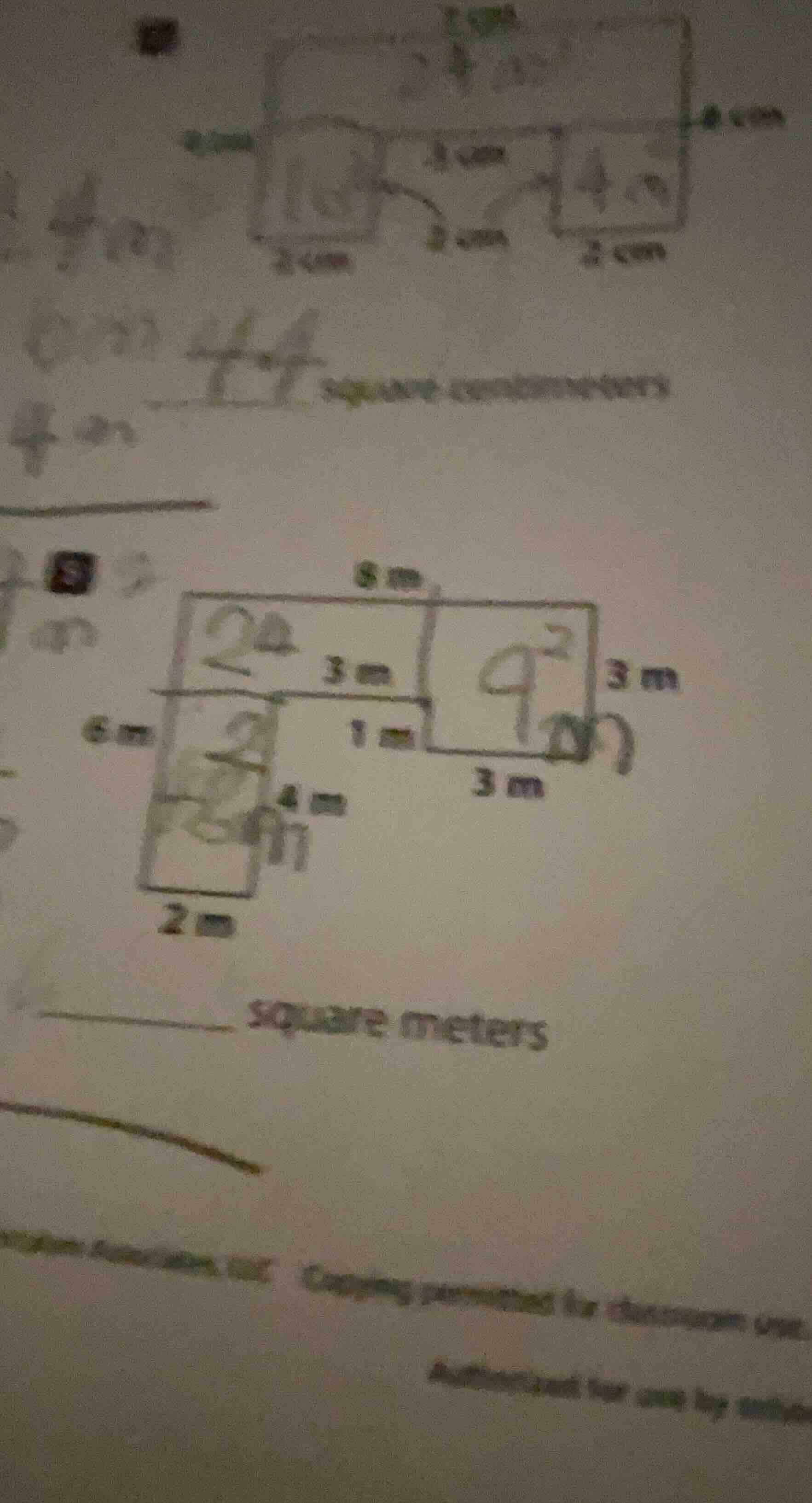
there are two figures (one with cm units and one with m units) showing composite shapes with labeled side lengths. the first figure has some handwritten numbers and labels like 4 cm, 3 cm, 2 cm. the second figure has side lengths 8 m, 3 m, 1 m, 6 m, 2 m, and labels like 24, 9, and asks for the area in square meters. there are also some handwritten notes and partial text about copying permission and authorized use.
Step1: Analyze the figure's components
The figure can be divided into three rectangles. Let's identify their dimensions:
- Rectangle 1: Dimensions \(2 \, \text{m} \times 4 \, \text{m}\) (from the left - bottom part).
- Rectangle 2: Dimensions \(3 \, \text{m} \times (3 + 1) \, \text{m}=3 \, \text{m} \times 4 \, \text{m}\) (the middle - top part). Wait, no, let's re - examine. Wait, maybe a better way:
Wait, looking at the figure, we can split it into three parts:
- The left - bottom rectangle: length \(2 \, \text{m}\), height \(4 \, \text{m}\). Area \(A_1=2\times4 = 8\) square meters.
- The middle rectangle: Let's see, the horizontal length: from the left, after the first rectangle, the remaining horizontal length for the middle part. Wait, maybe another approach. Wait, the total height of the left part is \(6 \, \text{m}\), and the bottom rectangle has height \(4 \, \text{m}\), so the top - left rectangle has height \(6 - 4=2 \, \text{m}\) and length \(3 \, \text{m}\) (since the middle horizontal segment is \(3 \, \text{m}\)). So area \(A_2 = 3\times2=6\) square meters.
- The right - hand square (since \(3\times3\)): area \(A_3=3\times3 = 9\) square meters.
Wait, maybe my initial split is wrong. Let's do it properly. Let's consider the figure as composed of three rectangles:
- Rectangle 1: Width \(2 \, \text{m}\), Height \(6 \, \text{m}\)? No, because there is a notch. Wait, no, the correct way is:
Looking at the figure, we can split it into three regions:
- Bottom - left rectangle: width \(2 \, \text{m}\), height \(4 \, \text{m}\). Area \(A_1=2\times4 = 8\).
- Middle - left rectangle: width \(3 \, \text{m}\), height \((6 - 4)=2 \, \text{m}\). Area \(A_2=3\times2 = 6\).
- Right - hand rectangle: width \(3 \, \text{m}\), height \(3 \, \text{m}\) (since it's a square - like shape with side \(3 \, \text{m}\)). Area \(A_3 = 3\times3=9\).
Wait, but that doesn't seem right. Wait, maybe the figure is a combination of a rectangle of \(6 \, \text{m}\times(3 + 3)=6\times6\) minus some parts? No, the figure has a notch. Wait, let's look at the dimensions again. The total horizontal length: \(3+3 = 6 \, \text{m}\), total vertical height: \(6 \, \text{m}\). But there is a notch of \(1 \, \text{m}\) in height and \(3 \, \text{m}\) in width? No, maybe not. Wait, the correct way is:
Alternative split:
- Rectangle 1: \(2 \, \text{m}\times4 \, \text{m}\) (area \(8\)).
- Rectangle 2: \(3 \, \text{m}\times(6 - 1) \, \text{m}\)? No, the \(1 \, \text{m}\) is a notch. Wait, maybe the figure is made up of three rectangles:
- Left - bottom: \(2\times4 = 8\)
- Middle - top: \(3\times3 = 9\) (wait, no, the middle - top has a height of \(3 \, \text{m}\) and length \(3 \, \text{m}\))
- The remaining part: a rectangle of \(3 \, \text{m}\times2 \, \text{m}\) (since \(6 - 4 = 2\))
Wait, I think I made a mistake. Let's calculate the area by adding the areas of the three visible rectangles:
- First rectangle (left - bottom): \(2 \, \text{m}\) (width) \(\times4 \, \text{m}\) (height) \(= 8\)
- Second rectangle (middle - top): \(3 \, \text{m}\) (width) \(\times2 \, \text{m}\) (height) \(= 6\) (since the height from the top of the first rectangle to the top of the figure is \(6 - 4=2\))
- Third rectangle (right - hand): \(3 \, \text{m}\) (width) \(\times3 \, \text{m}\) (height) \(= 9\)
Now, sum the areas: \(A=8 + 6+9=23\)? Wait, no, that can't be. Wait, maybe the middle rectangle has a different dimension. Wait, let's look at the horizontal and vertical dimensions again.
Wait, the total horizontal length: \(3 + 3=6 \, \text{m}\), total vertical h…

Snap & solve any problem in the app
Get step-by-step solutions on Sovi AI
Photo-based solutions with guided steps
Explore more problems and detailed explanations
\(24\)