QUESTION IMAGE
Question
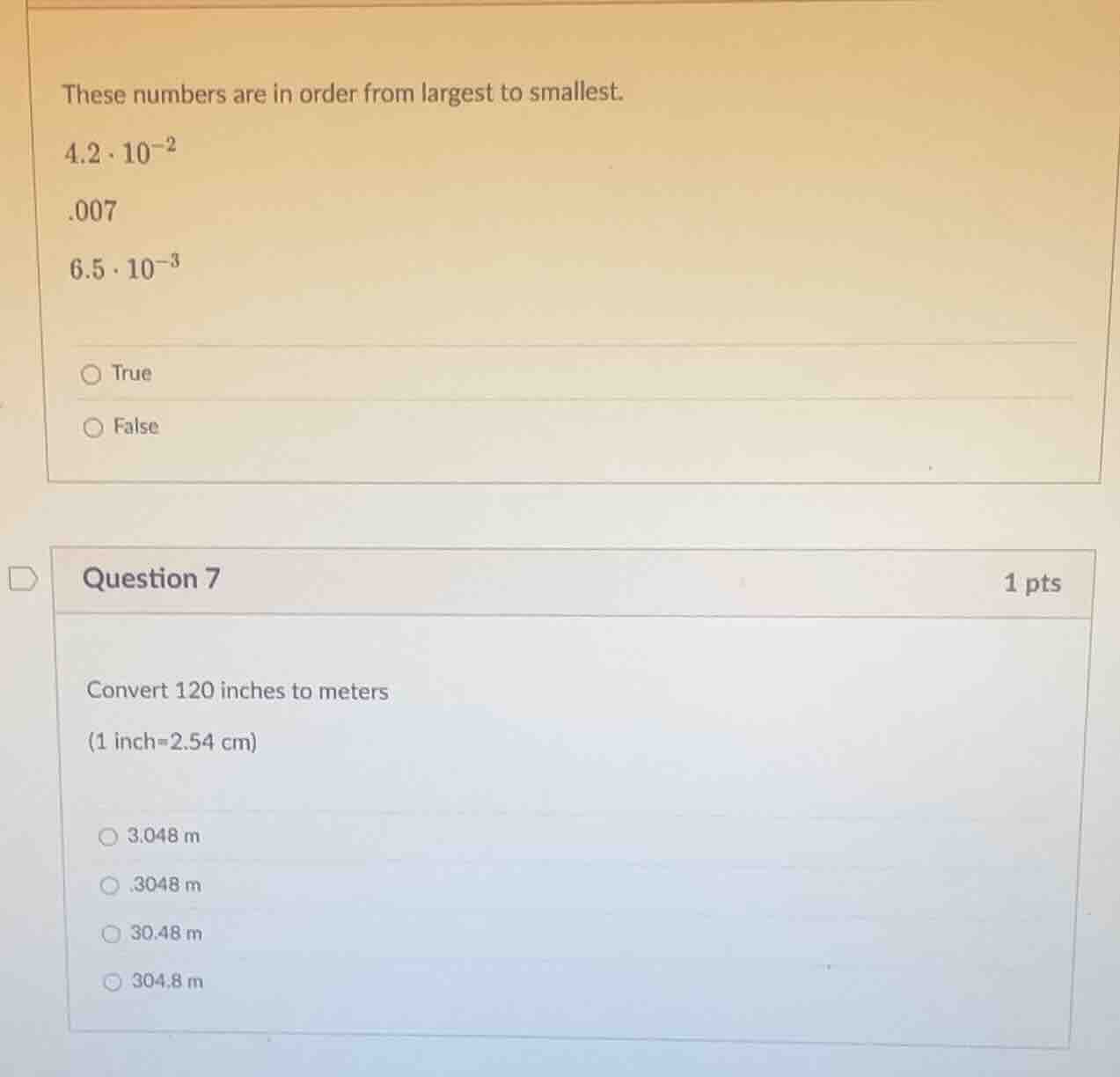
these numbers are in order from largest to smallest.
$4.2 \cdot 10^{-2}$
$.007$
$6.5 \cdot 10^{-3}$
\bigcirc true
\bigcirc false
question 7 1 pts
convert 120 inches to meters
(1 inch=2.54 cm)
\bigcirc 3.048 m
\bigcirc.3048 m
\bigcirc 30.48 m
\bigcirc 304.8 m
First Problem (True/False about number order)
Step1: Convert to decimal
Convert \(4.2 \cdot 10^{-2}\) to decimal: \(4.2 \cdot 10^{-2}=\frac{4.2}{100} = 0.042\)
Convert \(6.5 \cdot 10^{-3}\) to decimal: \(6.5 \cdot 10^{-3}=\frac{6.5}{1000}=0.0065\)
The numbers are \(0.042\), \(0.007\), \(0.0065\).
Step2: Order from largest to smallest
Order: \(0.042 > 0.007 > 0.0065\) (since \(0.042\) (from \(4.2 \cdot 10^{-2}\)) is larger than \(0.007\), and \(0.007\) is larger than \(0.0065\) (from \(6.5 \cdot 10^{-3}\))). So the order is correct.
Step1: Convert inches to centimeters
Given \(1\) inch \(= 2.54\) cm, so \(120\) inches \(= 120 \times 2.54\) cm.
Calculate \(120 \times 2.54 = 304.8\) cm.
Step2: Convert centimeters to meters
Since \(1\) meter \(= 100\) cm, divide by \(100\): \(\frac{304.8}{100}=3.048\) m.

Snap & solve any problem in the app
Get step-by-step solutions on Sovi AI
Photo-based solutions with guided steps
Explore more problems and detailed explanations
True