QUESTION IMAGE
Question
they came’ poem - bell ringer
questions 1-4 of 4 | page 1 of 1
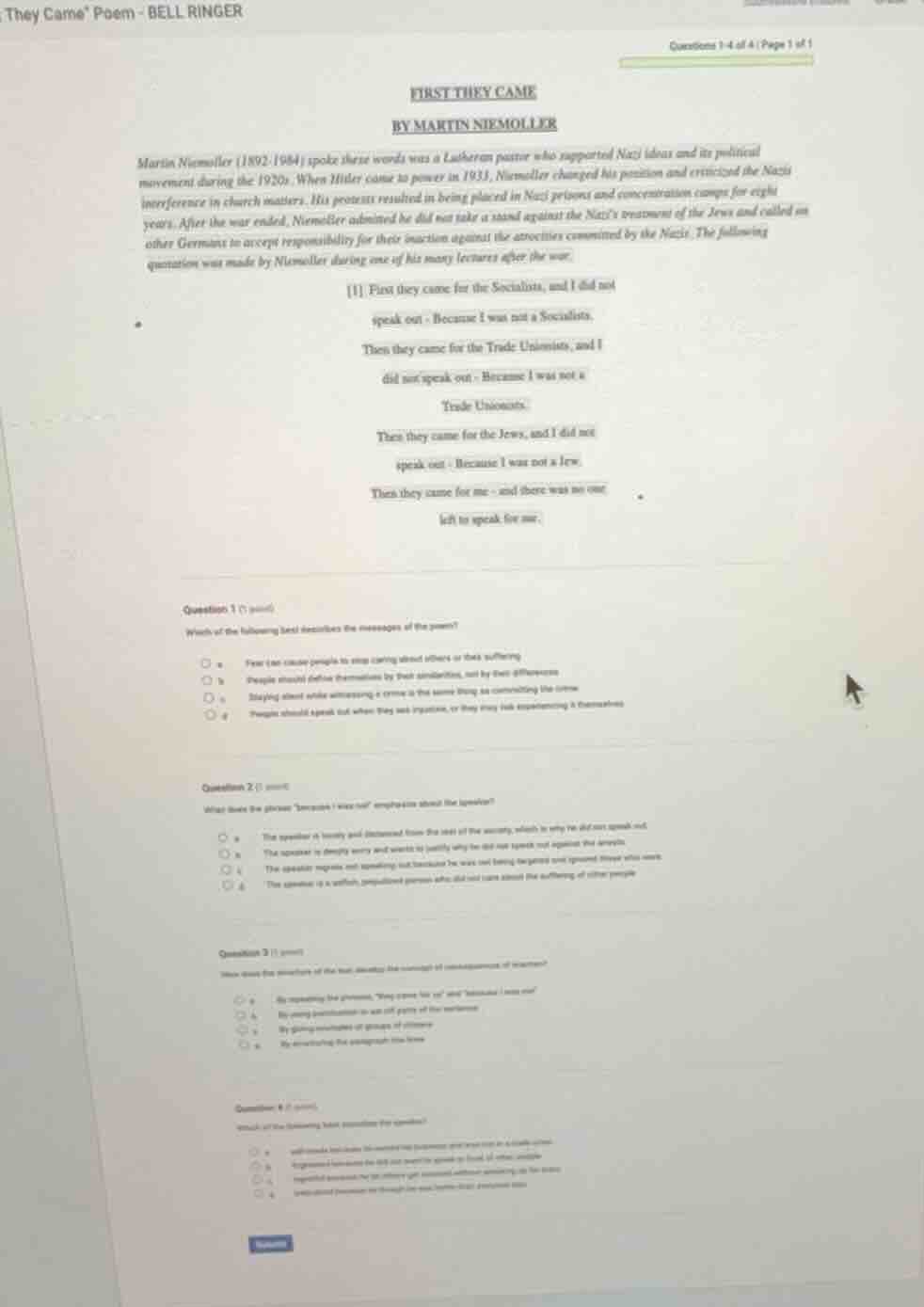
first they came
by martin niemoller
martin niemoller (1892 - 1984) spoke these words was a lutheran pastor who supported nazi ideas and its political movement during the 1920s. when hitler came to power in 1933, niemoller changed his position and criticized the nazis’ interference in church matters. his protests resulted in being placed in nazi prisons and concentration camps for eight years. after the war ended, niemoller admitted he did not take a stand against the nazis’ treatment of the jews and called on other germans to accept responsibility for their inaction against the atrocities committed by the nazis. the following quotation was made by niemoller during one of his many lectures after the war:
1 first they came for the socialists, and i did not
speak out - because i was not a socialist.
then they came for the trade unionists, and i
did not speak out - because i was not a
trade unionist.
then they came for the jews, and i did not
speak out - because i was not a jew.
then they came for me - and there was no one
left to speak for me.
question 1 (1 point)
which of the following best describes the message of the poem?
○ a
free time causes people to stop caring about others or their suffering.
○ b
people should define themselves by their similarities, not by their differences.
○ c
staying silent while witnessing a crime is the same thing as committing the crime.
○ d
people should speak out when they see injustice, or they may risk experiencing it themselves.
question 2 (1 point)
what does the phrase “because i was not” emphasize about the speaker?
○ a
the speaker is lonely and distanced from the rest of the society, which is why he did not speak out.
○ b
the speaker is deeply sorry and wants to justify why he did not speak out against the arrests.
○ c
the speaker regrets not speaking out because he was not being targeted and ignored those who were.
○ d
the speaker is a selfish, prejudiced person who did not care about the suffering of other people.
question 3 (1 point)
how does the repetition of the line develop the concept of ineffectiveness of inaction?
○ a
by repeating the phrases, “they came for me” and “because i was not”
○ b
by using punctuation to set off parts of the sentence
○ c
by giving examples of groups of citizens
○ d
by structuring the paragraph into lines
question 4 (1 point)
which of the following best describes the speaker?
○ a
self - aware because he wanted to gain power and control in a totalitarian regime
○ b
regretful because he did not try to protest or speak out in a subtle way
○ c
regretful because he did not speak out against the suffering of others
○ d
self - aware because he thought he was better than other previous nazis
Question 1:
The poem shows the speaker staying silent as groups are targeted one by one, until there is no one left to speak for them. This emphasizes that inaction against injustice can lead to harm befalling oneself.
Question 2:
The phrase "Because I was not a" is repeated to explain the speaker's inaction: they did not identify with each targeted group, so they felt no need to speak up, showing they were disconnected from the groups' suffering.
Question 3:
The poem uses a structure of repeating the same sentence pattern for each targeted group, building up to the final line where the speaker is targeted with no one left. This repetition reinforces the cost of inaction.
Question 4:
The speaker is a German pastor who initially supported the Nazis, then criticized them and was imprisoned. After the war, he admitted his failure to speak up for the Jews, so he is a regretful man who learned from his mistake.

Snap & solve any problem in the app
Get step-by-step solutions on Sovi AI
Photo-based solutions with guided steps
Explore more problems and detailed explanations
- d. People should speak out when they see injustice, or they may risk experiencing it themselves
- a. The speaker is totally and disconnected from the rest of the society, which is why he did not speak out
- a. By repeating the phrases, "they came for me" and "Because I was not"
- d. A regretful person who through his own learns from his mistakes