QUESTION IMAGE
Question
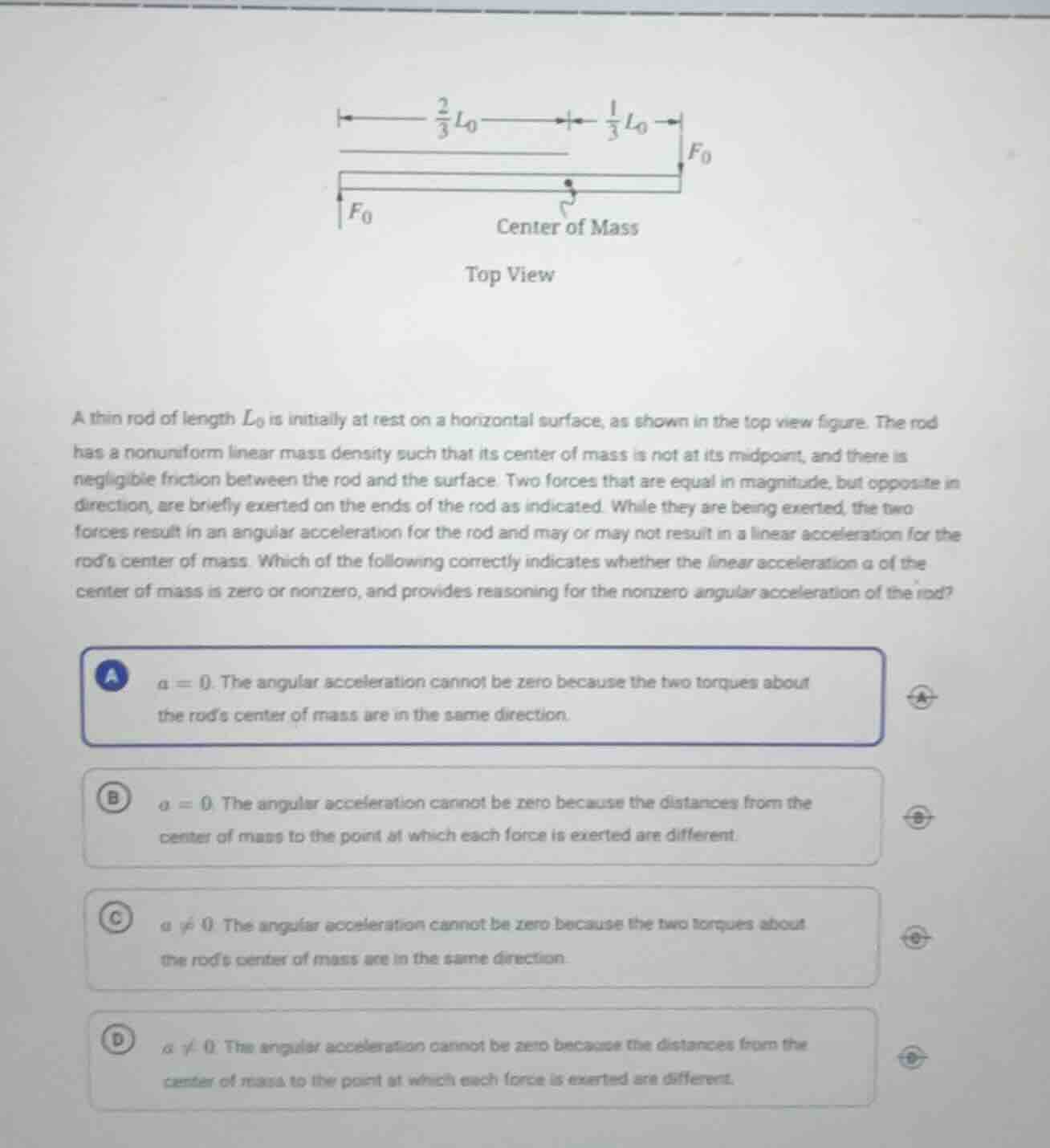
a thin rod of length $l_0$ is initially at rest on a horizontal surface, as shown in the top view figure. the rod has a nonuniform linear mass density such that its center of mass is not at its midpoint, and there is negligible friction between the rod and the surface. two forces that are equal in magnitude, but opposite in direction, are briefly exerted on the ends of the rod as indicated. while they are being exerted, the two forces result in an angular acceleration for the rod and may or may not result in a linear acceleration for the rod’s center of mass. which of the following correctly indicates whether the linear acceleration $a$ of the center of mass is zero or nonzero, and provides reasoning for the nonzero angular acceleration of the rod?
a $a = 0$. the angular acceleration cannot be zero because the two torques about the rod’s center of mass are in the same direction.
b $a = 0$. the angular acceleration cannot be zero because the distances from the center of mass to the point at which each force is exerted are different.
c $a \
eq 0$. the angular acceleration cannot be zero because the two torques about the rod’s center of mass are in the same direction.
d $a \
eq 0$. the angular acceleration cannot be zero because the distances from the center of mass to the point at which each force is exerted are different.
- For linear acceleration of the center of mass: The net force on the rod is $F_{net} = F_0 - F_0 = 0$. By Newton's second law for translation ($F_{net}=ma$), if $F_{net}=0$, then $a=0$.
- For angular acceleration: Calculate torques about the center of mass. The torque from the left force is $\tau_1 = F_0 \times \frac{2}{3}L_0$, and the torque from the right force is $\tau_2 = F_0 \times \frac{1}{3}L_0$. Both torques act in the same rotational direction (clockwise, from the top view), so the net torque $\tau_{net} = \tau_1 + \tau_2
eq 0$. By Newton's second law for rotation ($\tau_{net}=I\alpha$), a non-zero net torque leads to non-zero angular acceleration $\alpha$.

Snap & solve any problem in the app
Get step-by-step solutions on Sovi AI
Photo-based solutions with guided steps
Explore more problems and detailed explanations
A. $a = 0$. The angular acceleration cannot be zero because the two torques about the rod's center of mass are in the same direction.