QUESTION IMAGE
Question
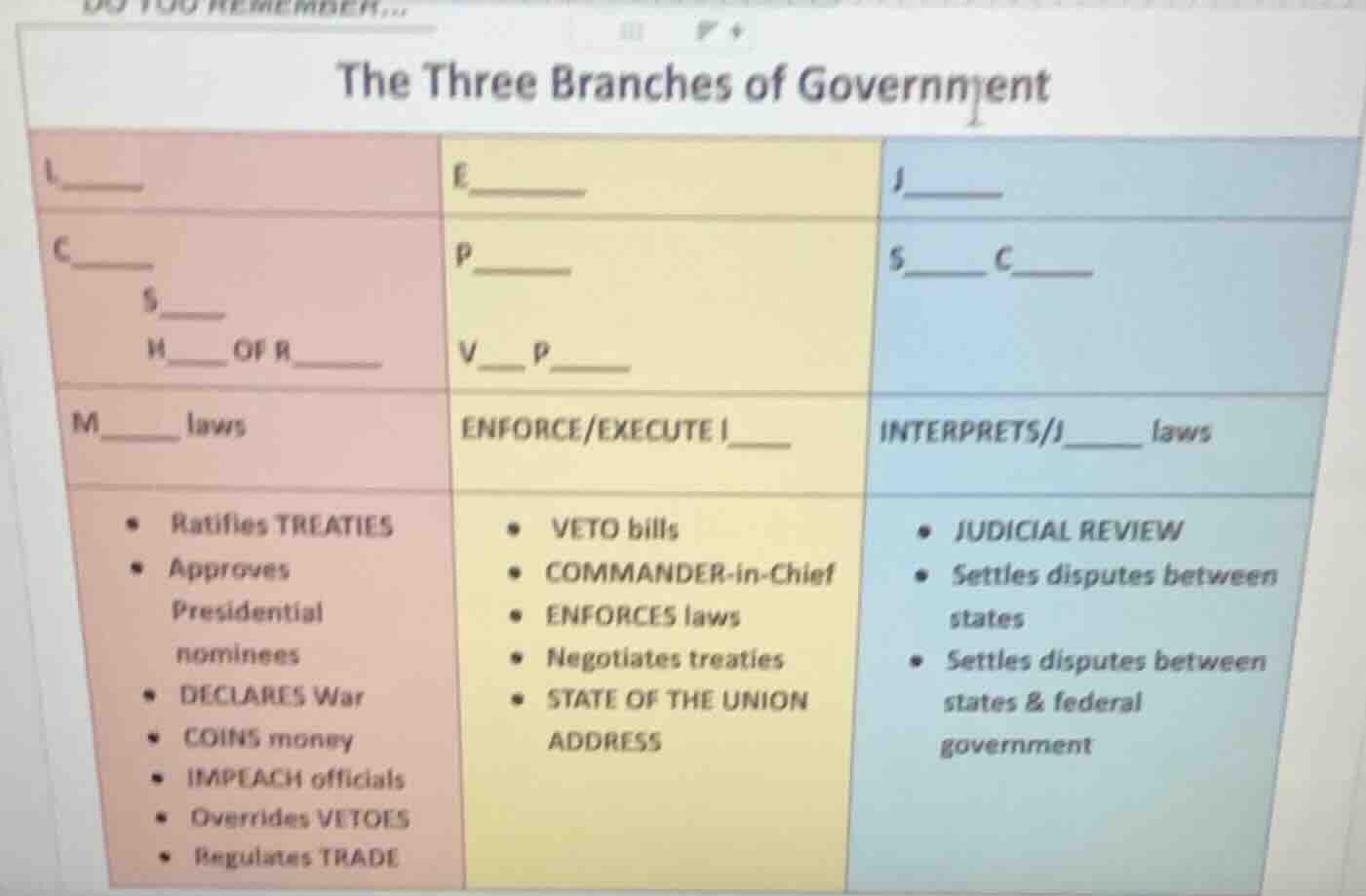
the three branches of government
l____\te__\tj____
c____\tp__\ts__ c____
\ts____\t\t\t
\th__ of r__\tv p____\t
m____ laws\tenforce/execute i\tinterprets/j____ laws
- ratifies treaties\t- veto bills\t- judicial review
- approves\t- commander - in - chief\t- settles disputes between
presidential\t- enforces laws\t states
nominees\t- negotiates treaties\t- settles disputes between
- declares war\t- state of the union\t states & federal
- coins money\t address\t government
- impeach officials\t\t
- overrides vetoes\t\t
- regulates trade\t\t
This is a fill-in-the-blank about the U.S. three branches of government. Each column corresponds to one branch, with its name, components, core function, and specific powers. We fill in the blanks based on standard U.S. government structure knowledge:
- The first column is the Legislative Branch, made up of Congress (Senate and House of Representatives), whose core function is making laws.
- The second column is the Executive Branch, led by the President, whose core function is enforcing laws.
- The third column is the Judicial Branch, centered on the Supreme Court, whose core function is interpreting laws.

Snap & solve any problem in the app
Get step-by-step solutions on Sovi AI
Photo-based solutions with guided steps
Explore more problems and detailed explanations
First Column (Legislative Branch):
L: Legislative
C: Congress
S: Senate
H: House; R: Representatives
M: Makes
Second Column (Executive Branch):
E: Executive
P: President
V: Vice; P: President
I: laws
Third Column (Judicial Branch):
J: Judicial
S: Supreme; C: Court
J: Judges