QUESTION IMAGE
Question
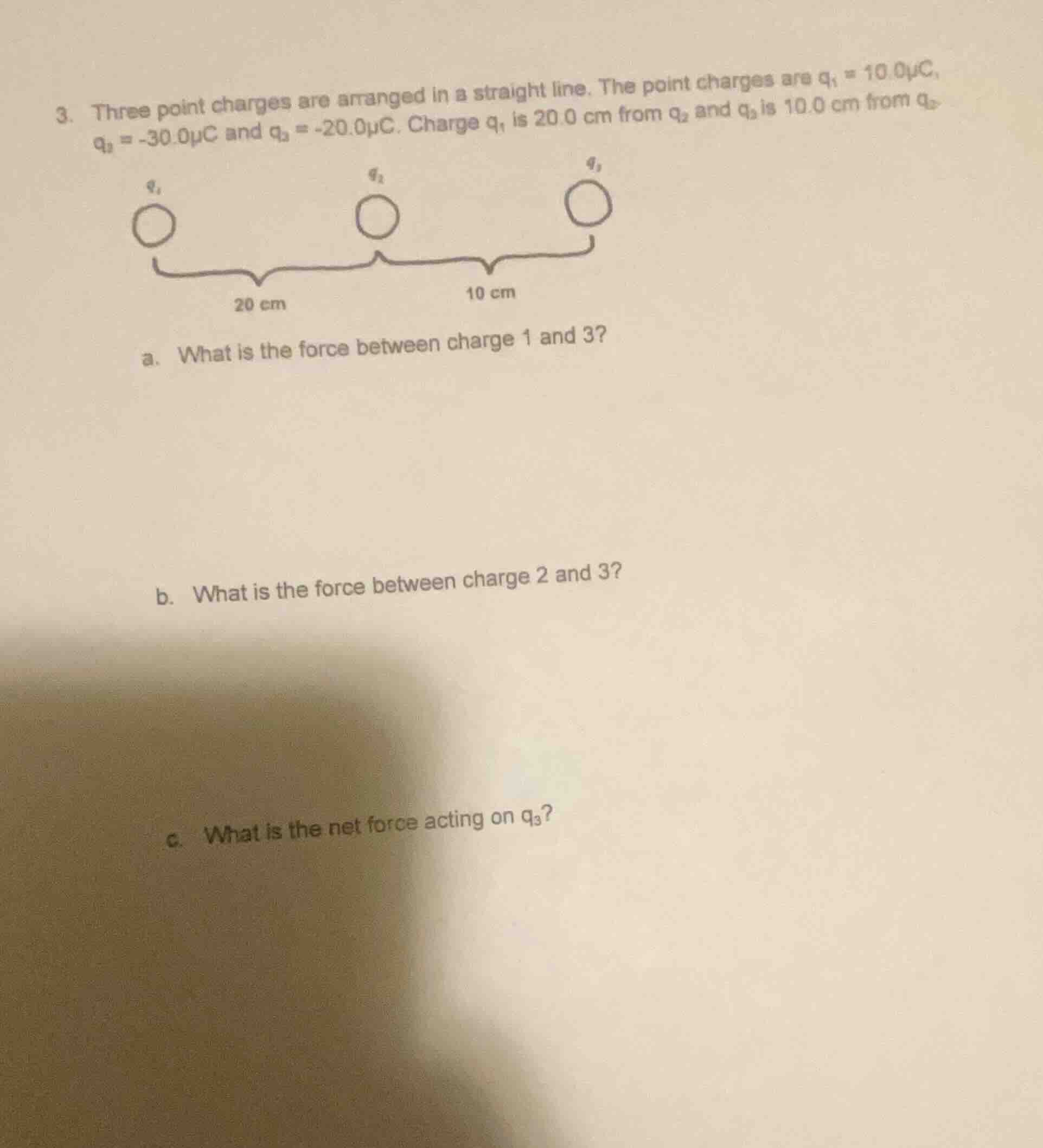
- three point charges are arranged in a straight line. the point charges are $q_1 = 10.0\mu c$, $q_2 = -30.0\mu c$ and $q_3 = -20.0\mu c$. charge $q_1$ is 20.0 cm from $q_2$ and $q_3$ is 10.0 cm from $q_2$.
(image of three circles labeled $q_1$, $q_2$, $q_3$ with 20 cm between $q_1$ and $q_2$, 10 cm between $q_2$ and $q_3$)
a. what is the force between charge 1 and 3?
b. what is the force between charge 2 and 3?
c. what is the net force acting on $q_3$?
Part a: Force between \( q_1 \) and \( q_3 \)
Step1: Identify given values
\( q_1 = 10.0 \, \mu\text{C} = 10.0 \times 10^{-6} \, \text{C} \), \( q_3 = -20.0 \, \mu\text{C} = -20.0 \times 10^{-6} \, \text{C} \)
Distance between \( q_1 \) and \( q_3 \), \( r = 20.0 \, \text{cm} + 10.0 \, \text{cm} = 30.0 \, \text{cm} = 0.30 \, \text{m} \)
Coulomb's constant, \( k = 8.988 \times 10^9 \, \text{N·m}^2/\text{C}^2 \)
Step2: Apply Coulomb's Law
Coulomb's Law: \( F = k \frac{|q_1 q_3|}{r^2} \)
Substitute values:
\( F = (8.988 \times 10^9) \frac{|(10.0 \times 10^{-6})(-20.0 \times 10^{-6})|}{(0.30)^2} \)
\( F = (8.988 \times 10^9) \frac{2.0 \times 10^{-10}}{0.09} \)
\( F \approx 19.97 \, \text{N} \) (attractive, since charges are opposite)
Step1: Identify given values
\( q_2 = -30.0 \, \mu\text{C} = -30.0 \times 10^{-6} \, \text{C} \), \( q_3 = -20.0 \, \mu\text{C} = -20.0 \times 10^{-6} \, \text{C} \)
Distance between \( q_2 \) and \( q_3 \), \( r = 10.0 \, \text{cm} = 0.10 \, \text{m} \)
Step2: Apply Coulomb's Law
Coulomb's Law: \( F = k \frac{|q_2 q_3|}{r^2} \)
Substitute values:
\( F = (8.988 \times 10^9) \frac{|(-30.0 \times 10^{-6})(-20.0 \times 10^{-6})|}{(0.10)^2} \)
\( F = (8.988 \times 10^9) \frac{6.0 \times 10^{-10}}{0.01} \)
\( F \approx 539.3 \, \text{N} \) (repulsive, since charges are like)
Step1: Analyze directions
- Force from \( q_1 \) on \( q_3 \): \( F_{13} \) (attractive, so \( q_1 \) pulls \( q_3 \) left)
- Force from \( q_2 \) on \( q_3 \): \( F_{23} \) (repulsive, so \( q_2 \) pushes \( q_3 \) right)
Assume right as positive. Then \( F_{13} = -19.97 \, \text{N} \) (left) and \( F_{23} = +539.3 \, \text{N} \) (right).
Step2: Calculate net force
\( F_{\text{net}} = F_{23} + F_{13} \)
\( F_{\text{net}} = 539.3 - 19.97 \approx 519.3 \, \text{N} \) (direction: right)

Snap & solve any problem in the app
Get step-by-step solutions on Sovi AI
Photo-based solutions with guided steps
Explore more problems and detailed explanations
Force between \( q_1 \) and \( q_3 \) is approximately \( \boldsymbol{20.0 \, \text{N}} \) (attractive).