QUESTION IMAGE
Question
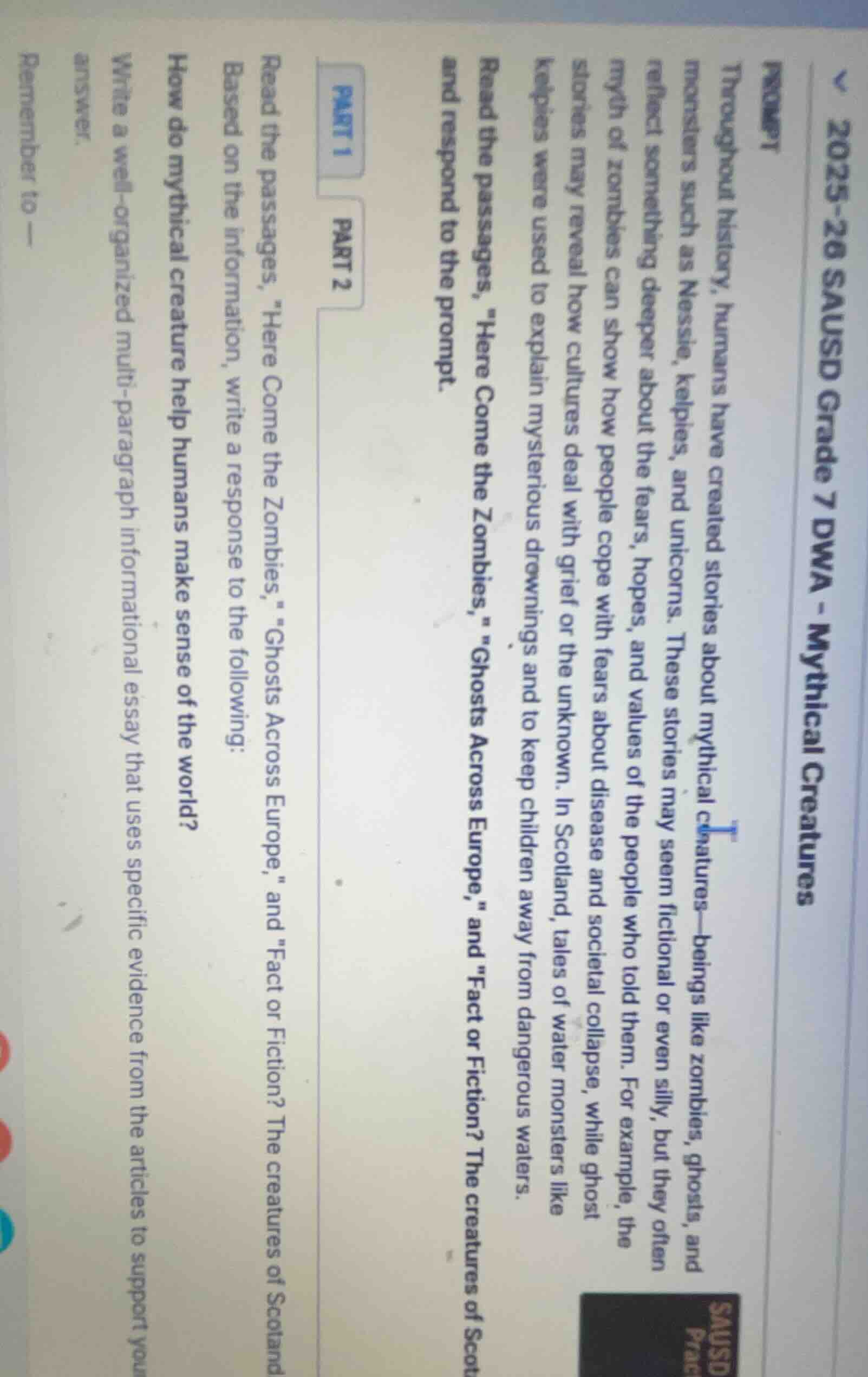
throughout history, humans have created stories about mythical creatures—beings like zombies, ghosts, and monsters such as nessie, kelpies, and unicorns. these stories may seem fictional or even silly, but they often reflect something deeper about the fears, hopes, and values of the people who told them. for example, the stories may reveal how cultures deal with grief or the unknown. in scotland, tales of water monsters like kelpies were used to explain mysterious drownings and to keep children away from dangerous waters. read the passages, \here come the zombies,\ \ghosts across europe,\ and \fact or fiction? the creatures of scot and respond to the prompt. part 1 part 2 read the passages, \here come the zombies,\ \ghosts across europe,\ and \fact or fiction? the creatures of scotland based on the information, write a response to the following: how do mythical creatures help humans make sense of the world? write a well - organized multi - paragraph informational essay that uses specific evidence from the articles to support your answer.
Mythical creatures help humans make sense of the world by reflecting their fears, hopes, and values. For example, zombie myths show how people cope with disease and societal collapse, as seen in "Here Come the Zombies." Ghost stories, like those in "Ghosts Across Europe," reveal how cultures deal with grief or the unknown. Scottish water monsters (kelpies) kept children from dangerous waters, per "The Creatures of Scotland," using myth to enforce safety. These stories turn abstract or terrifying concepts into tangible narratives, aiding understanding of complex emotions and societal issues.

Snap & solve any problem in the app
Get step-by-step solutions on Sovi AI
Photo-based solutions with guided steps
Explore more problems and detailed explanations
Mythical creatures help humans make sense of the world by acting as symbolic reflections of fears, hopes, and values. In “Here Come the Zombies,” zombie myths illustrate how people cope with disease and societal collapse, turning abstract anxieties into a narrative framework. “Ghosts Across Europe” shows ghost stories help cultures process grief or the unknown, providing comfort in the face of uncertainty. “The Creatures of Scotland” reveals kelpies (water monsters) were used to teach children about safety, using myth to enforce social rules. By transforming complex emotions and issues into tangible, story - based concepts, mythical creatures allow people to understand and navigate the world’s challenges.