QUESTION IMAGE
Question
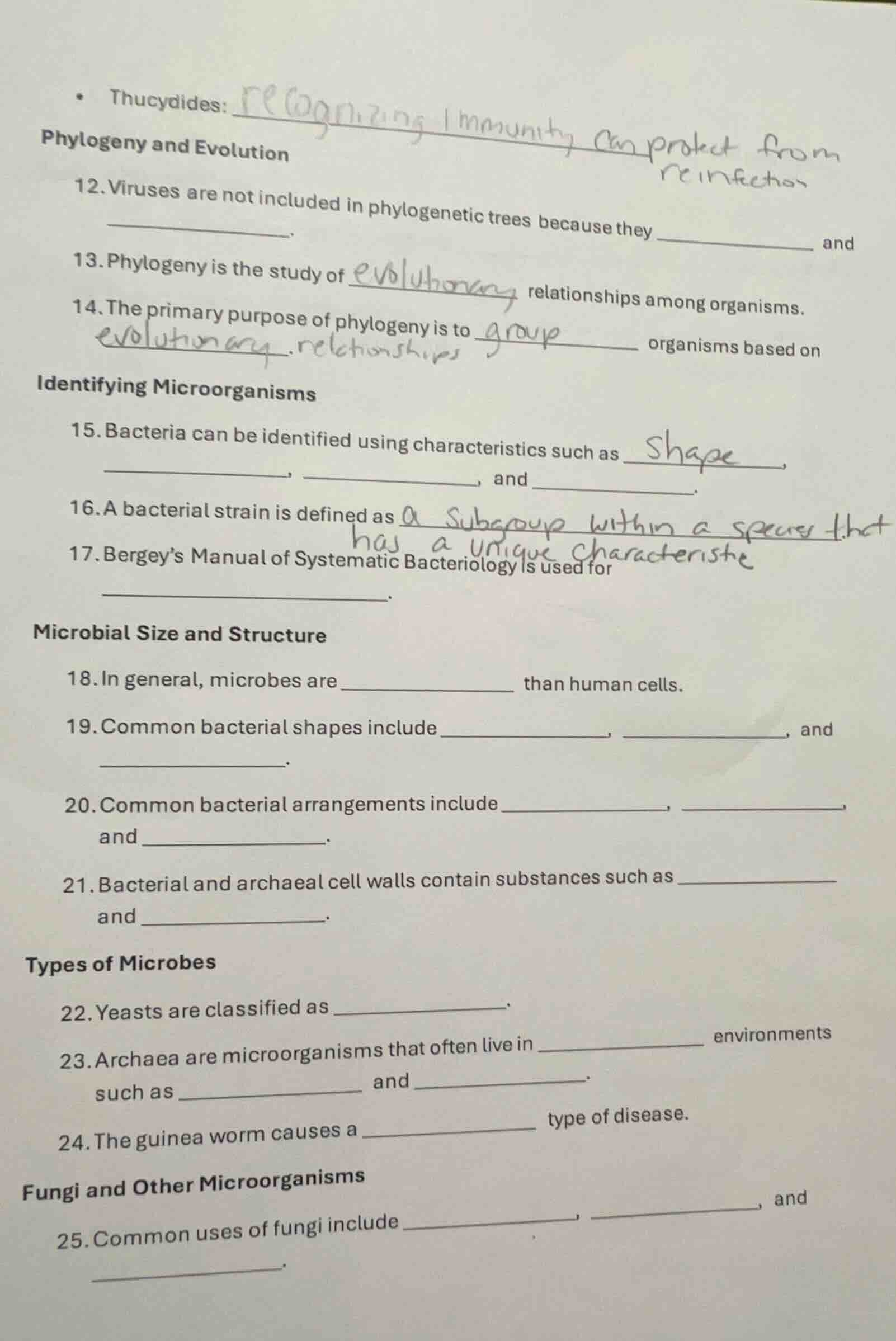
- thucydides:
phylogeny and evolution
- viruses are not included in phylogenetic trees because they ______ and ______.
- phylogeny is the study of ________ relationships among organisms.
- the primary purpose of phylogeny is to ______ organisms based on ______.
identifying microorganisms
- bacteria can be identified using characteristics such as ______, ____, ____, and ______.
- a bacterial strain is defined as ________.
- bergey’s manual of systematic bacteriology is used for ________.
microbial size and structure
- in general, microbes are ________ than human cells.
- common bacterial shapes include ______, ____, and ______.
- common bacterial arrangements include ______, ____, and ______.
- bacterial and archaeal cell walls contain substances such as ______ and ______.
types of microbes
- yeasts are classified as ________.
- archaea are microorganisms that often live in ______ environments such as ____ and ______.
- the guinea worm causes a ________ type of disease.
fungi and other microorganisms
- common uses of fungi include ______, ____, and ______.
Brief Explanations
- Q12: Viruses lack a shared evolutionary history via standard cellular ancestry and cannot be classified in phylogenetic trees because they are not cellular and do not have consistent, heritable genomic markers used for such trees in the same way as cellular organisms.
- Q13: Phylogeny focuses on evolutionary relationships between organisms.
- Q14: The core goal of phylogeny is grouping organisms by their evolutionary relatedness.
- Q15: Bacteria are identified by key physical/structural traits.
- Q16: A bacterial strain is a subgroup of a species with unique traits.
- Q17: Bergey's Manual is a standard reference for bacterial classification and identification.
- Q18: Microbes are defined by their small size relative to human cells.
- Q19: Bacteria have three primary classic shapes.
- Q20: Bacteria form distinct clustered/grouped arrangements.
- Q21: Bacteria and archaea have unique cell wall components that distinguish them.
- Q22: Yeasts are single-celled members of the fungi kingdom.
- Q23: Archaea are known for thriving in extreme, uninhabitable environments for most organisms.
- Q24: The guinea worm causes an infection transmitted via contaminated water, classified as a neglected tropical parasitic disease.
- Q25: Fungi have widespread industrial, food, and medical applications.

Snap & solve any problem in the app
Get step-by-step solutions on Sovi AI
Photo-based solutions with guided steps
Explore more problems and detailed explanations
- are not cellular; do not have consistent heritable traits
- evolutionary
- group; evolutionary relationships
- shape; cell wall structure; motility; metabolic properties
- a subgroup within a species that has unique genetic or phenotypic characteristics
- classifying and identifying bacterial species
- smaller
- cocci (spherical); bacilli (rod-shaped); spirilla (spiral-shaped)
- staphylococci (clusters); streptococci (chains); diplococci (pairs)
- peptidoglycan (bacteria); pseudopeptidoglycan (archaea)
- fungi (single-celled fungi)
- extreme; hot springs; deep-sea hydrothermal vents
- parasitic (neglected tropical)
- food production (bread/cheese); antibiotic production; bioremediation