QUESTION IMAGE
Question
2
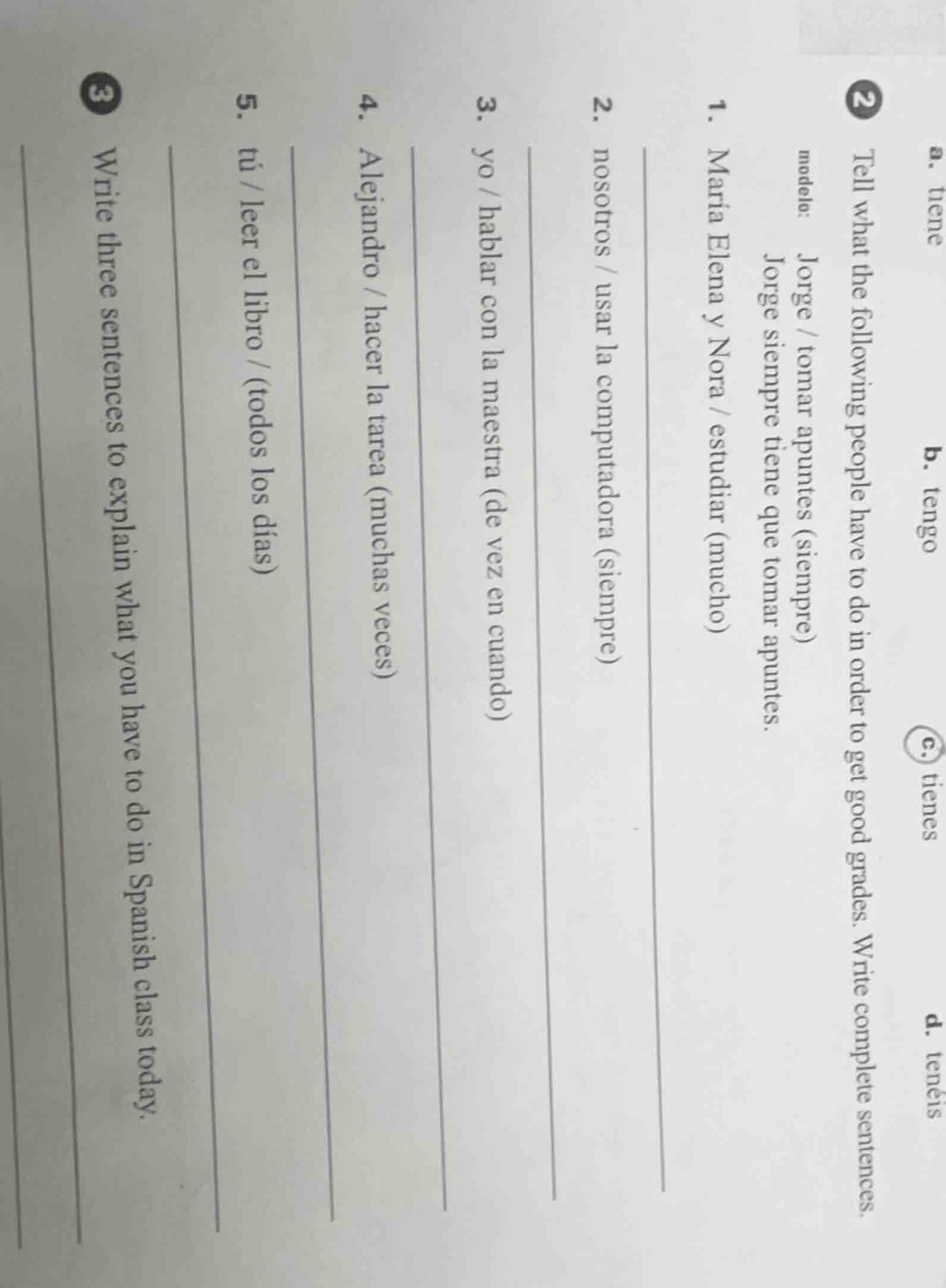
a. tiene
b. tengo
c. tienes
d. tenéis
tell what the following people have to do in order to get good grades. write complete sentences.
modelo:
jorge / tomar apuntes (siempre)
jorge siempre tiene que tomar apuntes.
- maría elena y nora / estudiar (mucho)
____________________
- nosotros / usar la computadora (siempre)
____________________
- yo / hablar con la maestra (de vez en cuando)
____________________
- alejandro / hacer la tarea (muchas veces)
____________________
- tú / leer el libro (todos los días)
____________________
3
write three sentences to explain what you have to do in spanish class today.
____________________
____________________
____________________
Part 2 (Completing Sentences)
1. María Elena y Nora / estudiar (mucho)
To form the sentence, we use the structure "subject + siempre tiene que + verb + adverb". For the subject "María Elena y Nora" (plural), the correct form of "tener que" is "tienen que". The verb "estudiar" remains in the infinitive, and "mucho" is the adverb. So the sentence is: María Elena y Nora siempre tienen que estudiar mucho.
2. nosotros / usar la computadora (siempre)
For the subject "nosotros" (we), the form of "tener que" is "tenemos que". The verb "usar" is in the infinitive, and "siempre" is the adverb of frequency. The sentence becomes: Nosotros siempre tenemos que usar la computadora.
3. yo / hablar con la maestra (de vez en cuando)
For the subject "yo" (I), the form of "tener que" is "tengo que". The verb "hablar" is in the infinitive, and "de vez en cuando" is the adverb phrase. The sentence is: Yo de vez en cuando tengo que hablar con la maestra.
4. Alejandro / hacer la tarea (muchas veces)
For the subject "Alejandro" (he), the form of "tener que" is "tiene que". The verb "hacer" is in the infinitive, and "muchas veces" is the adverb phrase. The sentence is: Alejandro muchas veces tiene que hacer la tarea.
5. tú / leer el libro (todos los días)
For the subject "tú" (you, informal), the form of "tener que" is "tienes que". The verb "leer" is in the infinitive, and "todos los días" is the adverb phrase. The sentence is: Tú todos los días tienes que leer el libro.
Part 3 (Writing Three Sentences)
To write sentences about what you have to do in Spanish class today, we use the structure "yo + tengo que + verb + (details)". Here are three examples:
- Yo tengo que estudiar el vocabulario de español hoy en clase. (I have to study Spanish vocabulary in class today.)
- Yo tengo que presentar mi ensayo en español hoy. (I have to present my Spanish essay today.)
- Yo tengo que practicar hablar en español con mis compañeros hoy en clase. (I have to practice speaking Spanish with my classmates in class today.)

Snap & solve any problem in the app
Get step-by-step solutions on Sovi AI
Photo-based solutions with guided steps
Explore more problems and detailed explanations
Part 2 (Completing Sentences)
1. María Elena y Nora / estudiar (mucho)
To form the sentence, we use the structure "subject + siempre tiene que + verb + adverb". For the subject "María Elena y Nora" (plural), the correct form of "tener que" is "tienen que". The verb "estudiar" remains in the infinitive, and "mucho" is the adverb. So the sentence is: María Elena y Nora siempre tienen que estudiar mucho.
2. nosotros / usar la computadora (siempre)
For the subject "nosotros" (we), the form of "tener que" is "tenemos que". The verb "usar" is in the infinitive, and "siempre" is the adverb of frequency. The sentence becomes: Nosotros siempre tenemos que usar la computadora.
3. yo / hablar con la maestra (de vez en cuando)
For the subject "yo" (I), the form of "tener que" is "tengo que". The verb "hablar" is in the infinitive, and "de vez en cuando" is the adverb phrase. The sentence is: Yo de vez en cuando tengo que hablar con la maestra.
4. Alejandro / hacer la tarea (muchas veces)
For the subject "Alejandro" (he), the form of "tener que" is "tiene que". The verb "hacer" is in the infinitive, and "muchas veces" is the adverb phrase. The sentence is: Alejandro muchas veces tiene que hacer la tarea.
5. tú / leer el libro (todos los días)
For the subject "tú" (you, informal), the form of "tener que" is "tienes que". The verb "leer" is in the infinitive, and "todos los días" is the adverb phrase. The sentence is: Tú todos los días tienes que leer el libro.
Part 3 (Writing Three Sentences)
To write sentences about what you have to do in Spanish class today, we use the structure "yo + tengo que + verb + (details)". Here are three examples:
- Yo tengo que estudiar el vocabulario de español hoy en clase. (I have to study Spanish vocabulary in class today.)
- Yo tengo que presentar mi ensayo en español hoy. (I have to present my Spanish essay today.)
- Yo tengo que practicar hablar en español con mis compañeros hoy en clase. (I have to practice speaking Spanish with my classmates in class today.)