QUESTION IMAGE
Question
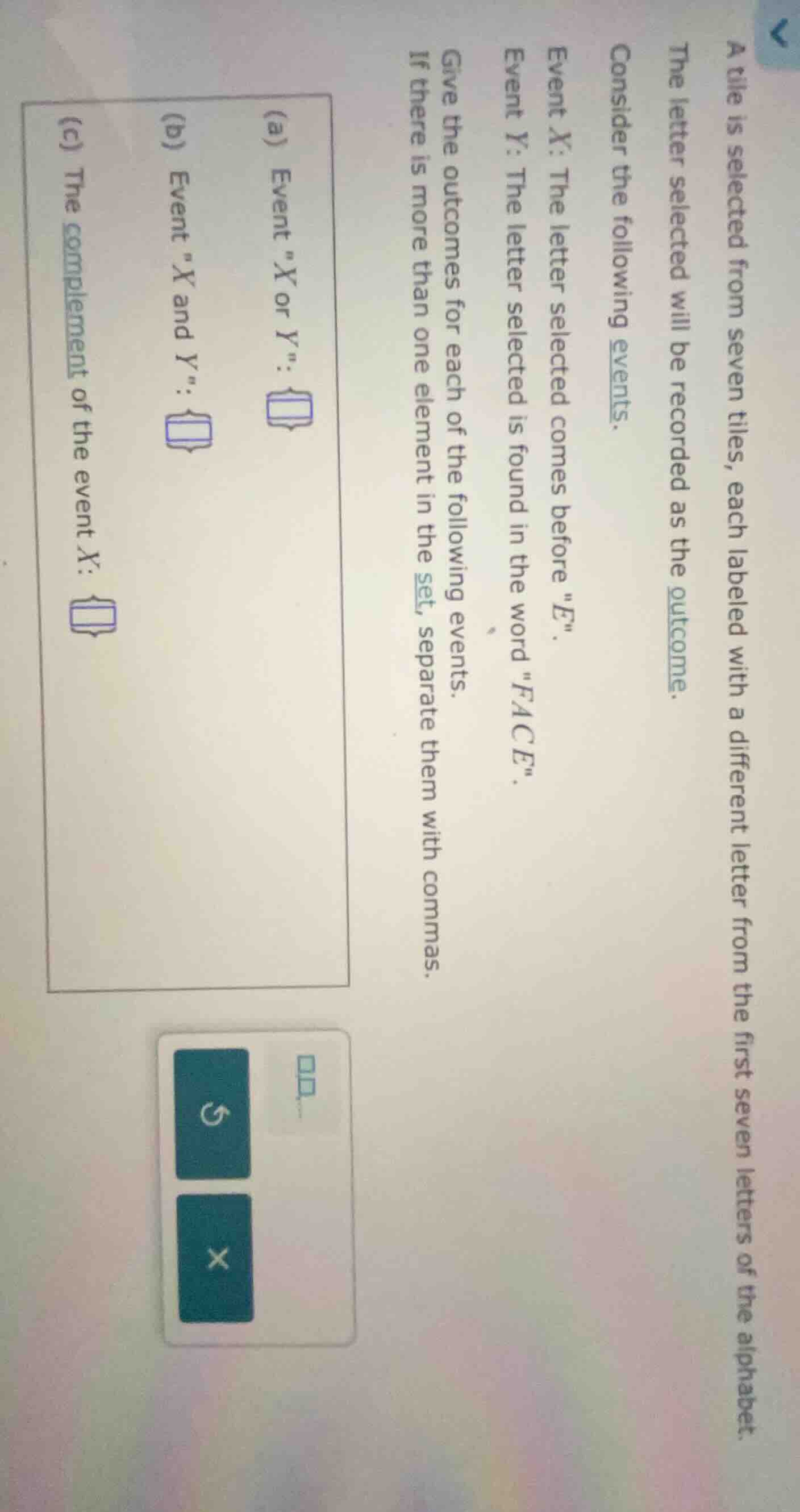
a tile is selected from seven tiles, each labeled with a different letter from the first seven letters of the alphabet. the letter selected will be recorded as the outcome. consider the following events. event x: the letter selected comes before \e\. event y: the letter selected is found in the word \face\. give the outcomes for each of the following events. if there is more than one element in the set, separate them with commas. (a) event \x or y\: \boxed{} (b) event \x and y\: \boxed{} (c) the complement of the event x: \boxed{}
First, we identify the set of tiles: the first seven letters of the alphabet are \( A, B, C, D, E, F, G \).
Part (a): Event "X or Y"
- Event X: The letter comes before "E". So the letters are \( A, B, C, D \) (since these are before \( E \) in the alphabet).
- Event Y: The letter is in "FACE". The letters in "FACE" are \( F, A, C, E \).
- The union of \( X \) and \( Y \) (i.e., "X or Y") includes all elements in \( X \) or \( Y \). So we combine the two sets: \( A, B, C, D \) (from X) and \( F, A, C, E \) (from Y). Removing duplicates, we get \( A, B, C, D, E, F \).
Part (b): Event "X and Y"
- The intersection of \( X \) and \( Y \) (i.e., "X and Y") includes elements that are in both \( X \) and \( Y \).
- From \( X \): \( A, B, C, D \); from \( Y \): \( F, A, C, E \). The common elements are \( A, C \).
Part (c): Complement of Event X
- The sample space \( S \) is \( \{A, B, C, D, E, F, G\} \).
- Event \( X \) is \( \{A, B, C, D\} \). The complement of \( X \) (denoted \( X^c \)) is all elements in \( S \) not in \( X \). So \( X^c = \{E, F, G\} \).
Final Answers:
(a) \( \{A, B, C, D, E, F\} \)
(b) \( \{A, C\} \)
(c) \( \{E, F, G\} \)

Snap & solve any problem in the app
Get step-by-step solutions on Sovi AI
Photo-based solutions with guided steps
Explore more problems and detailed explanations
First, we identify the set of tiles: the first seven letters of the alphabet are \( A, B, C, D, E, F, G \).
Part (a): Event "X or Y"
- Event X: The letter comes before "E". So the letters are \( A, B, C, D \) (since these are before \( E \) in the alphabet).
- Event Y: The letter is in "FACE". The letters in "FACE" are \( F, A, C, E \).
- The union of \( X \) and \( Y \) (i.e., "X or Y") includes all elements in \( X \) or \( Y \). So we combine the two sets: \( A, B, C, D \) (from X) and \( F, A, C, E \) (from Y). Removing duplicates, we get \( A, B, C, D, E, F \).
Part (b): Event "X and Y"
- The intersection of \( X \) and \( Y \) (i.e., "X and Y") includes elements that are in both \( X \) and \( Y \).
- From \( X \): \( A, B, C, D \); from \( Y \): \( F, A, C, E \). The common elements are \( A, C \).
Part (c): Complement of Event X
- The sample space \( S \) is \( \{A, B, C, D, E, F, G\} \).
- Event \( X \) is \( \{A, B, C, D\} \). The complement of \( X \) (denoted \( X^c \)) is all elements in \( S \) not in \( X \). So \( X^c = \{E, F, G\} \).
Final Answers:
(a) \( \{A, B, C, D, E, F\} \)
(b) \( \{A, C\} \)
(c) \( \{E, F, G\} \)