QUESTION IMAGE
Question
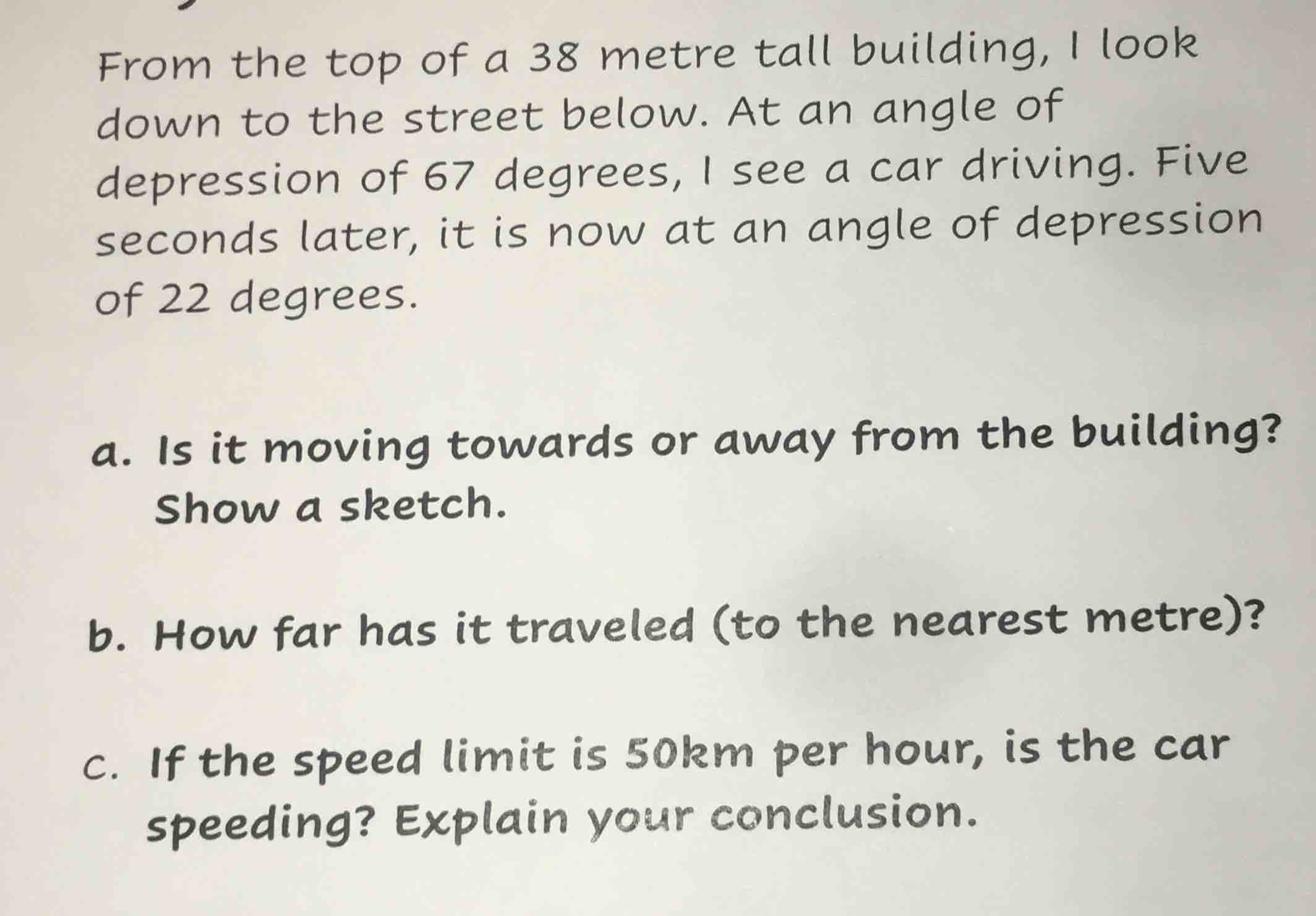
from the top of a 38 metre tall building, i look down to the street below. at an angle of depression of 67 degrees, i see a car driving. five seconds later, it is now at an angle of depression of 22 degrees.
a. is it moving towards or away from the building? show a sketch.
b. how far has it traveled (to the nearest metre)?
c. if the speed limit is 50km per hour, is the car speeding? explain your conclusion.
Part a
Step1: Understand Angle of Depression
The angle of depression is the angle between the horizontal line of sight and the line to the object. A smaller angle of depression means the object is farther away (since \(\tan(\theta)=\frac{\text{opposite}}{\text{adjacent}}\), for a fixed opposite side (building height), smaller \(\theta\) means larger adjacent side (distance from building)). Initially, the angle is \(67^\circ\), later \(22^\circ\) (smaller). So the car is moving away.
Step2: Sketch Description
- Draw a vertical line (building) of height \(38\) m.
- From the top, draw a horizontal line (line of sight).
- First, draw a line from the top to the car with angle of depression \(67^\circ\) (so the angle between horizontal and this line is \(67^\circ\), forming a right triangle with the building and the ground).
- Then, draw another line from the top to the car 5 seconds later with angle of depression \(22^\circ\). The second adjacent side (distance from building) is longer, so the car moved away.
Step1: Find Initial Distance (\(d_1\))
Using \(\tan(\theta)=\frac{\text{opposite}}{\text{adjacent}}\), for angle of depression \(\theta\), the angle with the vertical's complement? Wait, no: angle of depression equals the angle of elevation from the car to the top (alternate interior angles). So for initial angle \(67^\circ\) (angle of depression), the angle of elevation is \(67^\circ\). So \(\tan(67^\circ)=\frac{38}{d_1}\)? Wait, no: wait, angle of depression: horizontal line from top, so the triangle has height \(38\) m (opposite side), adjacent side \(d_1\) (distance from building), and angle at the top (between horizontal and line to car) is \(67^\circ\). So \(\tan(67^\circ)=\frac{38}{d_1}\)? Wait, no: \(\tan(\theta)=\frac{\text{opposite}}{\text{adjacent}}\), where \(\theta\) is the angle of depression (between horizontal and line of sight). So \(\tan(67^\circ)=\frac{38}{d_1}\)? Wait, no, horizontal line is from top, so the vertical side is \(38\), horizontal side is \(d_1\), and the angle between horizontal and line to car is \(67^\circ\), so \(\tan(67^\circ)=\frac{38}{d_1}\)? Wait, no: \(\tan(\theta)=\frac{\text{opposite}}{\text{adjacent}}\), here opposite is \(38\), adjacent is \(d_1\), and \(\theta = 67^\circ\)? Wait, no, angle of depression: if you look down, the angle between horizontal (from top) and the line to car is \(67^\circ\), so the angle in the right triangle at the car's position (angle of elevation) is also \(67^\circ\). So \(\tan(67^\circ)=\frac{38}{d_1}\) → \(d_1=\frac{38}{\tan(67^\circ)}\). Similarly, \(d_2=\frac{38}{\tan(22^\circ)}\). Then distance traveled is \(d_2 - d_1\).
Step2: Calculate \(d_1\)
\(\tan(67^\circ)\approx 2.3559\), so \(d_1=\frac{38}{2.3559}\approx 16.13\) m.
Step3: Calculate \(d_2\)
\(\tan(22^\circ)\approx 0.4040\), so \(d_2=\frac{38}{0.4040}\approx 94.06\) m.
Step4: Distance Traveled
Distance \(= d_2 - d_1 = 94.06 - 16.13 = 77.93\approx 78\) m.
Step1: Find Speed in m/s
Distance traveled is \(78\) m in \(5\) seconds. Speed \(v=\frac{78}{5}=15.6\) m/s.
Step2: Convert to km/h
To convert m/s to km/h: multiply by \(3.6\). So \(v = 15.6\times 3.6 = 56.16\) km/h.
Step3: Compare with Speed Limit
Speed limit is \(50\) km/h. \(56.16>50\), so the car is speeding.

Snap & solve any problem in the app
Get step-by-step solutions on Sovi AI
Photo-based solutions with guided steps
Explore more problems and detailed explanations
The car is moving away from the building. (Sketch: Vertical line (building) of height 38m. Horizontal line from top. Two lines from top to ground: first with \(67^\circ\) depression, second with \(22^\circ\) depression, second line's horizontal distance from building is longer.)