QUESTION IMAGE
Question
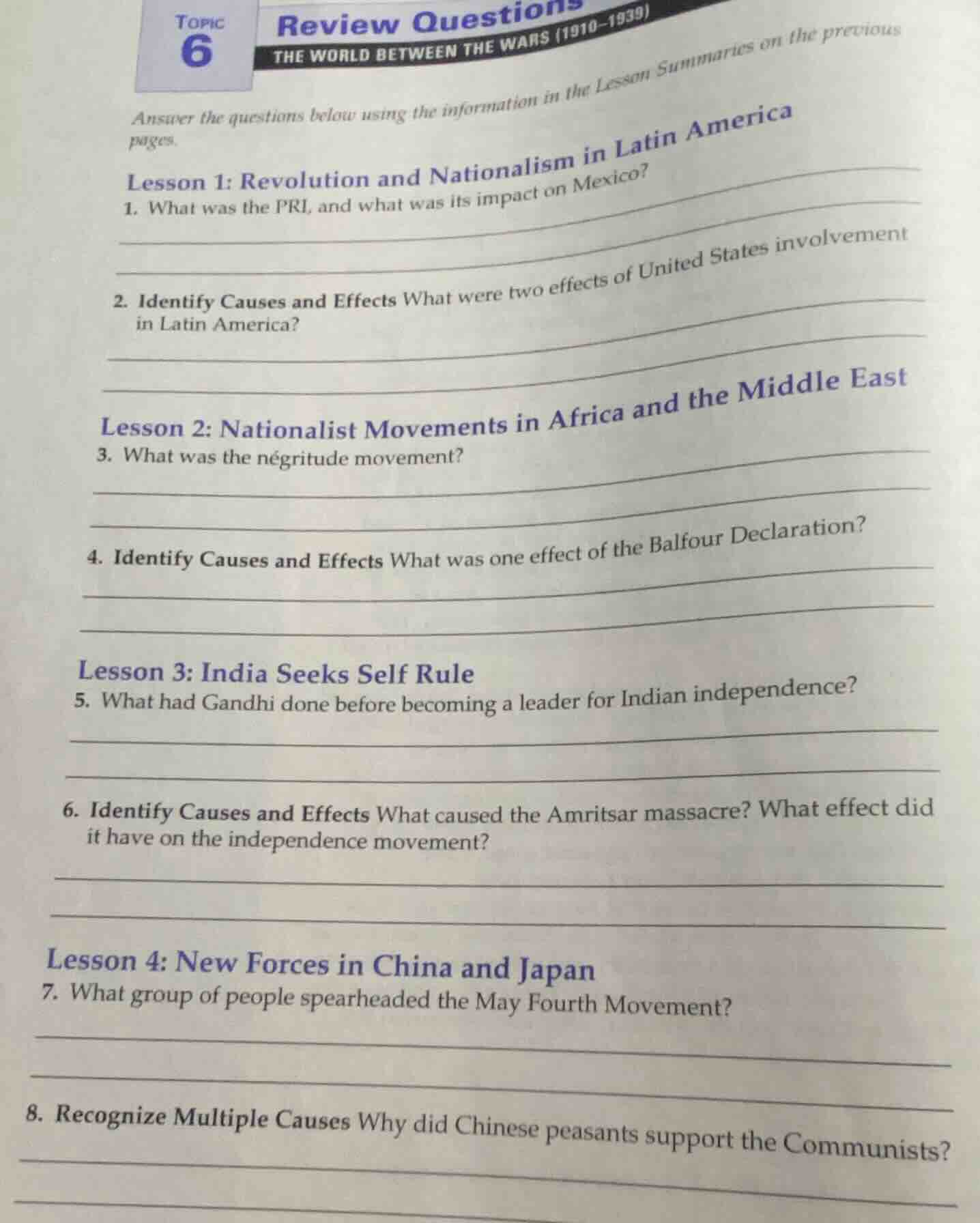
topic 6 review questions the world between the wars (1910 - 1939) answer the questions below using the information in the lesson summaries on the previous pages. lesson 1: revolution and nationalism in latin america 1. what was the pri, and what was its impact on mexico? 2. identify causes and effects what were two effects of united states involvement in latin america? lesson 2: nationalist movements in africa and the middle east 3. what was the négritude movement? 4. identify causes and effects what was one effect of the balfour declaration? lesson 3: india seeks self rule 5. what had gandhi done before becoming a leader for indian independence? 6. identify causes and effects what caused the amritsar massacre? what effect did it have on the independence movement? lesson 4: new forces in china and japan 7. what group of people spearheaded the may fourth movement? 8. recognize multiple causes why did chinese peasants support the communists?
To answer these questions, we'll use the information from the lesson summaries (not provided here, but based on typical world history content for this time period):
Question 1: What was the PRI, and what was its impact on Mexico?
The PRI (Institutional Revolutionary Party) was a dominant political party in Mexico. It provided political stability, promoted economic development (e.g., land reforms, industrialization), but also faced criticism for authoritarianism and corruption over time.
U.S. involvement (e.g., economic influence, military interventions) led to economic dependency (Latin American economies tied to U.S. markets) and political instability (support for authoritarian regimes to protect U.S. interests), or alternatively, modernization of infrastructure but at the cost of local sovereignty.
The négritude movement was a cultural/political movement led by Black intellectuals (e.g., Aimé Césaire, Léopold Senghor) that celebrated Black identity, heritage, and culture, rejecting colonial racism and promoting Pan-African solidarity.

Snap & solve any problem in the app
Get step-by-step solutions on Sovi AI
Photo-based solutions with guided steps
Explore more problems and detailed explanations
The PRI (Institutional Revolutionary Party) was a Mexican political party that dominated Mexican politics for decades. Its impact included stabilizing the country after revolution, implementing social reforms (like land redistribution), promoting industrial growth, but also being accused of authoritarianism and limiting political competition.