QUESTION IMAGE
Question
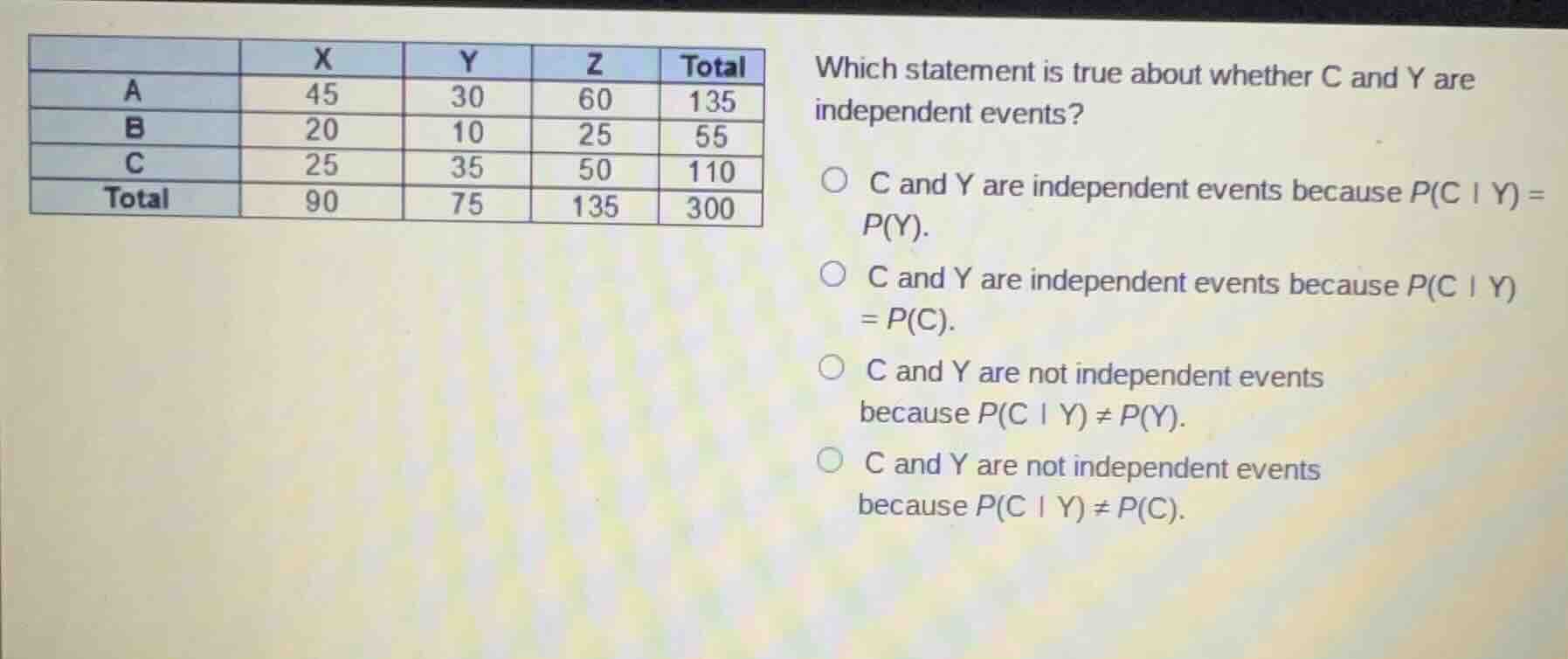
| x | y | z | total | |
| a | 45 | 30 | 60 | 135 |
| b | 20 | 10 | 25 | 55 |
| c | 25 | 35 | 50 | 110 |
| total | 90 | 75 | 135 | 300 |
which statement is true about whether c and y are independent events?
- c and y are independent events because ( p(c mid y) = p(y) ).
- c and y are independent events because ( p(c mid y) = p(c) ).
- c and y are not independent events because ( p(c mid y)
eq p(y) ).
- c and y are not independent events because ( p(c mid y)
eq p(c) ).
Step1: Recall the independence formula
Two events \( C \) and \( Y \) are independent if \( P(C|Y) = P(C) \). The formula for conditional probability is \( P(C|Y)=\frac{P(C\cap Y)}{P(Y)} \).
Step2: Calculate \( P(C) \)
The total number of outcomes is \( 300 \) (from the "Total" row and "Total" column). The number of outcomes for \( C \) is \( 110 \) (from the "Total" column of row \( C \)). So \( P(C)=\frac{110}{300}=\frac{11}{30}\approx0.3667 \).
Step3: Calculate \( P(Y) \)
The number of outcomes for \( Y \) is \( 75 \) (from the "Total" row of column \( Y \)). So \( P(Y)=\frac{75}{300}=\frac{1}{4} = 0.25 \).
Step4: Calculate \( P(C\cap Y) \)
The number of outcomes for \( C\cap Y \) is \( 35 \) (from row \( C \) and column \( Y \)). So \( P(C\cap Y)=\frac{35}{300}=\frac{7}{60}\approx0.1167 \).
Step5: Calculate \( P(C|Y) \)
Using the conditional probability formula: \( P(C|Y)=\frac{P(C\cap Y)}{P(Y)}=\frac{\frac{35}{300}}{\frac{75}{300}}=\frac{35}{75}=\frac{7}{15}\approx0.4667 \). Wait, no, wait: \( \frac{35}{75}=\frac{7}{15}\approx0.4667 \)? Wait, no, \( 35\div75=\frac{7}{15}\approx0.4667 \), but \( P(C)=\frac{110}{300}=\frac{11}{30}\approx0.3667 \). Wait, no, I made a mistake. Wait, \( P(C|Y)=\frac{n(C\cap Y)}{n(Y)}=\frac{35}{75}=\frac{7}{15}\approx0.4667 \)? Wait, no, \( n(Y) \) is \( 75 \), \( n(C\cap Y) \) is \( 35 \). Wait, but \( P(C)=\frac{110}{300}=\frac{11}{30}\approx0.3667 \), and \( P(C|Y)=\frac{35}{75}=\frac{7}{15}\approx0.4667 \)? Wait, that can't be. Wait, no, wait the total is \( 300 \), so \( n(C) = 110 \), \( n(Y)=75 \), \( n(C\cap Y)=35 \). So \( P(C|Y)=\frac{35}{75}=\frac{7}{15}\approx0.4667 \), \( P(C)=\frac{110}{300}=\frac{11}{30}\approx0.3667 \). Wait, but that would mean they are not independent? Wait, no, wait I think I messed up the formula. Wait, the correct formula for independence is \( P(C\cap Y)=P(C)\times P(Y) \). Let's check that. \( P(C)\times P(Y)=\frac{110}{300}\times\frac{75}{300}=\frac{110\times75}{300\times300}=\frac{8250}{90000}=\frac{11}{120}\approx0.0917 \), but \( P(C\cap Y)=\frac{35}{300}=\frac{7}{60}\approx0.1167 \). Wait, no, that's not equal. Wait, but maybe my initial step was wrong. Wait, the formula for independence is \( P(C|Y) = P(C) \) (or \( P(Y|C)=P(Y) \)). Let's recalculate \( P(C|Y) \) correctly. \( P(C|Y)=\frac{n(C\cap Y)}{n(Y)}=\frac{35}{75}=\frac{7}{15}\approx0.4667 \), and \( P(C)=\frac{110}{300}=\frac{11}{30}\approx0.3667 \). Wait, these are not equal. Wait, but maybe I made a mistake in the numbers. Wait, row \( C \) total is \( 110 \) (25 + 35 + 50 = 110, correct). Column \( Y \) total is 30 + 10 + 35 = 75, correct. Total is 135 + 55 + 110 = 300, correct. So \( P(C)=\frac{110}{300}=\frac{11}{30}\approx0.3667 \), \( P(C|Y)=\frac{35}{75}=\frac{7}{15}\approx0.4667 \). Since \( P(C|Y)
eq P(C) \), the events are not independent, and the reason is \( P(C|Y)
eq P(C) \).

Snap & solve any problem in the app
Get step-by-step solutions on Sovi AI
Photo-based solutions with guided steps
Explore more problems and detailed explanations
C and Y are not independent events because \( P(C \mid Y)
eq P(C) \). (The corresponding option is the last one: "C and Y are not independent events because \( P(C \mid Y)
eq P(C) \).")