QUESTION IMAGE
Question
0.tr.7 congruent triangles
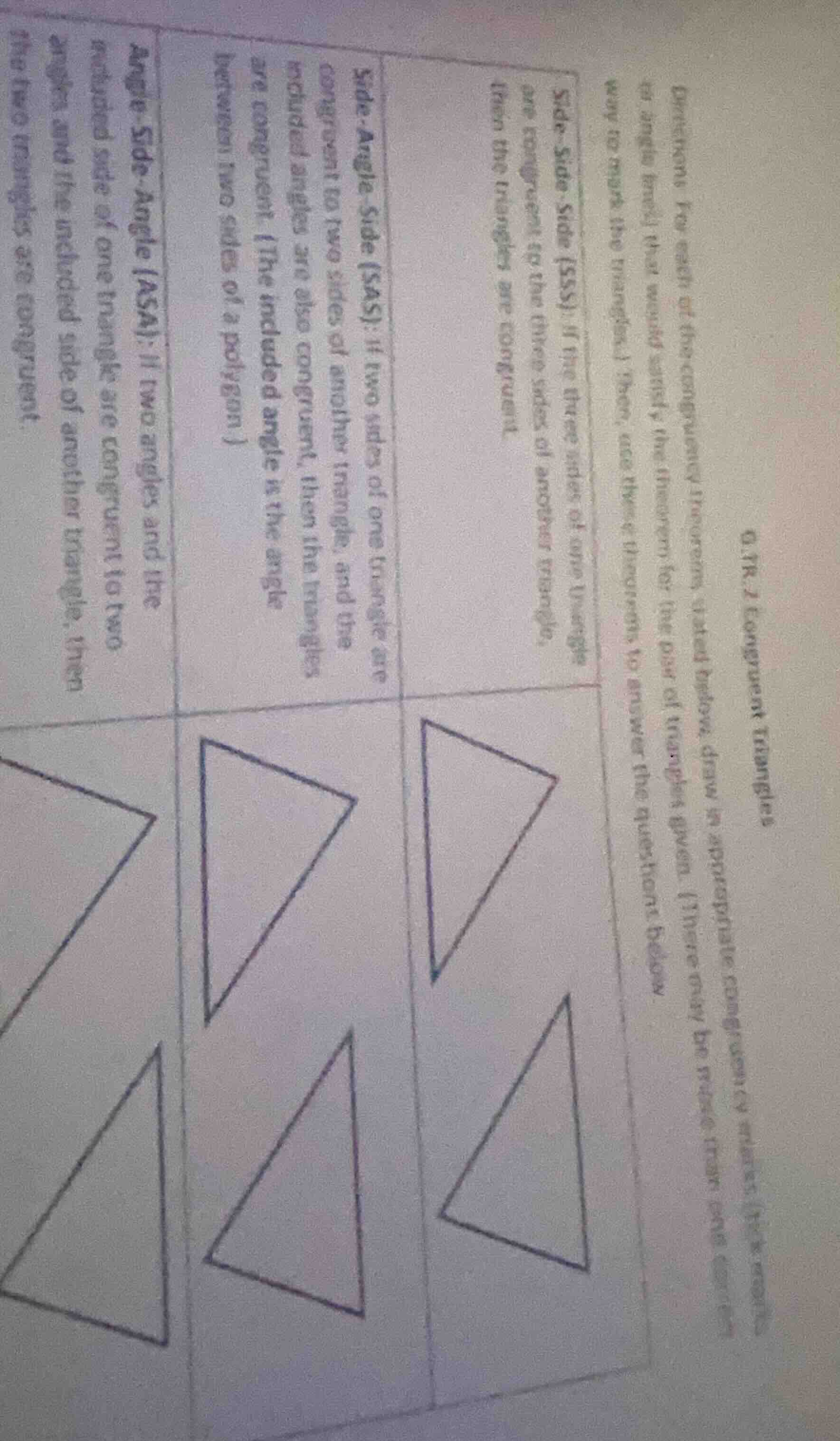
definitions for each of the congruency theorems stated below, draw an appropriate congruency (asa, sas, sss, aas, hl) mark the triangles. then, use these theorems to answer the questions below.
side - side - side (sss): if the three sides of one triangle are congruent to the three sides of another triangle, then the triangles are congruent.
side - angle - side (sas): if two sides of one triangle are congruent to two sides of another triangle, and the included angles are also congruent, then the triangles are congruent (the included angle is the angle between two sides of a polygon)
angle - side - angle (asa): if two angles and the included side of one triangle are congruent to two angles and the included side of another triangle, then the two triangles are congruent.
To solve problems related to triangle congruence (SSS, SAS, ASA), follow these steps:
Step 1: Identify the Congruence Criterion
- SSS (Side - Side - Side): Check if all three sides of one triangle are congruent to the three sides of another triangle.
- SAS (Side - Angle - Side): Verify if two sides and the included angle of one triangle are congruent to two sides and the included angle of another triangle.
- ASA (Angle - Side - Angle): Determine if two angles and the included side of one triangle are congruent to two angles and the included side of another triangle.
Step 2: Analyze the Given Triangles
For each pair of triangles:
- Examine the marked sides and angles.
- Match the marked parts to the corresponding congruence criterion (SSS, SAS, or ASA).
Step 3: Apply the Criterion
Once you've identified the correct criterion (SSS, SAS, or ASA) that the triangles satisfy, you can conclude that the triangles are congruent by that criterion.
For example, if two triangles have all three corresponding sides marked as equal, you would use the SSS criterion to say they are congruent. If two sides and the angle between them are marked as equal in two triangles, you would use the SAS criterion, and so on for ASA.
If you have specific triangles (with markings) to analyze, apply these steps:
- List the marked congruent parts (sides or angles).
- Match them to SSS, SAS, or ASA.
- State the congruence by the appropriate criterion.
If you provide the specific markings or details of the triangles, I can help you apply these steps to determine the congruence criterion.

Snap & solve any problem in the app
Get step-by-step solutions on Sovi AI
Photo-based solutions with guided steps
Explore more problems and detailed explanations
To solve problems related to triangle congruence (SSS, SAS, ASA), follow these steps:
Step 1: Identify the Congruence Criterion
- SSS (Side - Side - Side): Check if all three sides of one triangle are congruent to the three sides of another triangle.
- SAS (Side - Angle - Side): Verify if two sides and the included angle of one triangle are congruent to two sides and the included angle of another triangle.
- ASA (Angle - Side - Angle): Determine if two angles and the included side of one triangle are congruent to two angles and the included side of another triangle.
Step 2: Analyze the Given Triangles
For each pair of triangles:
- Examine the marked sides and angles.
- Match the marked parts to the corresponding congruence criterion (SSS, SAS, or ASA).
Step 3: Apply the Criterion
Once you've identified the correct criterion (SSS, SAS, or ASA) that the triangles satisfy, you can conclude that the triangles are congruent by that criterion.
For example, if two triangles have all three corresponding sides marked as equal, you would use the SSS criterion to say they are congruent. If two sides and the angle between them are marked as equal in two triangles, you would use the SAS criterion, and so on for ASA.
If you have specific triangles (with markings) to analyze, apply these steps:
- List the marked congruent parts (sides or angles).
- Match them to SSS, SAS, or ASA.
- State the congruence by the appropriate criterion.
If you provide the specific markings or details of the triangles, I can help you apply these steps to determine the congruence criterion.