QUESTION IMAGE
Question
tracie rides the bus home from school each day. the graph represents her distance from home relative to the number of minutes since the bus left the school.
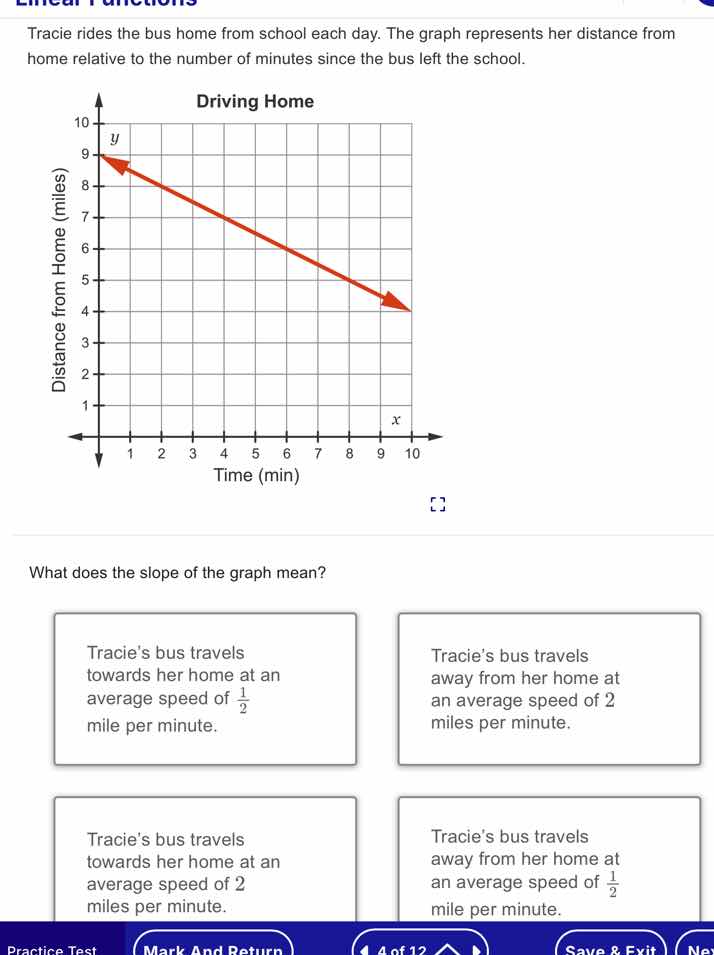
graph of driving home with x-axis as time (min) from 0 to 10, y-axis as distance from home (miles) from 0 to 10, red line from (0,9) to (10,4)
what does the slope of the graph mean?
- tracie’s bus travels towards her home at an average speed of 1/2 mile per minute.
- tracie’s bus travels away from her home at an average speed of 2 miles per minute.
- tracie’s bus travels towards her home at an average speed of 2 miles per minute.
- tracie’s bus travels away from her home at an average speed of 1/2 mile per minute.
Brief Explanations
- First, recall the formula for slope: \( \text{slope} = \frac{\text{change in } y}{\text{change in } x} \). Here, \( y \) is distance from home (miles) and \( x \) is time (minutes).
- The graph starts at \( (0, 9) \) (when time \( x = 0 \), distance from home \( y = 9 \) miles) and, for example, when \( x = 9 \), \( y = 4 \). So the change in \( y \) is \( 4 - 9 = -5 \), and change in \( x \) is \( 9 - 0 = 9 \)? Wait, no, let's pick two clear points. Wait, looking at the graph, at \( x = 0 \), \( y = 9 \); at \( x = 10 \)? Wait, no, the arrow is at \( x = 9 \), \( y = 4 \)? Wait, maybe better: from \( x = 0 \) (9 miles) to \( x = 10 \)? Wait, no, let's see the grid. Each square is 1 unit. Let's take two points: (0, 9) and (10, 4)? No, wait the red line goes from (0,9) to (10,4)? Wait, no, when x=0, y=9; when x=10, what's y? Wait the arrow is at x=9, y=4? Wait maybe I misread. Wait, the y-axis is distance from home, so as time increases (x increases), distance from home (y) decreases, so it's moving towards home. So slope is negative (since y decreases as x increases). Now, let's calculate slope. Let's take two points: (0, 9) and (10, 4)? No, wait, let's take (0,9) and (10,4)? Wait, 9 - 4 = 5, over 10 - 0 = 10? No, that's 5/10 = 1/2, but since it's decreasing, slope is -1/2. So the rate is 1/2 mile per minute towards home (since distance from home is decreasing, so moving towards home, speed is 1/2 mile per minute). Wait, no, wait: slope is \( \frac{\Delta y}{\Delta x} \). If at x=0, y=9; at x=10, y=4? No, wait the graph: when x=0, y=9; when x=10, what's y? Wait the red line: let's see, from (0,9) to (10,4)? No, maybe (0,9) and (10,4) is not right. Wait, maybe (0,9) and (10,4) is wrong. Wait, let's check the options. The first option says "towards her home at an average speed of 1/2 mile per minute". Let's verify. Speed is distance over time. The distance from home decreases, so the bus is moving towards home. The change in distance: from 9 miles to, say, 4 miles in 10 minutes? No, wait, maybe from x=0 (9 miles) to x=10 (4 miles): 9 - 4 = 5 miles, over 10 minutes: 5/10 = 1/2 mile per minute. So that's the speed towards home (since distance from home is decreasing, so moving towards home, speed is 1/2 mile per minute). So the first option is correct: "Tracie’s bus travels towards her home at an average speed of \( \frac{1}{2} \) mile per minute."

Snap & solve any problem in the app
Get step-by-step solutions on Sovi AI
Photo-based solutions with guided steps
Explore more problems and detailed explanations
A. Tracie’s bus travels towards her home at an average speed of \( \frac{1}{2} \) mile per minute.