QUESTION IMAGE
Question
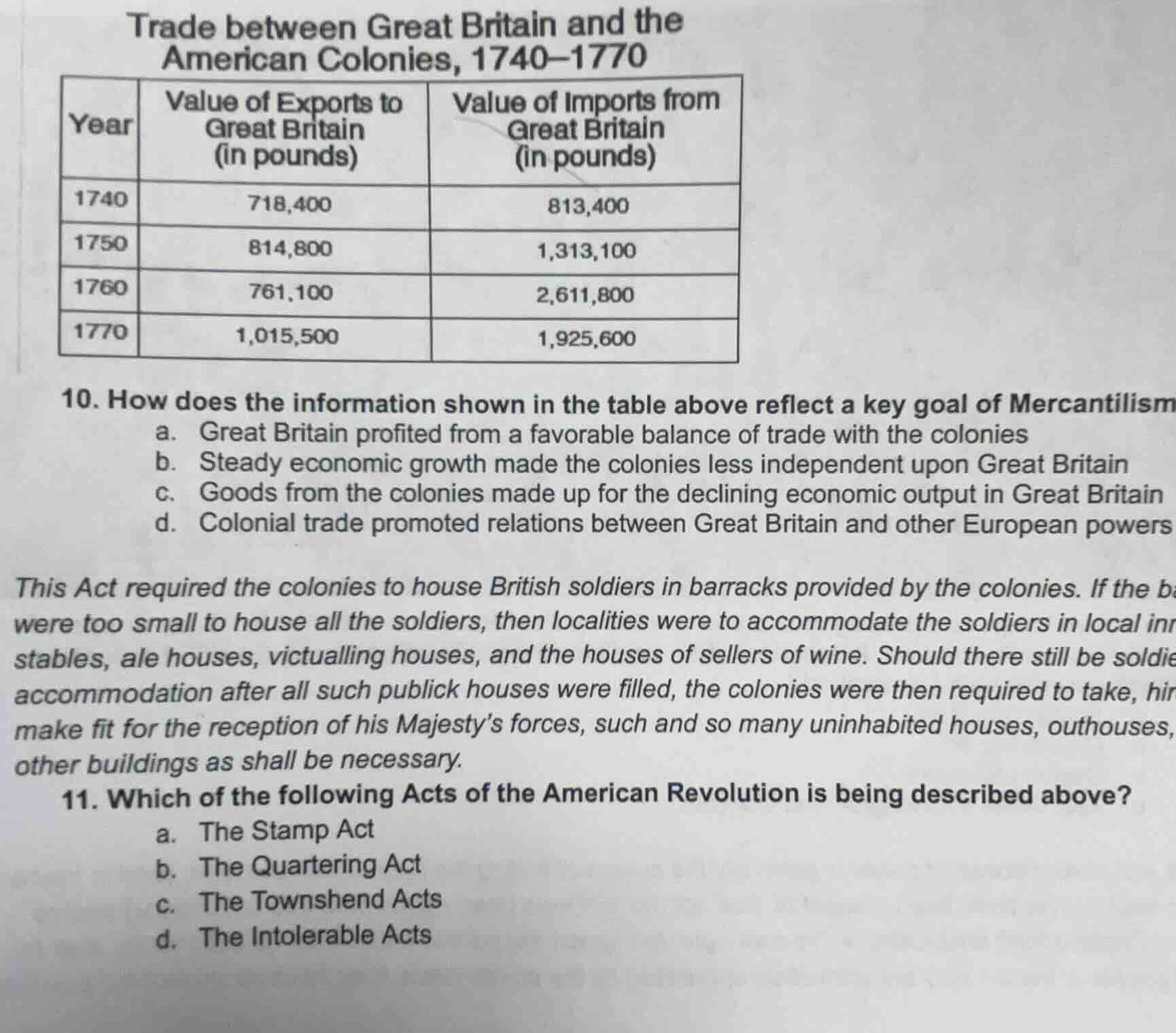
trade between great britain and the american colonies, 1740–1770
year\tvalue of exports to great britain (in pounds)\tvalue of imports from great britain (in pounds)
1740\t718,400\t813,400
1750\t814,800\t1,313,100
1760\t761,100\t2,611,800
1770\t1,015,500\t1,925,600
- how does the information shown in the table above reflect a key goal of mercantilism
a. great britain profited from a favorable balance of trade with the colonies
b. steady economic growth made the colonies less independent upon great britain
c. goods from the colonies made up for the declining economic output in great britain
d. colonial trade promoted relations between great britain and other european powers
this act required the colonies to house british soldiers in barracks provided by the colonies. if the b were too small to house all the soldiers, then localities were to accommodate the soldiers in local inn stables, ale houses, victualling houses, and the houses of sellers of wine. should there still be soldie accommodation after all such publick houses were filled, the colonies were then required to take, hir make fit for the reception of his majesty’s forces, such and so many uninhabited houses, outhouses, other buildings as shall be necessary.
- which of the following acts of the american revolution is being described above?
a. the stamp act
b. the quartering act
c. the townshend acts
d. the intolerable acts
For Question 10:
Mercantilism's core goal was for a nation to have a favorable balance of trade, where the value of imports into the nation from its colonies exceeds the value of its exports to them, accumulating wealth. Calculating the trade balance for each year:
- 1740: $813,400 - 718,400 = 95,000$ pounds (Britain imports more)
- 1750: $1,313,100 - 814,800 = 498,300$ pounds (Britain imports more)
- 1760: $2,611,800 - 761,100 = 1,850,700$ pounds (Britain imports more)
- 1770: $1,925,600 - 1,015,500 = 910,100$ pounds (Britain imports more)
This shows Britain had a favorable balance of trade with the colonies, matching mercantilist goals. Option b is incorrect because growing trade made colonies more dependent, not less. Option c is unsupported, as the table does not show British economic decline. Option d is irrelevant, as the table only covers Britain-colony trade, not trade with other European powers.
For Question 11:
The described act mandates colonies to house British soldiers in colonial-provided barracks, inns, stables, or uninhabited buildings if needed. This directly matches the provisions of the Quartering Act. The Stamp Act imposed taxes on paper goods, the Townshend Acts taxed imported goods like tea and glass, and the Intolerable Acts were punitive measures after the Boston Tea Party, none of which focus on housing soldiers.

Snap & solve any problem in the app
Get step-by-step solutions on Sovi AI
Photo-based solutions with guided steps
Explore more problems and detailed explanations
- a. Great Britain profited from a favorable balance of trade with the colonies
- b. The Quartering Act