QUESTION IMAGE
Question
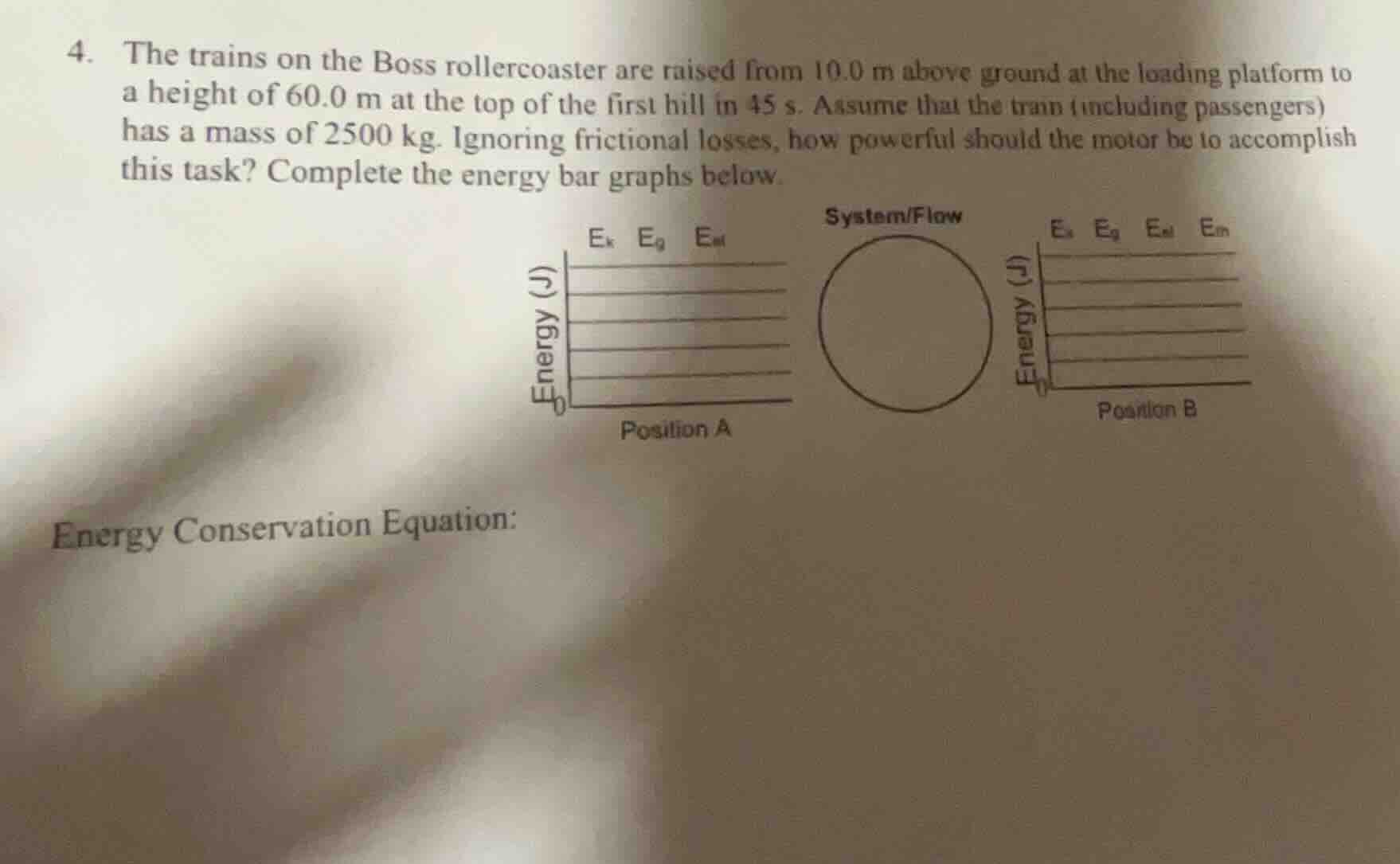
- the trains on the boss rollercoaster are raised from 10.0 m above ground at the loading platform to a height of 60.0 m at the top of the first hill in 45 s. assume that the train (including passengers) has a mass of 2500 kg. ignoring frictional losses, how powerful should the motor be to accomplish this task? complete the energy bar graphs below. energy conservation equation:
Step1: Calculate the change in gravitational potential energy
The formula for gravitational potential energy is \( E_g = mgh \). The change in height \( \Delta h = 60.0 - 10.0 = 50.0 \, \text{m} \). So the change in potential energy \( \Delta E_g = mg\Delta h \).
\( \Delta E_g = 2500 \, \text{kg} \times 9.8 \, \text{m/s}^2 \times 50.0 \, \text{m} = 1225000 \, \text{J} \)
Step2: Calculate power
Power is the rate of energy transfer, so \( P = \frac{\Delta E}{t} \). Here, the energy transferred is the change in potential energy (ignoring friction), and time \( t = 45 \, \text{s} \).
\( P = \frac{1225000 \, \text{J}}{45 \, \text{s}} \approx 27222.22 \, \text{W} \) or \( 27.2 \, \text{kW} \) (rounded appropriately)

Snap & solve any problem in the app
Get step-by-step solutions on Sovi AI
Photo-based solutions with guided steps
Explore more problems and detailed explanations
The motor should have a power of approximately \( 27200 \, \text{W} \) (or \( 27.2 \, \text{kW} \)). For the energy bar graphs: At Position A (loading platform), \( E_g \) is lower (since height is 10m), \( E_k \) can be assumed zero (if starting from rest), and \( E_{net} \) relates to the initial energy. At Position B (top of hill), \( E_g \) is higher (height 60m), \( E_k \) can still be zero (if moving slowly, assuming final velocity is zero for energy change focus), and the energy input from the motor has converted to the increased \( E_g \). The energy conservation equation would be \( E_{in} = \Delta E_g \) (since \( E_{k} \) change is zero and no friction, so input energy from motor equals change in potential energy).