QUESTION IMAGE
Question
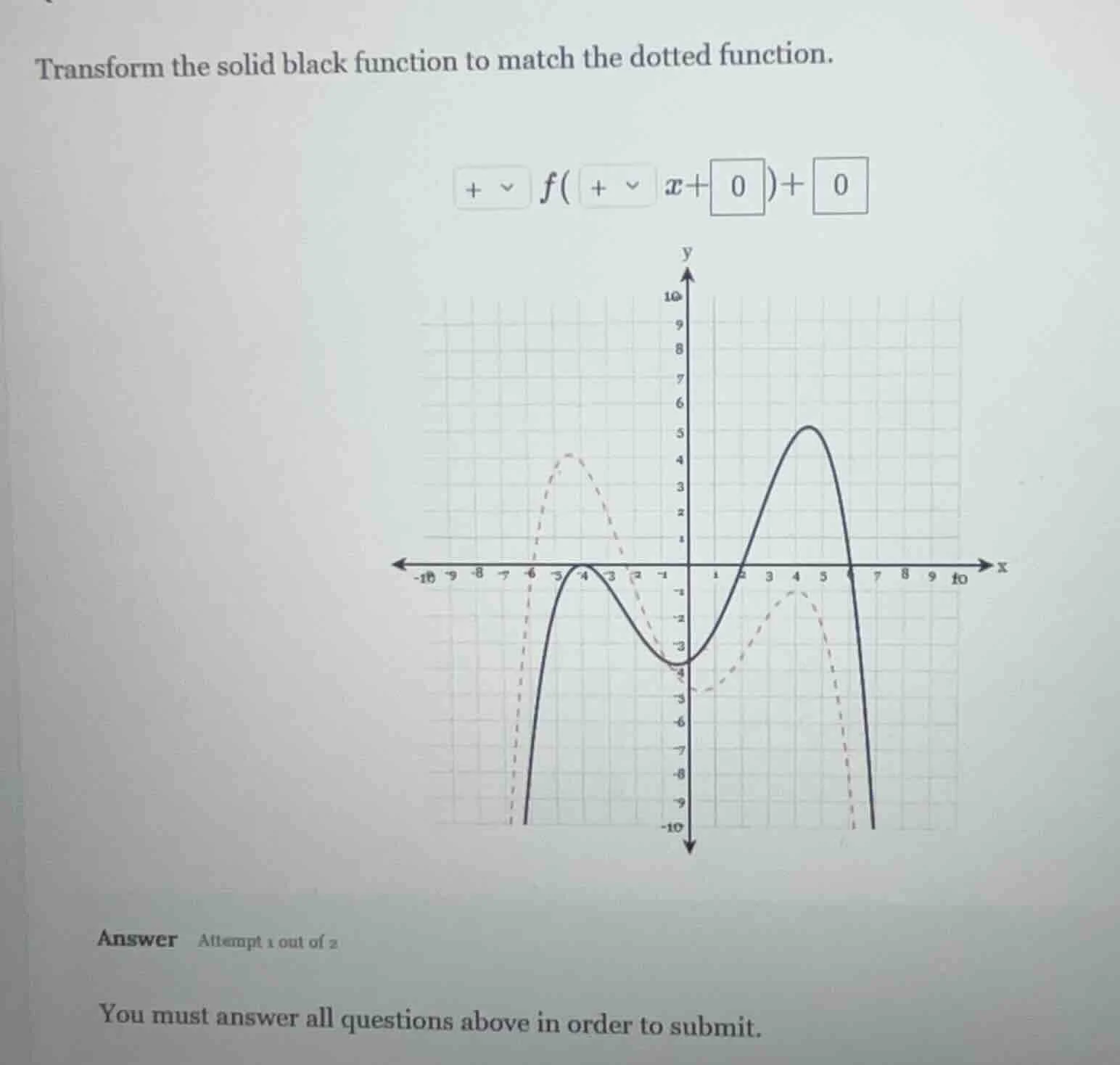
transform the solid black function to match the dotted function.
+ f( + x+ 0 )+ 0
answer attempt 1 out of 2
you must answer all questions above in order to submit.
Step1: Analyze Horizontal Shift
The solid function (black) and the dotted function: Let's check the horizontal shift. The dotted function's peak is at \( x = -5 \) (approx) and the solid's peak (after transformation) needs to shift? Wait, actually, let's look at the vertex or key points. Wait, the general form is \( a f(b(x - h)) + k \), but here the form is \( \pm f(\pm x + c) + d \), which can be rewritten as \( \pm f(\pm (x + \frac{c}{\pm})) + d \). Let's see the horizontal shift: the dotted function is to the left or right? Wait, the solid black function: let's take the vertex of the left part. Wait, maybe first check reflection. Wait, the dotted function is a reflection? Wait, no, let's check the direction. Wait, the solid function (black) has a root at \( x = 2 \), \( x = 6 \), and the dotted function has roots at \( x = -6 \), \( x = -3 \)? Wait, maybe horizontal shift and reflection. Wait, the form given is \( + \ f( + \ x + 0 ) + 0 \), but we need to adjust. Wait, maybe the horizontal shift: let's see the dotted function is shifted left by 8? Wait, no, let's take a key point. The solid function's minimum (the bottom of the right curve) is at \( (0, -4) \)? Wait, no, looking at the graph, the solid black function: when \( x = 0 \), \( y = -4 \). The dotted function: let's see the peak of the left dotted curve is at \( x = -5 \), \( y = 4 \), and the right dotted curve is at \( x = 5 \), \( y = -1 \)? Wait, maybe reflection over y-axis? Wait, if we reflect over y-axis, the transformation is \( f(-x) \). Wait, let's check: if we have \( f(-x) \), that reflects over y-axis. Let's see the solid function: for example, the root at \( x = 2 \), reflecting over y-axis would give \( x = -2 \), but the dotted function's root is at \( x = -6 \)? Wait, maybe horizontal shift. Wait, the first box is the sign outside \( f \), the second box is the sign inside \( f \) for \( x \), the third is the constant inside, the fourth is the constant outside. Let's re-express the form: \( \text{sign1} \ f( \text{sign2} \ x + c ) + d \), which is \( \text{sign1} \ f( \text{sign2}(x + \frac{c}{\text{sign2}}) ) + d \). Let's assume sign1 is \( + \) (no vertical reflection), sign2 is \( - \) (horizontal reflection over y-axis), then \( f(-x + c) \). Wait, let's take a point: the solid function has a root at \( x = 6 \), the dotted function has a root at \( x = -6 \). So reflecting over y-axis ( \( x \to -x \) ) would map \( x = 6 \) to \( x = -6 \), which matches. So the inside the function: \( -x \), so \( \text{sign2} = - \), so the middle box (the sign for \( x \)) is \( - \). Then, what about horizontal shift? Wait, maybe no shift, just reflection. Wait, but also, the vertical shift? Wait, the dotted function's peak is at \( y = 4 \), solid's minimum is at \( y = -4 \), so vertical reflection? Wait, sign1: if we have \( -f(-x) \), but the first box is \( + \) or \( - \). Wait, maybe the first sign is \( - \) (vertical reflection) and the second sign is \( - \) (horizontal reflection). Wait, let's start over.
Wait, the general function transformation: \( y = a f(b(x - h)) + k \), where \( a \) is vertical stretch/reflection, \( b \) is horizontal stretch/reflection, \( h \) is horizontal shift, \( k \) is vertical shift. The given form is \( \text{sign1} \ f( \text{sign2} \ x + c ) + d \), which can be written as \( \text{sign1} \ f( \text{sign2}(x + \frac{c}{\text{sign2}}) ) + d \), so \( b = \text{sign2} \), \( h = - \frac{c}{\text{sign2}} \), \( a = \text{sign1} \), \( k = d \).
Looking at the graph: the solid black function and the dotted fun…

Snap & solve any problem in the app
Get step-by-step solutions on Sovi AI
Photo-based solutions with guided steps
Explore more problems and detailed explanations
- \( f(-x + 0) + 0 \) (so the first box is \( - \), second box is \( - \), third box is \( 0 \), fourth box is \( 0 \))
Wait, but the form is \( \text{sign1} \ f( \text{sign2} \ x + c ) + d \), so:
sign1: \( - \)
sign2: \( - \)
c: \( 0 \)
d: \( 0 \)
So the answer is:
First dropdown: \( - \)
Second dropdown: \( - \)
Third box: \( 0 \)
Fourth box: \( 0 \)
But since the user might need the values, the answer is:
\( - f( - x + 0 ) + 0 \)
So the first sign is \( - \), second sign is \( - \), third constant is \( 0 \), fourth constant is \( 0 \).