QUESTION IMAGE
Question
transformations
identifying transformations that map a regular polygon onto itself
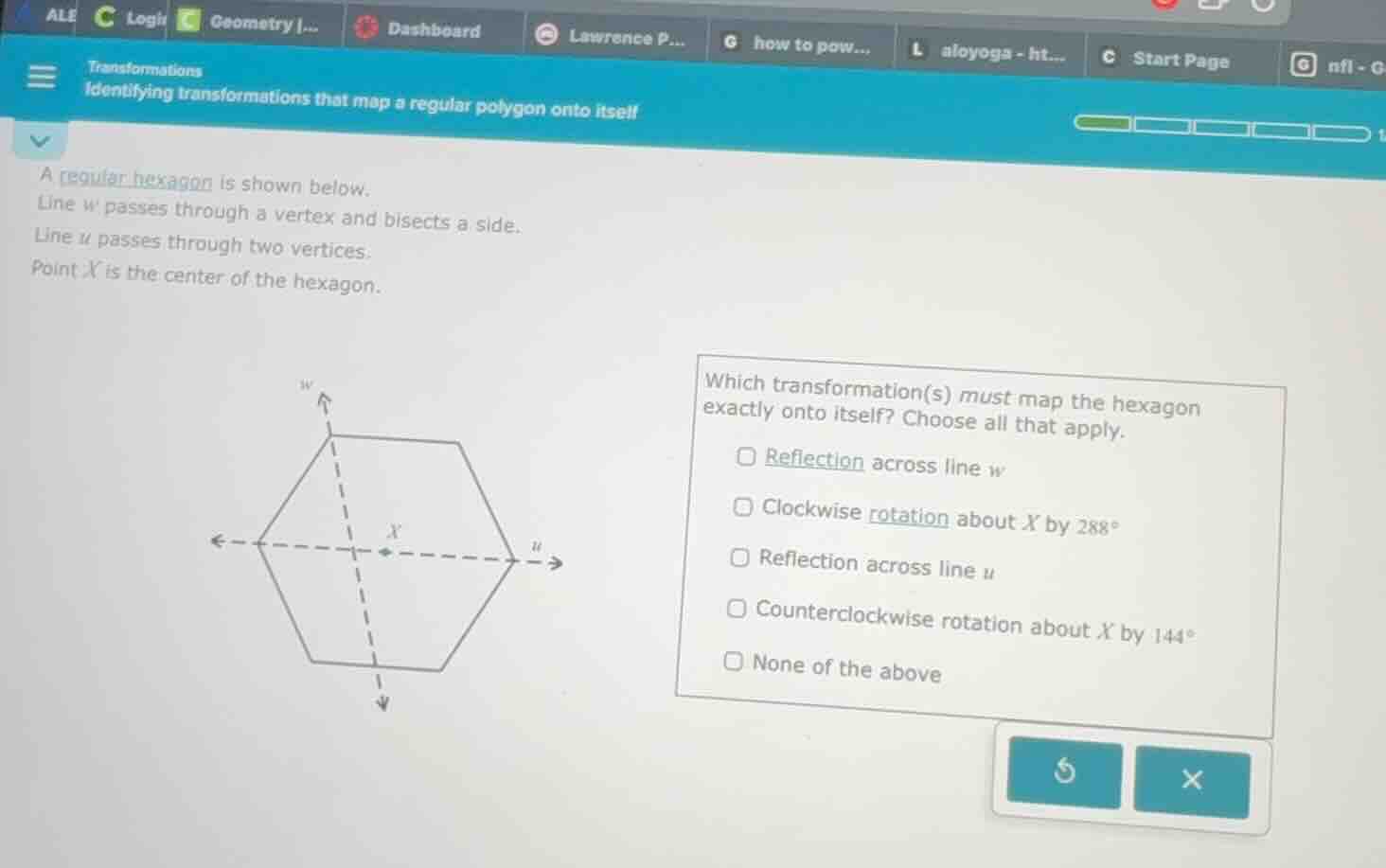
a regular hexagon is shown below.
line w passes through a vertex and bisects a side.
line u passes through two vertices.
point x is the center of the hexagon.
which transformation(s) must map the hexagon exactly onto itself? choose all that apply.
- reflection across line w
- clockwise rotation about x by 288°
- reflection across line u
- counterclockwise rotation about x by 144°
- none of the above
Step1: Analyze Reflection across line w
A regular hexagon has reflection symmetry. Line w passes through a vertex and bisects a side. For a regular hexagon, a line through a vertex and the midpoint of the opposite side is a line of reflection. So reflection across line w will map the hexagon onto itself.
Step2: Analyze Clockwise rotation about X by 288°
The central angle between adjacent vertices in a regular hexagon is $\frac{360^{\circ}}{6} = 60^{\circ}$. A clockwise rotation of $288^{\circ}$ is equivalent to a counterclockwise rotation of $360^{\circ}- 288^{\circ}=72^{\circ}$, but also, since $288^{\circ}= 4\times60^{\circ}+ 48^{\circ}$? Wait, no, $288\div60 = 4.8$, but actually, the order of rotation symmetry is 6, so rotations by multiples of $60^{\circ}$ map it onto itself. Wait, $288^{\circ}= 60^{\circ}\times4 + 48^{\circ}$? No, $60\times4 = 240$, $60\times5=300$. Wait, no, $360 - 72=288$, and $72$ is not a multiple of $60$. Wait, no, I made a mistake. The central angle is $60^{\circ}$, so rotations by $60k^{\circ}$, where $k = 0,1,2,3,4,5$ map it onto itself. $288\div60 = 4.8$, which is not an integer. Wait, no, $288 = 360 - 72$, but $72$ is not a multiple of $60$. Wait, no, maybe I miscalculated. Wait, $60\times4 = 240$, $60\times5 = 300$. So $288$ is not a multiple of $60$. Wait, but that can't be. Wait, no, the order of the hexagon is 6, so the rotation angle should be $\frac{360}{6}=60^{\circ}$ per step. So rotations by $60^{\circ}, 120^{\circ}, 180^{\circ}, 240^{\circ}, 300^{\circ}$ (and $360^{\circ}$ which is the same as $0^{\circ}$) map it onto itself. $288^{\circ}$ is not one of these. Wait, but maybe I messed up. Wait, let's check the rotation: a clockwise rotation of $288^{\circ}$ is the same as a counterclockwise rotation of $72^{\circ}$, but $72$ is not a multiple of $60$. So that's not a symmetry? Wait, no, wait the regular hexagon has rotational symmetry of order 6, so only rotations by multiples of $60^{\circ}$ (i.e., $60k^{\circ}$, $k = 0,1,2,3,4,5$) map it onto itself. So $288^{\circ}$ is not a multiple of $60^{\circ}$? Wait, $60\times4 = 240$, $60\times5 = 300$, so $288$ is between them. So that's not a symmetry. Wait, but maybe I made a mistake here. Wait, no, let's recalculate: $360\div6 = 60$, so each rotation by $60^{\circ}$ (and multiples) works. So $288^{\circ}$: $288\div60 = 4.8$, not an integer. So that's not a symmetry. Wait, but the answer options: maybe I was wrong. Wait, let's check the other options.
Step3: Analyze Reflection across line u
Line u passes through two vertices. In a regular hexagon, a line passing through two opposite vertices is a line of reflection symmetry. So reflection across line u (which is a diameter through two vertices) will map the hexagon onto itself.
Step4: Analyze Counterclockwise rotation about X by 144°
The central angle is $60^{\circ}$, so $144^{\circ}\div60^{\circ}=2.4$, which is not an integer. So a counterclockwise rotation of $144^{\circ}$ is not a multiple of $60^{\circ}$, so it won't map the hexagon onto itself.
So let's re-express:
- Reflection across line w: Line w passes through a vertex and bisects a side. In a regular hexagon, a line through a vertex and the midpoint of the opposite side is a line of reflection symmetry. So this should work. Wait, earlier I thought line u is through two vertices, but line w is through a vertex and midpoint of a side. Let's confirm the reflection symmetries of a regular hexagon. A regular hexagon has 6 lines of reflection: 3 through opposite vertices (like line u) and 3 through the midpoints of opposite s…

Snap & solve any problem in the app
Get step-by-step solutions on Sovi AI
Photo-based solutions with guided steps
Explore more problems and detailed explanations
Reflection across line w, Reflection across line u (the checkboxes for these two options should be selected)