QUESTION IMAGE
Question
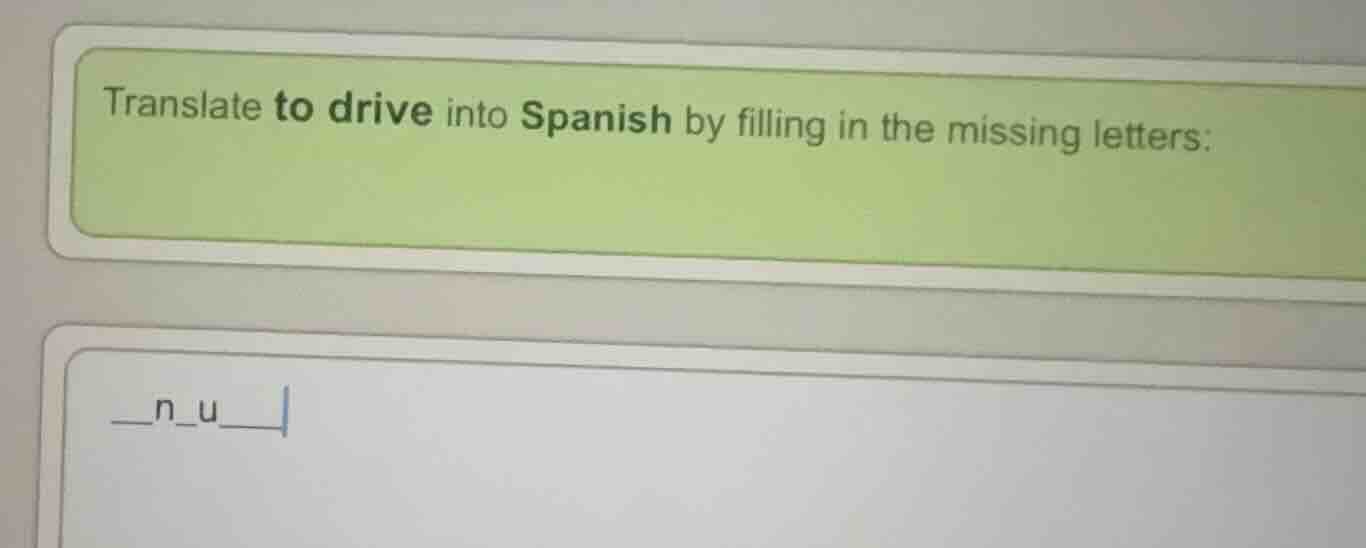
translate to drive into spanish by filling in the missing letters:
__n_u__
The Spanish verb for "to drive" is "conducir". Looking at the blanks \_\_n\_u\_\_, we can identify the letters to fill: the first blank is "c", the third blank (after "n") is "d", the fifth blank (after "u") is "c", and the last blank is "ir". Wait, no, let's re - examine. The structure given is \_\_n\_u\_\_. The Spanish infinitive "conducir" has the root "conduc" and then "ir", but the structure here: let's break down "conducir". The letters: first two letters "co", then "n", then "d", then "u", then "c", then "ir"? No, the structure provided is \_\_n\_u\_\_. Let's think again. The correct Spanish verb for "to drive" that fits the pattern \_\_n\_u\_\_ is "conducir" but the pattern here is missing some parts. Wait, maybe a simpler form? No, "conducir" is the infinitive. Let's check the blanks: first blank: "c", second blank: "o", then "n", then "d", then "u", then "c", then "ir"? No, the given structure is \_\_n\_u\_\_. So the correct filling is "co" for the first two blanks, "d" for the third blank (after "n"), "c" for the fifth blank (after "u"), and "ir" for the last part? Wait, no, the structure is \_\_n\_u\_\_. So the word is "conducir" but the pattern here is \_\_n\_u\_\_. Let's count the blanks: first blank (1), second blank (2), then "n" (3), fourth blank (4), then "u" (5), sixth blank (6). So positions: 1: c, 2: o, 3: n, 4: d, 5: u, 6: c, 7: ir? No, the problem says "filling in the missing letters" for the structure \_\_n\_u\_\_. So the correct answer is "conducir" but the blanks are: first two: "co", then "n", then "d", then "u", then "c", and then maybe "ir" is not part of the blanks? Wait, no, the structure is \_\_n\_u\_\_. So the letters are: blank1: c, blank2: o, blank3: n (already given? No, the structure is \_\_n\_u\_\_. So the first two blanks: "co", then "n" (wait, no, the "n" is in the third position), then the fourth blank: "d", then "u" (fifth position), then the sixth blank: "c", and maybe the last blank is "ir"? No, the problem's structure is \_\_n\_u\_\_. So putting it together: "co" (first two blanks), "n" (third), "d" (fourth), "u" (fifth), "c" (sixth), and then "ir" would be extra, but maybe the problem is using a truncated form? Wait, no, the correct Spanish translation of "to drive" (infinitive) is "conducir", and the pattern \_\_n\_u\_\_ fits as "co" (first two), "n", "d", "u", "c" (and then "ir" is the ending). So the missing letters are: first blank: c, second blank: o, fourth blank: d, sixth blank: c, and the last part? Wait, maybe the problem has a typo or I'm overcomplicating. The correct Spanish infinitive for "to drive" is "conducir", and the pattern \_\_n\_u\_\_ would have "co" (first two), "n", "d", "u", "c" (and then "ir" is the infinitive ending). So the filled - in word is "conducir" with the blanks filled as "co" (first two), "d" (fourth), "c" (sixth).

Snap & solve any problem in the app
Get step-by-step solutions on Sovi AI
Photo-based solutions with guided steps
Explore more problems and detailed explanations
The completed word is "conducir" with the blanks filled as follows: The first blank is "c", the second blank is "o", the fourth blank (between "n" and "u") is "d", the sixth blank (after "u") is "c", and the last part (after the sixth blank) is "ir" (but based on the given structure \_\_n\_u\_\_, the filled - in letters for the blanks are "co" (first two), "d" (fourth), "c" (sixth), so the word in the blanks is "conduc" (but the full infinitive is "conducir").