QUESTION IMAGE
Question
translation: (x, y) → (x + 10, y + 3) and scale factor (reduction ratio): 1/2; translation: (x, y) → (x + 10, y + 3) and scale factor (enlargement ratio): 2; translation: (x, y) → (x - 10, y + 3) and scale factor (enlargement ratio): 2; translation: (x, y) → (x - 10, y - 3) and scale factor (reduction ratio): 1/2
Step1: Find the center coordinates
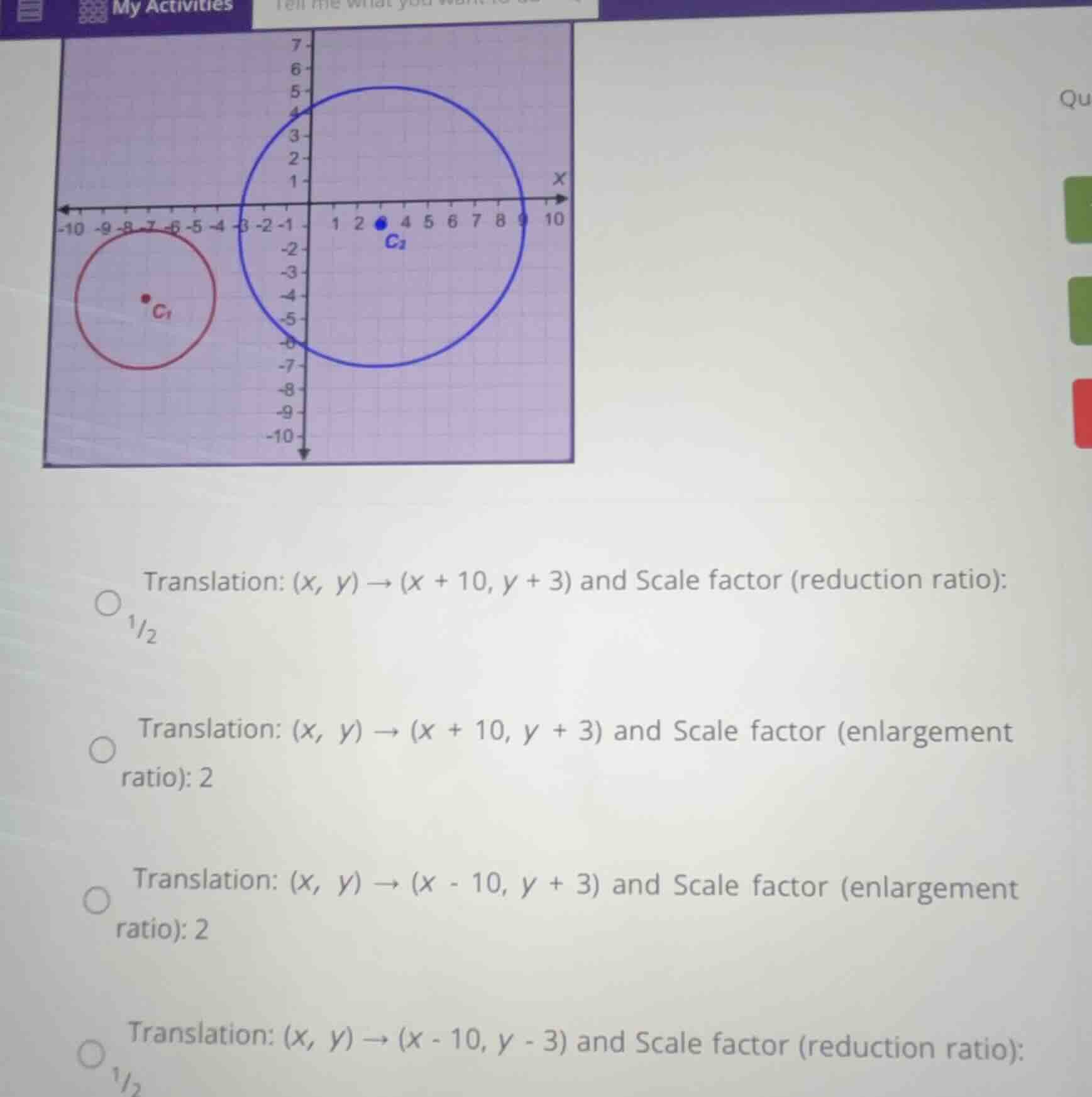
First, identify the center of \( C_1 \) and \( C_2 \). From the graph, \( C_1 \) is at \((-8, -3)\) and \( C_2 \) is at \((2, 0)\)? Wait, no, looking at the blue center \( C_2 \) is at \((3, -1)\)? Wait, maybe better to calculate the translation. Let's find the center of \( C_1 \): from the red circle, center \( C_1 \) is at \((-8, -3)\) (since it's in the left, around x=-8, y=-3). Center \( C_2 \) is at \((3, 0)\)? Wait, no, the blue center \( C_2 \) is at (3, -1)? Wait, the blue dot is at (3, -1)? Wait, the grid: x-axis, y-axis. Let's check the translation: to go from \( C_1 \) to \( C_2 \), the x-coordinate changes from -8 to 3? Wait, no, maybe I misread. Wait, the red circle is on the left, center \( C_1 \) at \((-8, -3)\), and the blue circle's center \( C_2 \) is at \((3, 0)\)? Wait, no, the blue dot is at (3, -1)? Wait, the problem's options: translation is (x, y) → (x + 10, y + 3). Let's test: if \( C_1 \) is at \((-8, -3)\), then applying (x + 10, y + 3) gives (-8 + 10, -3 + 3) = (2, 0). Wait, but the blue center is at (3, -1)? Maybe my initial center is wrong. Alternatively, maybe \( C_1 \) is at \((-8, -3)\) and \( C_2 \) is at (2, 0) (since -8 + 10 = 2, -3 + 3 = 0). Now, check the scale factor. The red circle ( \( C_1 \)) is smaller, blue ( \( C_2 \)) is larger. So if the scale factor is enlargement, then the scale factor should be greater than 1. Let's see the radius: suppose \( C_1 \) has radius r, \( C_2 \) has radius 2r (scale factor 2). So the translation is (x + 10, y + 3) (since -8 + 10 = 2, -3 + 3 = 0) and scale factor 2 (enlargement, since blue circle is bigger than red). So the correct option is the one with translation (x + 10, y + 3) and scale factor 2 (enlargement). Wait, the options: the second option is "Translation: \( (x, y) \to (x + 10, y + 3) \) and Scale factor (enlargement ratio): 2". Let's verify translation: from \( C_1 \) (let's say center at (-8, -3)) to \( C_2 \) (center at (2, 0)): -8 + 10 = 2, -3 + 3 = 0. Yes, that's a translation of (x + 10, y + 3). Now, scale factor: if the red circle is smaller, blue is larger, so scale factor 2 (enlargement) makes sense. So the correct option is the second one.
Step2: Check scale factor
The red circle ( \( C_1 \)) is smaller, blue ( \( C_2 \)) is larger. So if the scale factor is 2, that means the blue circle is twice as big as the red, so enlargement. So the translation is (x + 10, y + 3) (moving 10 units right, 3 units up) and scale factor 2 (enlargement).

Snap & solve any problem in the app
Get step-by-step solutions on Sovi AI
Photo-based solutions with guided steps
Explore more problems and detailed explanations
The correct option is: "Translation: \( (x, y) \to (x + 10, y + 3) \) and Scale factor (enlargement ratio): 2" (the second option in the list).