QUESTION IMAGE
Question
translations
teacher voice - translations along a vector \\(\langle a, b \
angle\\) can be expressed using a rule \\((x, y) \to (x + a, y + b)\\).
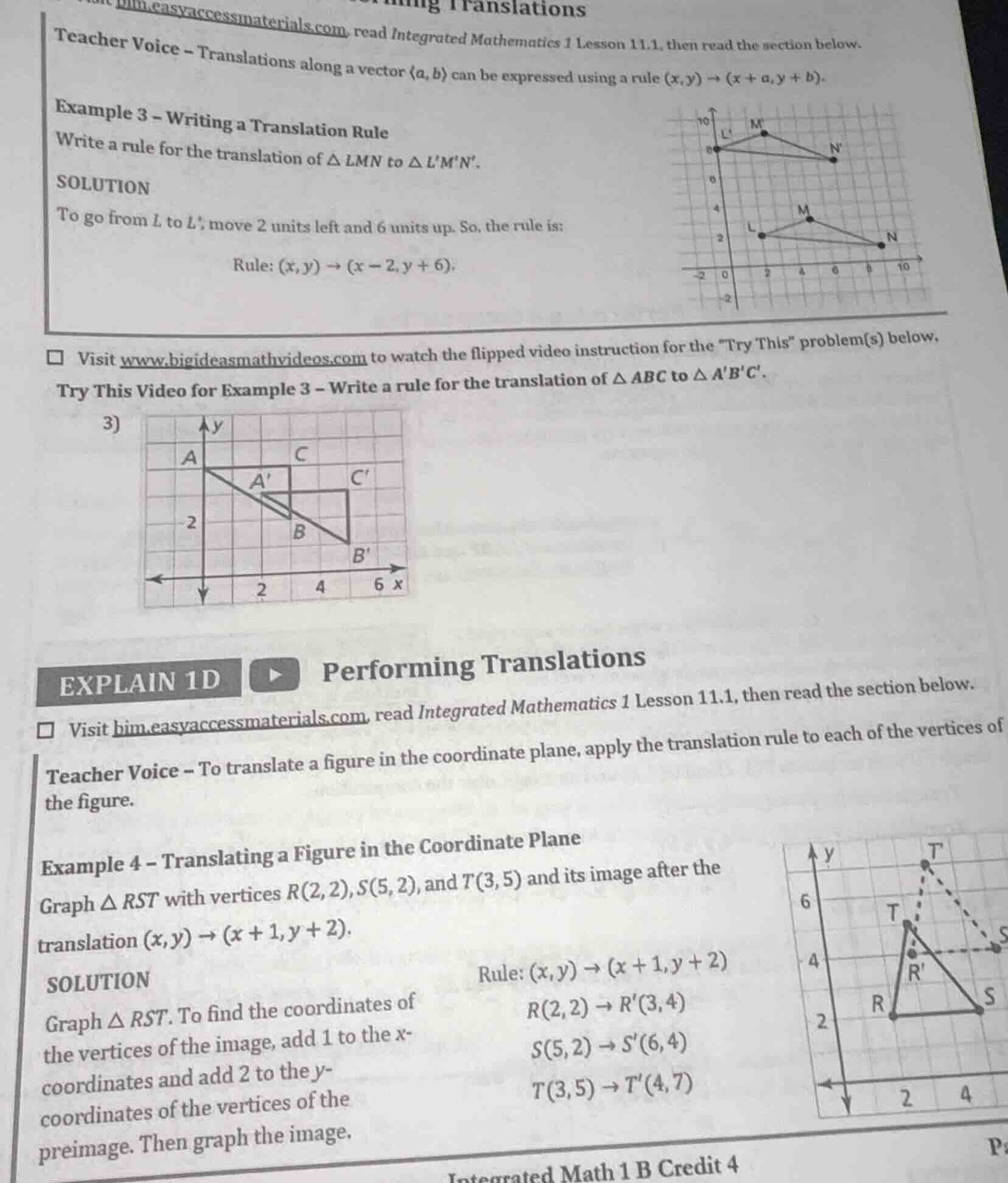
example 3 - writing a translation rule
write a rule for the translation of \\(\triangle lmn\\) to \\(\triangle lmn\\).
solution
to go from \\(l\\) to \\(l\\): move 2 units left and 6 units up. so, the rule is:
\\(\text{rule: } (x, y) \to (x - 2, y + 6)\\).
\\(\square\\) visit www.bigideasmathvideos.com to watch the flipped video instruction for the \try this\ problem(s) below.
try this video for example 3 - write a rule for the translation of \\(\triangle abc\\) to \\(\triangle abc\\).
3)
\\(\
\\) with points \\(a\\), \\(c\\), \\(a\\), \\(c\\), \\(b\\), \\(b\\)
explain 1d \\(\triangleright\\) performing translations
\\(\square\\) visit bim.easyaccessmaterials.com, read integrated mathematics 1 lesson 11.1, then read the section below.
teacher voice - to translate a figure in the coordinate plane, apply the translation rule to each of the vertices of
the figure.
example 4 - translating a figure in the coordinate plane
graph \\(\triangle rst\\) with vertices \\(r(2, 2)\\), \\(s(5, 2)\\), and \\(t(3, 5)\\) and its image after the
translation \\((x, y) \to (x + 1, y + 2)\\).
solution
graph \\(\triangle rst\\). to find the coordinates of
the vertices of the image, add 1 to the \\(x\\)-
coordinates and add 2 to the \\(y\\)-
coordinates of the vertices of the
preimage. then graph the image.
\\(\text{rule: } (x, y) \to (x + 1, y + 2)\\)
\\(r(2, 2) \to r(3, 4)\\)
\\(s(5, 2) \to s(6, 4)\\)
\\(t(3, 5) \to t(4, 7)\\)
integrated math 1 b credit 4
Step1: Identify coordinates of A
Original point $A=(0,4)$; Image $A'=(2,3)$
Step2: Calculate x-change
$\Delta x = 2 - 0 = 2$
Step3: Calculate y-change
$\Delta y = 3 - 4 = -1$
Step4: Form translation rule
$(x,y) \to (x+\Delta x, y+\Delta y)$

Snap & solve any problem in the app
Get step-by-step solutions on Sovi AI
Photo-based solutions with guided steps
Explore more problems and detailed explanations
Rule: $(x,y) \to (x+2, y-1)$