QUESTION IMAGE
Question
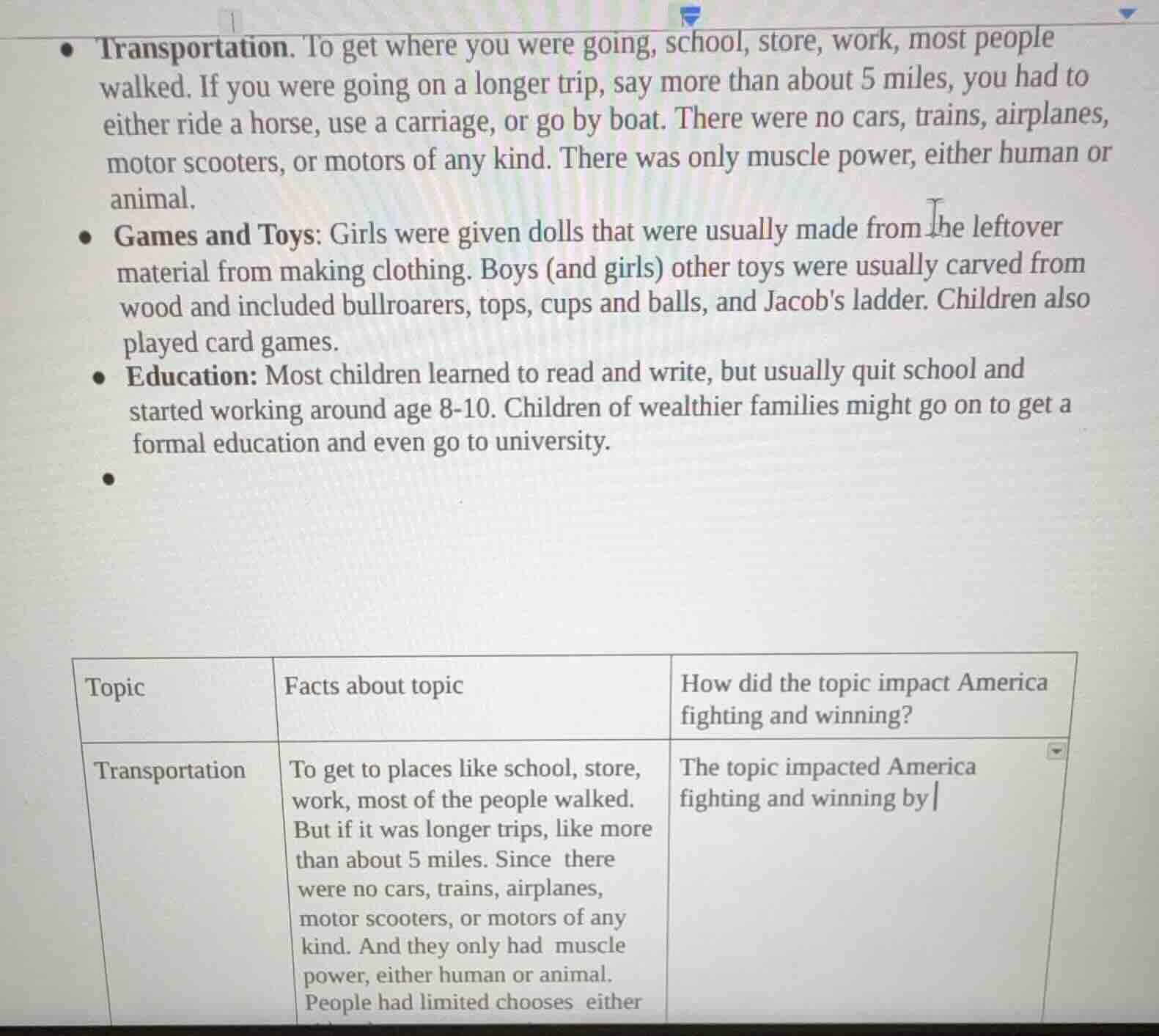
- transportation. to get where you were going, school, store, work, most people walked. if you were going on a longer trip, say more than about 5 miles, you had to either ride a horse, use a carriage, or go by boat. there were no cars, trains, airplanes, motor scooters, or motors of any kind. there was only muscle power, either human or animal.
- games and toys: girls were given dolls that were usually made from the leftover material from making clothing. boys (and girls) other toys were usually carved from wood and included bullroarers, tops, cups and balls, and jacobs ladder. children also played card games.
- education: most children learned to read and write, but usually quit school and started working around age 8 - 10. children of wealthier families might go on to get a formal education and even go to university.
| topic | facts about topic | how did the topic impact america fighting and winning? |
|---|
The text describes pre-motorized transportation relying on human/animal muscle. For wartime movement of troops, supplies, and communication, this limited speed and range, making it harder to quickly deploy forces, resupply frontlines, or coordinate across large distances compared to modern motorized transport. This slow, muscle-powered transport would have slowed military operations, but also meant armies had to plan around local resources (like horses, boats) and shorter travel distances, shaping strategies to work within these constraints.

Snap & solve any problem in the app
Get step-by-step solutions on Sovi AI
Photo-based solutions with guided steps
Explore more problems and detailed explanations
Limiting military mobility and supply speed: armies could only move troops, weapons, and supplies slowly via walking, horses, or boats, which slowed deployment, resupply, and coordination during battles, forcing military strategies to adapt to these slow, muscle-powered constraints.