QUESTION IMAGE
Question
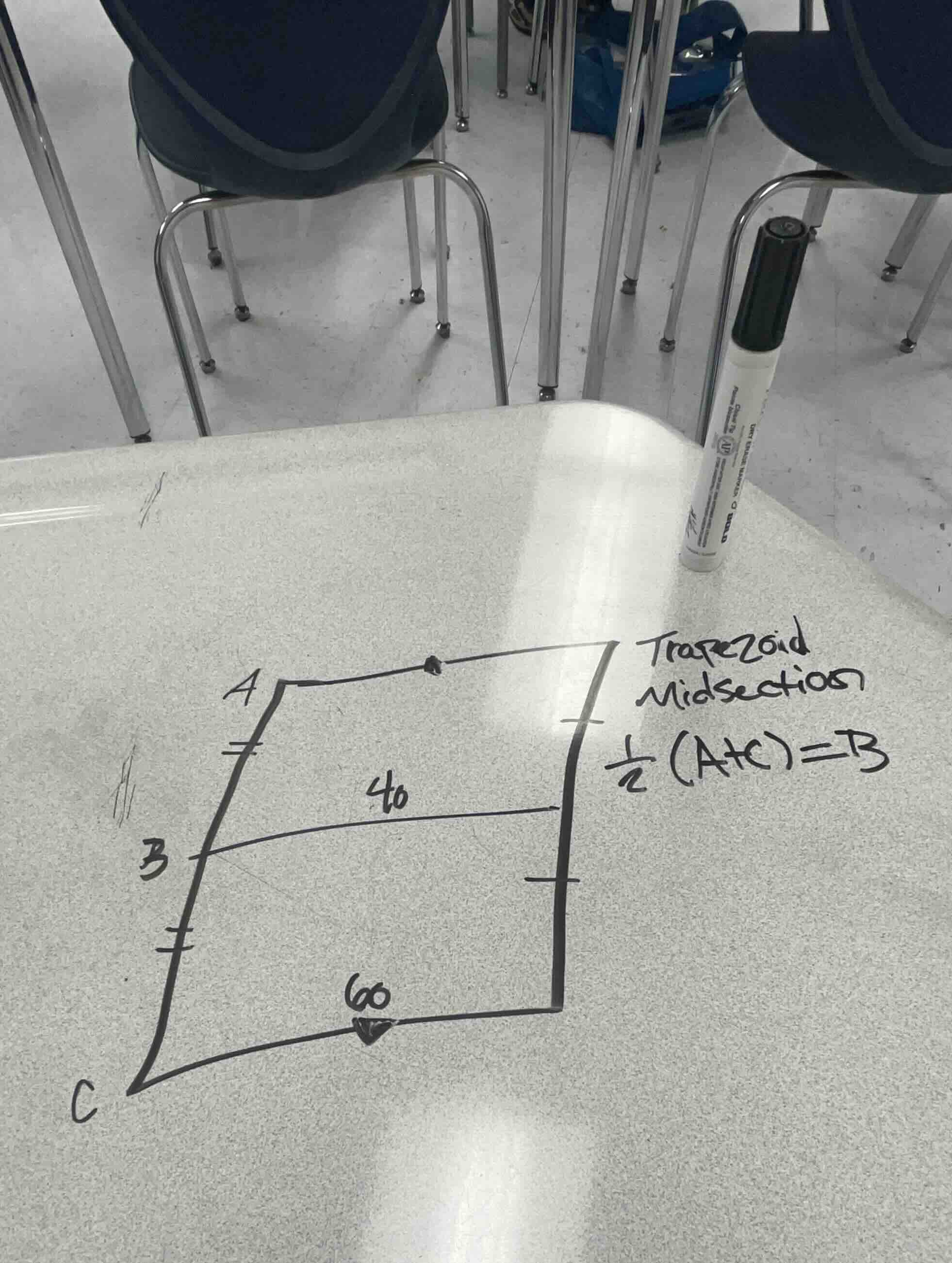
trapezoid midsection
\frac{1}{2}(a + c) = b
(there is a trapezoid diagram with vertices a, b, c, and the lengths 40 and 60 marked on the sides, and some equal - segment marks on the legs)
Step1: Recall the trapezoid midsection formula
The formula for the midsection (median) \( B \) of a trapezoid is \( B=\frac{1}{2}(A + C) \), where \( A \) and \( C \) are the lengths of the two parallel sides. From the diagram, we can see that one of the parallel sides (let's say \( A \)) has a midsection - related length? Wait, actually, looking at the diagram, the two parallel sides seem to be the top and bottom. Wait, the midsection length is given by the formula \( \frac{1}{2}(A + C)=B \), and we have the midsection (the middle segment) as 40? Wait, no, maybe I misread. Wait, the diagram has a trapezoid with the midsection (the middle line) labeled with the formula \( \frac{1}{2}(A + C)=B \), and the bottom base \( C = 60 \), and the midsection \( B = 40 \)? Wait, no, let's re - express. Let's assume that \( B \) is the midsection, \( A \) is the top base, and \( C \) is the bottom base. The formula is \( B=\frac{1}{2}(A + C) \). We know \( B = 40 \) and \( C = 60 \), and we need to find \( A \)? Wait, no, maybe the problem is to find one of the bases. Wait, let's use the formula \( B=\frac{1}{2}(A + C) \). Let's plug in the known values. Wait, if \( B = 40 \) and \( C = 60 \), then:
Step2: Solve for \( A \)
Starting with \( 40=\frac{1}{2}(A + 60) \)
Multiply both sides by 2: \( 40\times2=A + 60 \)
\( 80=A + 60 \)
Subtract 60 from both sides: \( A=80 - 60=20 \)? Wait, no, maybe I got the labels wrong. Wait, maybe the midsection is between the two bases, and the formula is that the midsection length is the average of the two bases. Wait, maybe the problem is to verify or find a base. Wait, let's check the formula again. The midline (midsection) of a trapezoid is parallel to the two bases and its length is the average of the lengths of the two bases. So if the midsection \( B = 40 \) and one base \( C = 60 \), then \( B=\frac{A + C}{2}\), so \( 40=\frac{A+60}{2} \), solving for \( A \):
Multiply both sides by 2: \( 80=A + 60 \)
Subtract 60: \( A = 20 \). Wait, but maybe the problem is to find the length of the top base. Alternatively, if we assume that the midsection is 40, and the bottom base is 60, we can find the top base.

Snap & solve any problem in the app
Get step-by-step solutions on Sovi AI
Photo-based solutions with guided steps
Explore more problems and detailed explanations
If we are finding the top base \( A \) using the trapezoid midsection formula \( B=\frac{1}{2}(A + C) \) with \( B = 40 \) and \( C = 60 \), then \( A = 20 \).