QUESTION IMAGE
Question
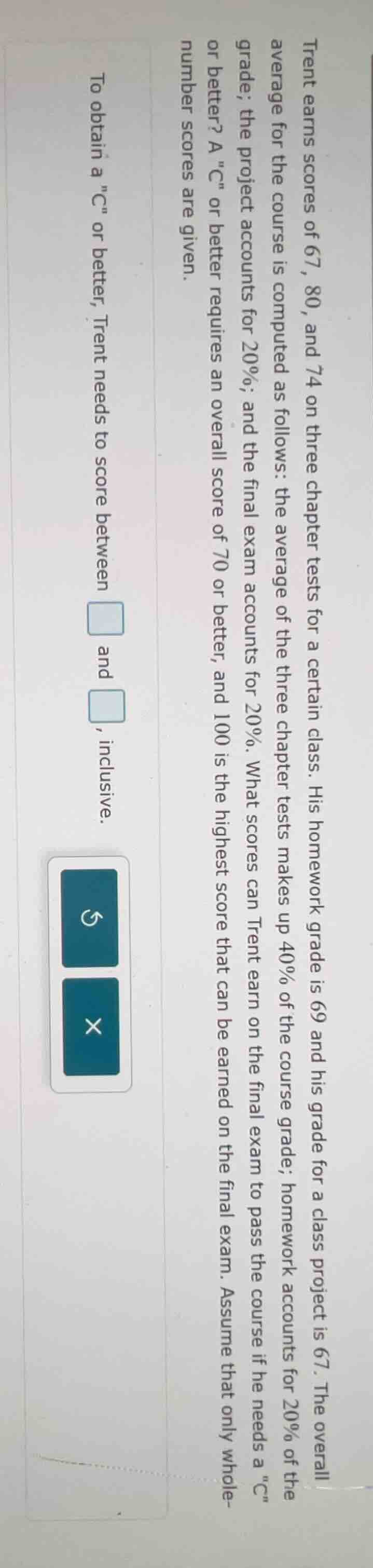
trent earns scores of 67, 80, and 74 on three chapter tests for a certain class. his homework grade is 69 and his grade for a class project is 67. the overall average for the course is computed as follows: the average of the three chapter tests makes up 40% of the course grade; homework accounts for 20% of the grade; the project accounts for 20%; and the final exam accounts for 20%. what scores can trent earn on the final exam to pass the course if he needs a \c\ or better? a \c\ or better requires an overall score of 70 or better, and 100 is the highest score that can be earned on the final exam. assume that only whole - number scores are given. to obtain a \c\ or better, trent needs to score between (square) and (square), inclusive.
Step1: Calculate the average of chapter tests
First, find the average of the three chapter test scores (67, 80, 74). The formula for the average of \(n\) numbers \(x_1, x_2, \dots, x_n\) is \(\frac{x_1 + x_2 + \dots + x_n}{n}\). Here, \(n = 3\), so the average is \(\frac{67 + 80 + 74}{3}\).
\[
\frac{67 + 80 + 74}{3}=\frac{221}{3}\approx73.67
\]
Then, the contribution of the chapter tests to the overall grade is \(40\%\) of this average. So, \(0.4\times\frac{221}{3}\).
\[
0.4\times\frac{221}{3}=\frac{88.4}{3}\approx29.47
\]
Step2: Calculate the contribution of homework and project
The homework grade is 69, and it accounts for \(20\%\) of the overall grade. So, \(0.2\times69 = 13.8\).
The project grade is 67, and it accounts for \(20\%\) of the overall grade. So, \(0.2\times67 = 13.4\).
Step3: Set up the inequality for the final exam
Let \(x\) be the score on the final exam (which accounts for \(20\%\) of the overall grade, so its contribution is \(0.2x\)). The overall grade is the sum of the contributions from chapter tests, homework, project, and final exam. We want the overall grade to be at least 70 (for a "C" or better) and at most 100 (since that's the highest possible score). So, the inequality is:
\[
70\leq0.4\times\frac{221}{3}+ 0.2\times69 + 0.2\times67+0.2x\leq100
\]
First, calculate the sum of the known contributions: \(\frac{88.4}{3}+ 13.8 + 13.4\).
\[
\frac{88.4}{3}+ 13.8 + 13.4=\frac{88.4}{3}+27.2=\frac{88.4 + 81.6}{3}=\frac{170}{3}\approx56.67
\]
So the inequality becomes:
\[
70\leq\frac{170}{3}+0.2x\leq100
\]
Subtract \(\frac{170}{3}\) from all parts:
\[
70-\frac{170}{3}\leq0.2x\leq100 - \frac{170}{3}
\]
Calculate \(70-\frac{170}{3}=\frac{210 - 170}{3}=\frac{40}{3}\approx13.33\) and \(100-\frac{170}{3}=\frac{300 - 170}{3}=\frac{130}{3}\approx43.33\)? Wait, no, wait. Wait, we made a mistake here. Wait, the chapter test average contribution was miscalculated? Wait, no, let's re - do the known contributions:
Wait, the chapter test average is \(\frac{67 + 80 + 74}{3}=\frac{221}{3}\approx73.6667\). Then, \(40\%\) of that is \(0.4\times73.6667\approx29.4667\).
Homework contribution: \(0.2\times69 = 13.8\).
Project contribution: \(0.2\times67 = 13.4\).
Sum of these three contributions: \(29.4667+13.8 + 13.4=56.6667\).
So the inequality is \(70\leq56.6667 + 0.2x\leq100\).
Subtract 56.6667 from all parts:
\(70 - 56.6667\leq0.2x\leq100 - 56.6667\)
\(13.3333\leq0.2x\leq43.3333\)
Now, solve for \(x\) by dividing all parts by 0.2:
\(\frac{13.3333}{0.2}\leq x\leq\frac{43.3333}{0.2}\)
\(66.6665\leq x\leq216.6665\)
But since the maximum score on the final exam is 100 (because scores are whole - number scores and the highest possible is 100), we adjust the upper bound to 100. And since scores are whole numbers, we can also consider the lower bound. Wait, but let's check the calculation again. Wait, maybe we made a mistake in the initial average. Wait, 67 + 80+74 = 221? 67+80 = 147, 147 + 74 = 221, yes. Then average is 221/3≈73.6667. Then 40% of that is 0.473.6667≈29.4667. Homework: 0.269 = 13.8. Project: 0.2*67 = 13.4. Sum of these: 29.4667+13.8 + 13.4 = 56.6667. Then the overall grade is 56.6667+0.2x. We want 70≤56.6667 + 0.2x≤100. Subtract 56.6667: 13.3333≤0.2x≤43.3333. Divide by 0.2: 66.6665≤x≤216.6665. But since the final exam score can't exceed 100, the upper limit is 100. And since we need a "C" or better (overall grade ≥70), let's find the minimum \(x\) such that 56.6667+0.2x≥70. So 0.2x≥70 - 56.6667 = 13.3333. Then x≥13.3333/0.2 = 66.6665. Since scores are whole numbers, the minimum whole number score is 67 (b…

Snap & solve any problem in the app
Get step-by-step solutions on Sovi AI
Photo-based solutions with guided steps
Explore more problems and detailed explanations
To obtain a "C" or better, Trent needs to score between \(\boldsymbol{67}\) and \(\boldsymbol{100}\), inclusive.