QUESTION IMAGE
Question
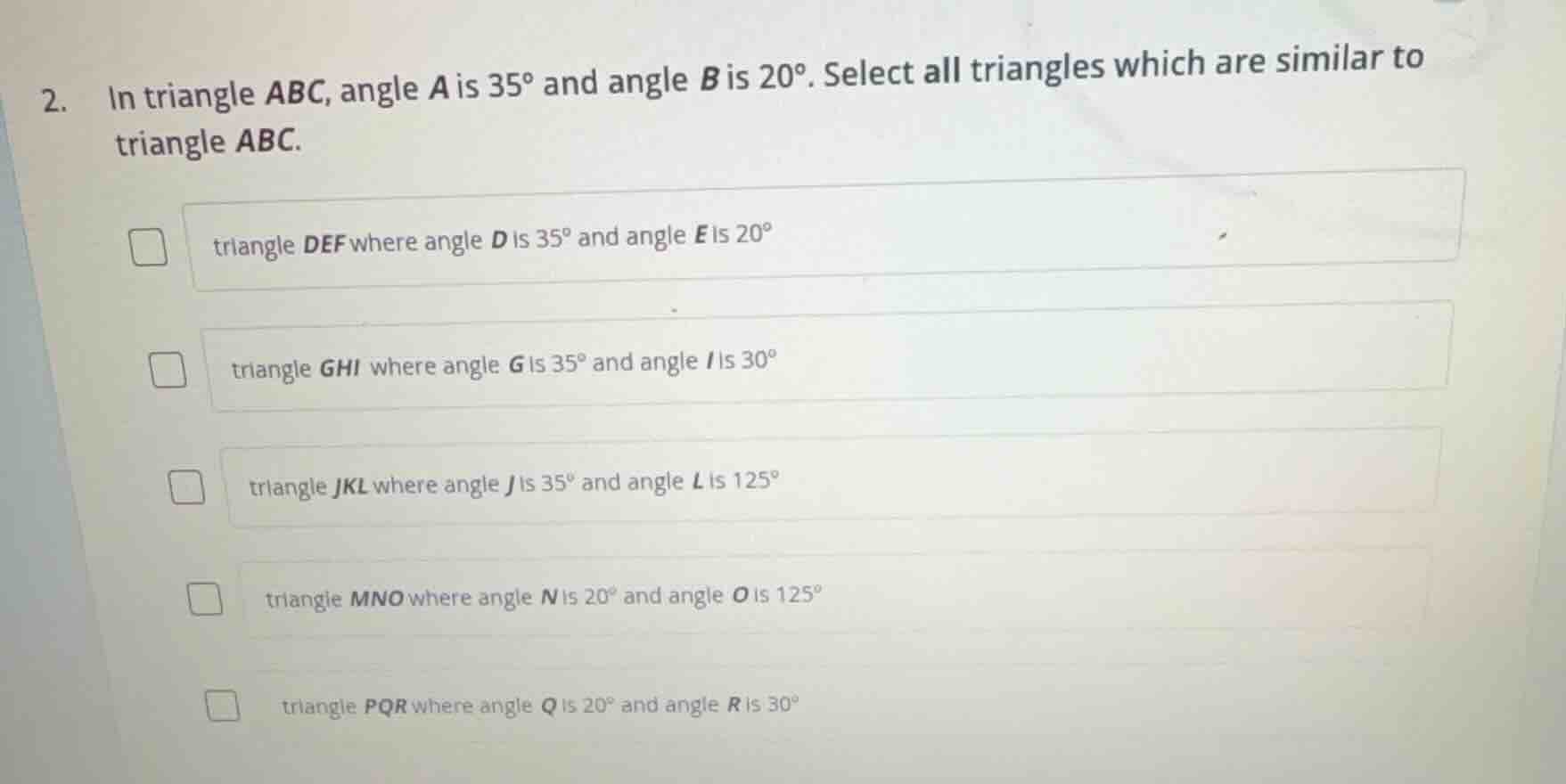
- in triangle abc, angle a is 35° and angle b is 20°. select all triangles which are similar to triangle abc.
- triangle def where angle d is 35° and angle e is 20°
- triangle ghi where angle g is 35° and angle i is 30°
- triangle jkl where angle j is 35° and angle l is 125°
- triangle mno where angle n is 20° and angle o is 125°
- triangle pqr where angle q is 20° and angle r is 30°
To determine similar triangles, we use the AA (Angle - Angle) similarity criterion, which states that if two angles of one triangle are equal to two angles of another triangle, the triangles are similar. First, we find the measure of the third angle in triangle \(ABC\).
Step 1: Find the third angle of \(\triangle ABC\)
The sum of the interior angles of a triangle is \(180^{\circ}\). In \(\triangle ABC\), we know that \(\angle A = 35^{\circ}\) and \(\angle B=20^{\circ}\). Let the third angle be \(\angle C\). Then:
\[
\angle C=180^{\circ}-\angle A - \angle B=180^{\circ}-35^{\circ}-20^{\circ}=125^{\circ}
\]
Step 2: Analyze \(\triangle DEF\)
In \(\triangle DEF\), \(\angle D = 35^{\circ}\) and \(\angle E=20^{\circ}\). By AA similarity, since \(\angle D=\angle A\) and \(\angle E = \angle B\), \(\triangle DEF\sim\triangle ABC\).
Step 3: Analyze \(\triangle GHI\)
In \(\triangle GHI\), \(\angle G = 35^{\circ}\) and \(\angle I=30^{\circ}\). The third angle \(\angle H=180^{\circ}-35^{\circ}-30^{\circ}=115^{\circ}\). Since no two angles of \(\triangle GHI\) match two angles of \(\triangle ABC\) (either \(35^{\circ},20^{\circ}\) or \(35^{\circ},125^{\circ}\) or \(20^{\circ},125^{\circ}\)), \(\triangle GHI\) is not similar to \(\triangle ABC\).
Step 4: Analyze \(\triangle JKL\)
In \(\triangle JKL\), \(\angle J = 35^{\circ}\) and \(\angle L=125^{\circ}\). The third angle \(\angle K=180^{\circ}-35^{\circ}-125^{\circ}=20^{\circ}\). So we have \(\angle J=\angle A = 35^{\circ}\) and \(\angle K=\angle B=20^{\circ}\) (or \(\angle J=\angle A\) and \(\angle L=\angle C\)). By AA similarity, \(\triangle JKL\sim\triangle ABC\).
Step 5: Analyze \(\triangle MNO\)
In \(\triangle MNO\), \(\angle N = 20^{\circ}\) and \(\angle O=125^{\circ}\). The third angle \(\angle M=180^{\circ}-20^{\circ}-125^{\circ}=35^{\circ}\). So we have \(\angle M=\angle A = 35^{\circ}\) and \(\angle N=\angle B = 20^{\circ}\) (or \(\angle N=\angle B\) and \(\angle O=\angle C\)). By AA similarity, \(\triangle MNO\sim\triangle ABC\).
Step 6: Analyze \(\triangle PQR\)
In \(\triangle PQR\), \(\angle Q = 20^{\circ}\) and \(\angle R=30^{\circ}\). The third angle \(\angle P=180^{\circ}-20^{\circ}-30^{\circ}=130^{\circ}\). Since no two angles of \(\triangle PQR\) match two angles of \(\triangle ABC\), \(\triangle PQR\) is not similar to \(\triangle ABC\).

Snap & solve any problem in the app
Get step-by-step solutions on Sovi AI
Photo-based solutions with guided steps
Explore more problems and detailed explanations
The triangles similar to \(\triangle ABC\) are:
- triangle DEF where angle D is \(35^{\circ}\) and angle E is \(20^{\circ}\)
- triangle JKL where angle J is \(35^{\circ}\) and angle L is \(125^{\circ}\)
- triangle MNO where angle N is \(20^{\circ}\) and angle O is \(125^{\circ}\)