QUESTION IMAGE
Question
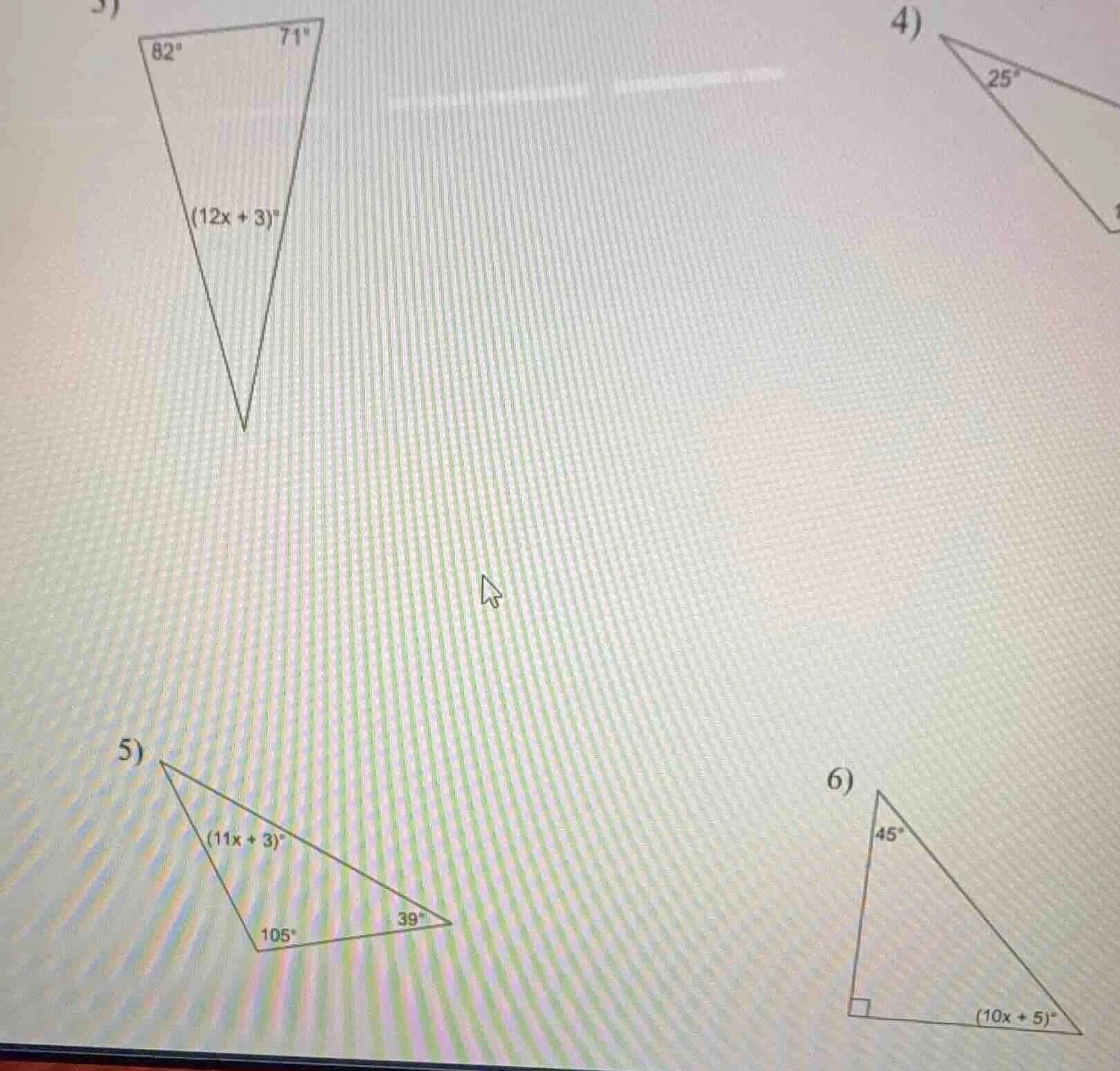
- a triangle with angles 82°, 71°, and (12x + 3)°. 4) a triangle with angle 25°. 5) a triangle with angles 105°, 39°, and (11x + 3)°. 6) a right triangle with angle 45° and (10x + 5)°.
Let's solve each triangle problem one by one. We'll use the fact that the sum of the interior angles of a triangle is \(180^\circ\).
Problem 3:
We have a triangle with angles \(82^\circ\), \(71^\circ\), and \((12x + 3)^\circ\).
Step 1: Set up the equation
The sum of the angles in a triangle is \(180^\circ\), so:
\[
82 + 71 + (12x + 3) = 180
\]
Step 2: Simplify the left side
First, add the constant terms:
\[
82 + 71 + 3 + 12x = 180
\]
\[
156 + 12x = 180
\]
Step 3: Solve for \(x\)
Subtract \(156\) from both sides:
\[
12x = 180 - 156
\]
\[
12x = 24
\]
Divide both sides by \(12\):
\[
x = \frac{24}{12} = 2
\]
Problem 5:
We have a triangle with angles \(105^\circ\), \(39^\circ\), and \((11x + 3)^\circ\).
Step 1: Set up the equation
Using the sum of angles in a triangle:
\[
105 + 39 + (11x + 3) = 180
\]
Step 2: Simplify the left side
Add the constant terms:
\[
105 + 39 + 3 + 11x = 180
\]
\[
147 + 11x = 180
\]
Step 3: Solve for \(x\)
Subtract \(147\) from both sides:
\[
11x = 180 - 147
\]
\[
11x = 33
\]
Divide both sides by \(11\):
\[
x = \frac{33}{11} = 3
\]
Problem 6:
We have a right triangle (one angle is \(90^\circ\)) with angles \(45^\circ\), \(90^\circ\), and \((10x + 5)^\circ\).
Step 1: Set up the equation
The sum of angles in a triangle is \(180^\circ\), so:
\[
45 + 90 + (10x + 5) = 180
\]
Step 2: Simplify the left side
Add the constant terms:
\[
45 + 90 + 5 + 10x = 180
\]
\[
140 + 10x = 180
\]
Step 3: Solve for \(x\)
Subtract \(140\) from both sides:
\[
10x = 180 - 140
\]
\[
10x = 40
\]
Divide both sides by \(10\):
\[
x = \frac{40}{10} = 4
\]
Problem 4:
We have a triangle with angles \(25^\circ\), let's assume the third angle is \(y\) (but the diagram is cut off, so we'll assume it's a triangle with angles \(25^\circ\), \(y\), and another angle. Wait, maybe it's a triangle with angles \(25^\circ\), \(180 - 25 - \text{third angle}\), but since the diagram is incomplete, we'll focus on the ones we can solve.
For Problem 3: \(x = 2\)
For Problem 5: \(x = 3\)
For Problem 6: \(x = 4\)
If you need help with Problem 4, please provide the complete diagram or angle information.

Snap & solve any problem in the app
Get step-by-step solutions on Sovi AI
Photo-based solutions with guided steps
Explore more problems and detailed explanations
Let's solve each triangle problem one by one. We'll use the fact that the sum of the interior angles of a triangle is \(180^\circ\).
Problem 3:
We have a triangle with angles \(82^\circ\), \(71^\circ\), and \((12x + 3)^\circ\).
Step 1: Set up the equation
The sum of the angles in a triangle is \(180^\circ\), so:
\[
82 + 71 + (12x + 3) = 180
\]
Step 2: Simplify the left side
First, add the constant terms:
\[
82 + 71 + 3 + 12x = 180
\]
\[
156 + 12x = 180
\]
Step 3: Solve for \(x\)
Subtract \(156\) from both sides:
\[
12x = 180 - 156
\]
\[
12x = 24
\]
Divide both sides by \(12\):
\[
x = \frac{24}{12} = 2
\]
Problem 5:
We have a triangle with angles \(105^\circ\), \(39^\circ\), and \((11x + 3)^\circ\).
Step 1: Set up the equation
Using the sum of angles in a triangle:
\[
105 + 39 + (11x + 3) = 180
\]
Step 2: Simplify the left side
Add the constant terms:
\[
105 + 39 + 3 + 11x = 180
\]
\[
147 + 11x = 180
\]
Step 3: Solve for \(x\)
Subtract \(147\) from both sides:
\[
11x = 180 - 147
\]
\[
11x = 33
\]
Divide both sides by \(11\):
\[
x = \frac{33}{11} = 3
\]
Problem 6:
We have a right triangle (one angle is \(90^\circ\)) with angles \(45^\circ\), \(90^\circ\), and \((10x + 5)^\circ\).
Step 1: Set up the equation
The sum of angles in a triangle is \(180^\circ\), so:
\[
45 + 90 + (10x + 5) = 180
\]
Step 2: Simplify the left side
Add the constant terms:
\[
45 + 90 + 5 + 10x = 180
\]
\[
140 + 10x = 180
\]
Step 3: Solve for \(x\)
Subtract \(140\) from both sides:
\[
10x = 180 - 140
\]
\[
10x = 40
\]
Divide both sides by \(10\):
\[
x = \frac{40}{10} = 4
\]
Problem 4:
We have a triangle with angles \(25^\circ\), let's assume the third angle is \(y\) (but the diagram is cut off, so we'll assume it's a triangle with angles \(25^\circ\), \(y\), and another angle. Wait, maybe it's a triangle with angles \(25^\circ\), \(180 - 25 - \text{third angle}\), but since the diagram is incomplete, we'll focus on the ones we can solve.
For Problem 3: \(x = 2\)
For Problem 5: \(x = 3\)
For Problem 6: \(x = 4\)
If you need help with Problem 4, please provide the complete diagram or angle information.