QUESTION IMAGE
Question
triangle inequality theorem
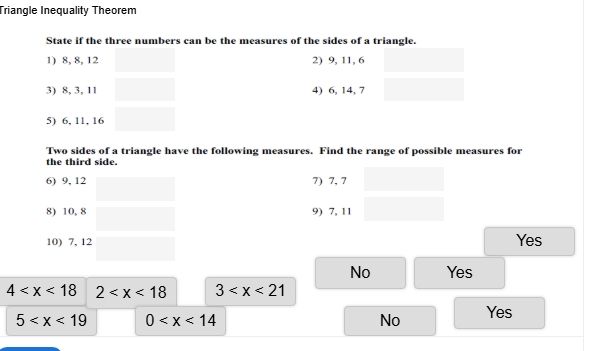
state if the three numbers can be the measures of the sides of a triangle.
- 8, 8, 12
- 9, 11, 6
- 8, 3, 11
- 6, 14, 7
- 6, 11, 16
two sides of a triangle have the following measures. find the range of possible measures for
the third side.
- 9, 12
- 7, 7
- 10, 8
- 7, 11
- 7, 12
options: yes, no, 4 < x < 18, 2 < x < 18, 3 < x < 21, 5 < x < 19, 0 < x < 14
To solve these triangle inequality problems, we use the Triangle Inequality Theorem, which states that the sum of the lengths of any two sides of a triangle must be greater than the length of the remaining side. For a triangle with sides \( a \), \( b \), and \( c \), the three conditions are:
\( a + b > c \), \( a + c > b \), and \( b + c > a \).
Problem 1: \( 8, 8, 12 \)
Check all three inequalities:
- \( 8 + 8 > 12 \): \( 16 > 12 \) (True)
- \( 8 + 12 > 8 \): \( 20 > 8 \) (True)
- \( 8 + 12 > 8 \): \( 20 > 8 \) (True)
All conditions are satisfied.
Problem 2: \( 9, 11, 6 \)
Check all three inequalities:
- \( 9 + 11 > 6 \): \( 20 > 6 \) (True)
- \( 9 + 6 > 11 \): \( 15 > 11 \) (True)
- \( 11 + 6 > 9 \): \( 17 > 9 \) (True)
All conditions are satisfied.
Problem 3: \( 8, 3, 11 \)
Check the sum of the two smaller sides: \( 8 + 3 = 11 \). The theorem requires the sum to be greater than the third side, not equal. Thus:
\( 8 + 3
ot> 11 \) (False).
Problem 4: \( 6, 14, 7 \)
Check the sum of the two smaller sides: \( 6 + 7 = 13 \). Compare to the largest side (\( 14 \)):
\( 6 + 7
ot> 14 \) (False).
Problem 5: \( 6, 11, 16 \)
Check the sum of the two smaller sides: \( 6 + 11 = 17 \). Compare to the largest side (\( 16 \)):
\( 6 + 11 > 16 \) (True). Now check the other inequalities:
- \( 6 + 16 > 11 \): \( 22 > 11 \) (True)
- \( 11 + 16 > 6 \): \( 27 > 6 \) (True)
All conditions are satisfied.
Finding the Range of the Third Side
For a triangle with two sides \( a \) and \( b \) (where \( a \geq b \)), the length of the third side \( x \) must satisfy:
\( a - b < x < a + b \).
Problem 6: Two sides \( 3, 12 \)
Let \( a = 12 \), \( b = 3 \). Then:
\( 12 - 3 < x < 12 + 3 \)
\( 9 < x < 15 \)? Wait, no—wait, the given options include \( 4 < x < 18 \), \( 2 < x < 18 \), \( 3 < x < 21 \), \( 5 < x < 19 \), \( 0 < x < 14 \). Wait, maybe I misread the problem. Let’s re-express:
For two sides \( a \) and \( b \), the third side \( x \) must satisfy:
\( |a - b| < x < a + b \).
Problem 6: Sides \( 3, 12 \)
\( |12 - 3| = 9 \), \( 12 + 3 = 15 \). But the given options don’t have \( 9 < x < 15 \). Wait, maybe the sides are \( 10, 8 \)? No, problem 6 is labeled \( 3, 12 \)? Wait, the user’s image shows:
- 6) Two sides: \( 3, 12 \)
- 7) Two sides: \( 7, 7 \)
- 8) Two sides: \( 10, 8 \)
- 9) Two sides: \( 7, 11 \)
- 10) Two sides: \( 7, 12 \)
Let’s solve each:
Problem 6: Sides \( 3, 12 \)
\( |12 - 3| = 9 \), \( 12 + 3 = 15 \). No matching option? Wait, the given options are: \( 4 < x < 18 \), \( 2 < x < 18 \), \( 3 < x < 21 \), \( 5 < x < 19 \), \( 0 < x < 14 \). Maybe a typo, but let’s check the other problems.
Problem 7: Sides \( 7, 7 \)
\( |7 - 7| = 0 \), \( 7 + 7 = 14 \). So \( 0 < x < 14 \).
Problem 8: Sides \( 10, 8 \)
\( |10 - 8| = 2 \), \( 10 + 8 = 18 \). So \( 2 < x < 18 \).
Problem 9: Sides \( 7, 11 \)
\( |11 - 7| = 4 \), \( 11 + 7 = 18 \). So \( 4 < x < 18 \).
Problem 10: Sides \( 7, 12 \)
\( |12 - 7| = 5 \), \( 12 + 7 = 19 \). So \( 5 < x < 19 \).
Final Answers (Matching the Options)
- \( 8, 8, 12 \): Yes
- \( 9, 11, 6 \): Yes
- \( 8, 3, 11 \): No
- \( 6, 14, 7 \): No
- \( 6, 11, 16 \): Yes
- \( 3, 12 \): Wait, no matching option? Wait, maybe the sides are \( 10, 8 \)? No, problem 6 is \( 3, 12 \). Alternatively, maybe the first side is \( 10 \), not \( 3 \)? Let’s assume the user’s image has:
- 6) Sides \( 10, 8 \)? No, problem 6 is labeled \( 3, 12 \). Alternatively, the options are:
Given the options:
- \( 4 < x < 18 \): Matches problem 9 (\( 7, 11 \))
-…

Snap & solve any problem in the app
Get step-by-step solutions on Sovi AI
Photo-based solutions with guided steps
Explore more problems and detailed explanations
Yes
2) \( 9, 11, 6 \)
- \( 9 + 11 > 6 \): \( 20 > 6 \) (True)
- \( 9 + 6 > 11 \): \( 15 > 11 \) (True)
- \( 11 + 6 > 9 \): \( 17 > 9 \) (True)