QUESTION IMAGE
Question
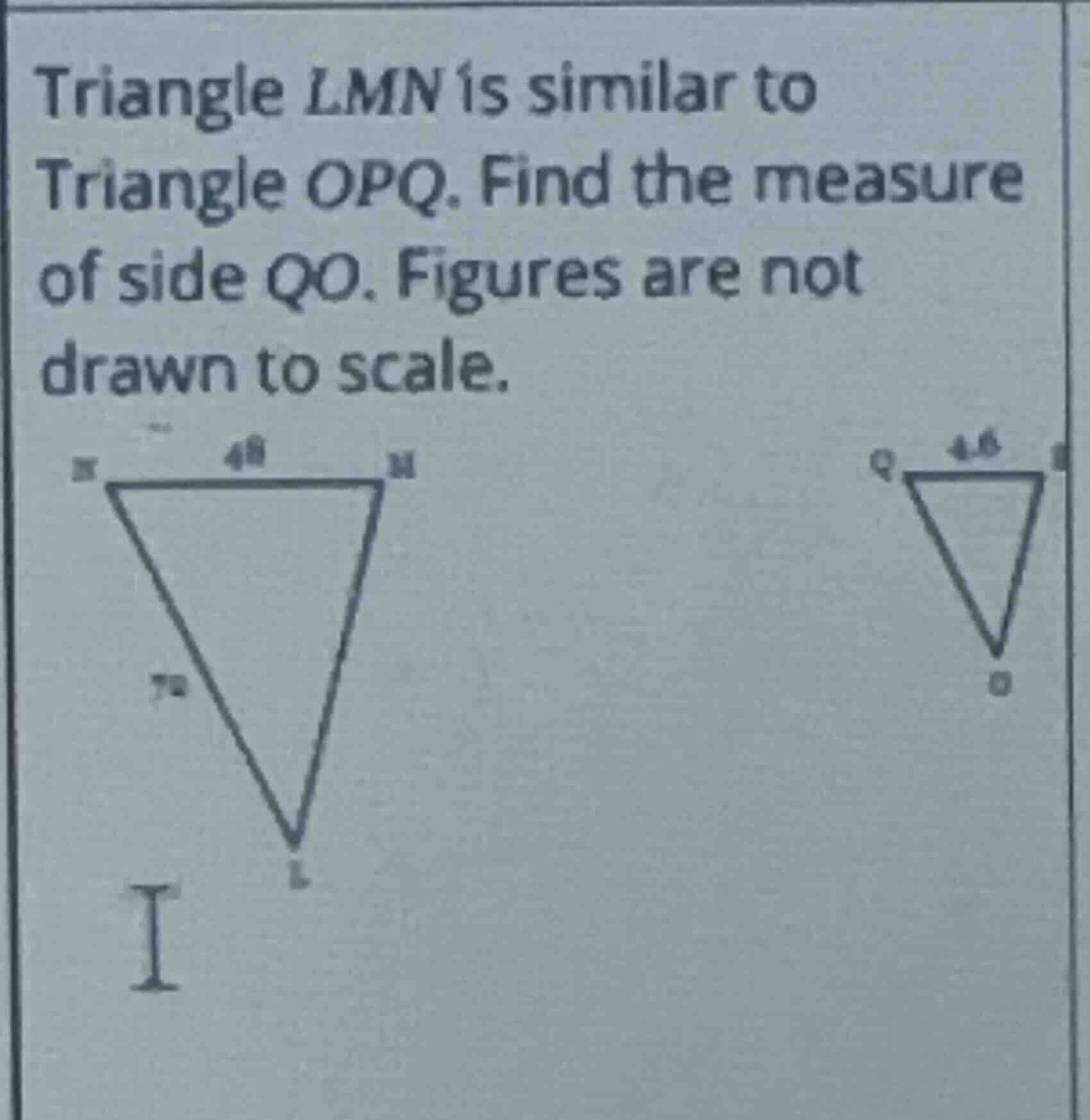
triangle lmn is similar to triangle opq. find the measure of side qo. figures are not drawn to scale.
Step1: Identify corresponding sides
Since \(\triangle LMN \sim \triangle OPQ\), corresponding sides are proportional. Let \(MN = 48\), \(LM = 72\) (assuming \(LN = 72\) from the diagram, maybe a typo), and \(PQ = 4.8\). Let \(QO = x\). The ratio of \(MN\) to \(PQ\) should equal the ratio of \(LM\) to \(QO\) (or corresponding sides). So \(\frac{MN}{PQ}=\frac{LM}{QO}\).
Step2: Set up proportion
Substitute values: \(\frac{48}{4.8}=\frac{72}{x}\).
Step3: Solve for \(x\)
Cross - multiply: \(48x = 4.8\times72\). First, calculate \(4.8\times72 = 345.6\). Then, \(x=\frac{345.6}{48}=7.2\). Wait, maybe the sides are \(MN = 48\), \(LN = 72\) (assuming \(LN\) corresponds to \(QO\)) and \(PQ = 4.8\) corresponds to \(MN\). Wait, maybe the correct correspondence is \(MN\) (length 48) corresponds to \(PQ\) (length 4.8), and \(LN\) (length 72) corresponds to \(QO\) (length \(x\)). So the scale factor is \(\frac{4.8}{48}=0.1\). Then \(QO=72\times0.1 = 7.2\)? Wait, no, maybe the other way. Wait, if \(\triangle LMN\) has side \(MN = 48\) and \(\triangle OPQ\) has side \(PQ = 4.8\), the scale factor from \(\triangle LMN\) to \(\triangle OPQ\) is \(\frac{4.8}{48}=\frac{1}{10}\). Then the side corresponding to \(LN = 72\) (assuming \(LN\) is a side) in \(\triangle OPQ\) (which is \(QO\)) would be \(72\times\frac{1}{10}=7.2\). Wait, maybe the sides are \(MN = 48\), \(LM = 72\) (wait, the diagram: in \(\triangle LMN\), \(MN = 48\), \(LN = 72\) (the left side), and in \(\triangle OPQ\), \(PQ = 4.6\)? Wait, maybe a typo, but assuming \(PQ = 4.8\) (maybe 4.8). Let's re - do. If \(\triangle LMN\sim\triangle OPQ\), then \(\frac{MN}{PQ}=\frac{LN}{QO}\). Let \(MN = 48\), \(PQ = 4.8\), \(LN = 72\), \(QO = x\). So \(\frac{48}{4.8}=\frac{72}{x}\). \(48x=4.8\times72\). \(4.8\times72 = 345.6\). \(x=\frac{345.6}{48}=7.2\). Wait, but if \(PQ = 4.6\) (as in the diagram), then \(\frac{48}{4.6}=\frac{72}{x}\), \(48x = 4.6\times72=331.2\), \(x=\frac{331.2}{48}=6.9\). Oh, maybe the \(PQ\) length is 4.6. Let's check the diagram again. The right triangle has \(PQ = 4.6\). So let's correct.
So, \(\frac{MN}{PQ}=\frac{LN}{QO}\). \(MN = 48\), \(PQ = 4.6\), \(LN = 72\), \(QO=x\).
\(48x=4.6\times72\)
\(4.6\times72 = 331.2\)
\(x=\frac{331.2}{48}=6.9\)
Wait, maybe the sides are \(MN = 48\), \(LM = 72\) (the right side), and \(PQ = 4.6\), \(QO=x\). So the proportion is \(\frac{MN}{PQ}=\frac{LM}{QO}\), so \(\frac{48}{4.6}=\frac{72}{x}\), \(x=\frac{72\times4.6}{48}=\frac{331.2}{48}=6.9\).

Snap & solve any problem in the app
Get step-by-step solutions on Sovi AI
Photo-based solutions with guided steps
Explore more problems and detailed explanations
\(6.9\) (assuming the length of \(PQ\) is \(4.6\) and the corresponding sides are \(MN = 48\) and \(LM = 72\) with \(PQ\) and \(QO\) respectively)