QUESTION IMAGE
Question
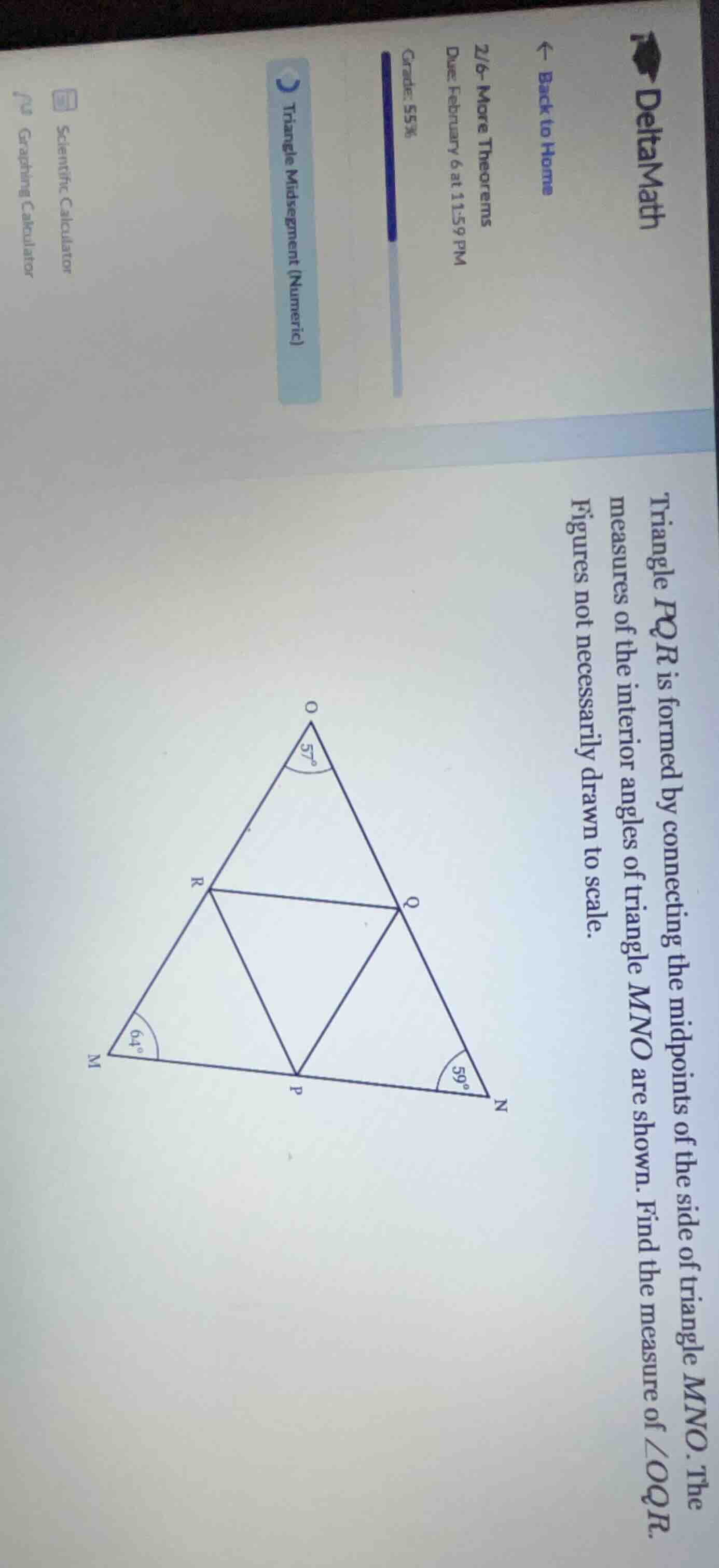
triangle pqr is formed by connecting the midpoints of the side of triangle mno. the measures of the interior angles of triangle mno are shown. find the measure of ∠oqr. figures not necessarily drawn to scale.
Step1: Determine the midline theorem
Since \( P, Q, R \) are midpoints, by the midline theorem, \( RQ \parallel MN \) and \( RQ=\frac{1}{2}MN \), \( PQ \parallel MO \), \( PQ = \frac{1}{2}MO \), \( PR \parallel NO \), \( PR=\frac{1}{2}NO \). So triangle \( PQR \) is similar to triangle \( MNO \), and the corresponding angles are equal. Also, \( RQ \parallel MN \) implies that \( \angle OQR=\angle OMN \)? Wait, no, let's check the angles of triangle \( MNO \) first.
Step2: Calculate the third angle of \( \triangle MNO \)
The sum of interior angles of a triangle is \( 180^\circ \). In \( \triangle MNO \), \( \angle M = 64^\circ \), \( \angle N=59^\circ \), so \( \angle O=180^\circ - 64^\circ - 59^\circ=57^\circ \).
Step3: Use midline parallelism to find \( \angle OQR \)
Since \( R \) and \( Q \) are midpoints, \( RQ \parallel MN \) (midline theorem: the segment connecting midpoints of two sides is parallel to the third side). So \( \angle OQR=\angle OMN \)? Wait, no, \( RQ \parallel MN \), so the alternate interior angles: \( \angle OQR \) and \( \angle N \)? Wait, maybe I mixed up. Wait, let's see the sides: \( R \) is midpoint of \( MO \), \( Q \) is midpoint of \( NO \), so \( RQ \parallel MN \) (connecting midpoints of \( MO \) and \( NO \), so parallel to \( MN \)). So \( \angle OQR \) and \( \angle N \) are corresponding angles? Wait, \( RQ \parallel MN \), so \( \angle OQR=\angle N = 59^\circ \)? No, wait, \( \angle N \) is at vertex \( N \), \( \angle OQR \) is at vertex \( Q \). Wait, maybe \( RQ \parallel MN \), so \( \angle OQR=\angle OMN \)? Wait, \( \angle OMN \) is \( \angle M = 64^\circ \)? No, let's re - examine.
Wait, another approach: since \( RQ \parallel MN \), then \( \angle OQR=\angle N \)? Wait, no, let's look at the angles of \( \triangle MNO \). Wait, \( \angle M = 64^\circ \), \( \angle N = 59^\circ \), \( \angle O=57^\circ \). Now, since \( RQ \parallel MN \), the line \( OQ \) is a transversal. So \( \angle OQR \) and \( \angle OMN \) (which is \( \angle M = 64^\circ \))? No, maybe I made a mistake. Wait, let's check the midpoints: \( R \) is midpoint of \( MO \), \( Q \) is midpoint of \( NO \), so \( RQ \) is midline, so \( RQ \parallel MN \) and \( RQ=\frac{1}{2}MN \). So the direction: \( RQ \) is parallel to \( MN \), so the angle at \( Q \), \( \angle OQR \), should be equal to the angle at \( N \), \( \angle N = 59^\circ \)? Wait, no, \( \angle N \) is \( 59^\circ \), \( \angle M \) is \( 64^\circ \), \( \angle O \) is \( 57^\circ \). Wait, maybe \( RQ \parallel MN \), so \( \angle OQR=\angle M = 64^\circ \)? No, let's think about the sides. \( MO \) has midpoint \( R \), \( NO \) has midpoint \( Q \), so \( RQ \) is parallel to \( MN \). So the angle between \( OQ \) and \( RQ \) (i.e., \( \angle OQR \)) should be equal to the angle between \( ON \) and \( MN \) (i.e., \( \angle N \))? Wait, \( \angle N \) is at \( N \), between \( ON \) and \( MN \), so yes, because \( RQ \parallel MN \) and \( OQ \) is part of \( ON \) (since \( Q \) is midpoint of \( ON \)), so \( \angle OQR=\angle N = 59^\circ \)? Wait, no, that doesn't seem right. Wait, let's calculate the angle of \( \triangle MNO \) again: \( 64 + 59+57 = 180 \), correct. Now, since \( RQ \parallel MN \), then \( \angle OQR \) and \( \angle OMN \) ( \( \angle M = 64^\circ \)) are alternate interior angles? Wait, \( RQ \parallel MN \), and \( OM \) is a transversal. So \( \angle OQR=\angle OMN = 64^\circ \)? No, I'm confused. Wait, maybe the other way: \( PQ \parallel MO \), so \( \angle OQR=\angle O \)? No, \( \angle O = 57^\circ \…

Snap & solve any problem in the app
Get step-by-step solutions on Sovi AI
Photo-based solutions with guided steps
Explore more problems and detailed explanations
\( 59^\circ \)