QUESTION IMAGE
Question
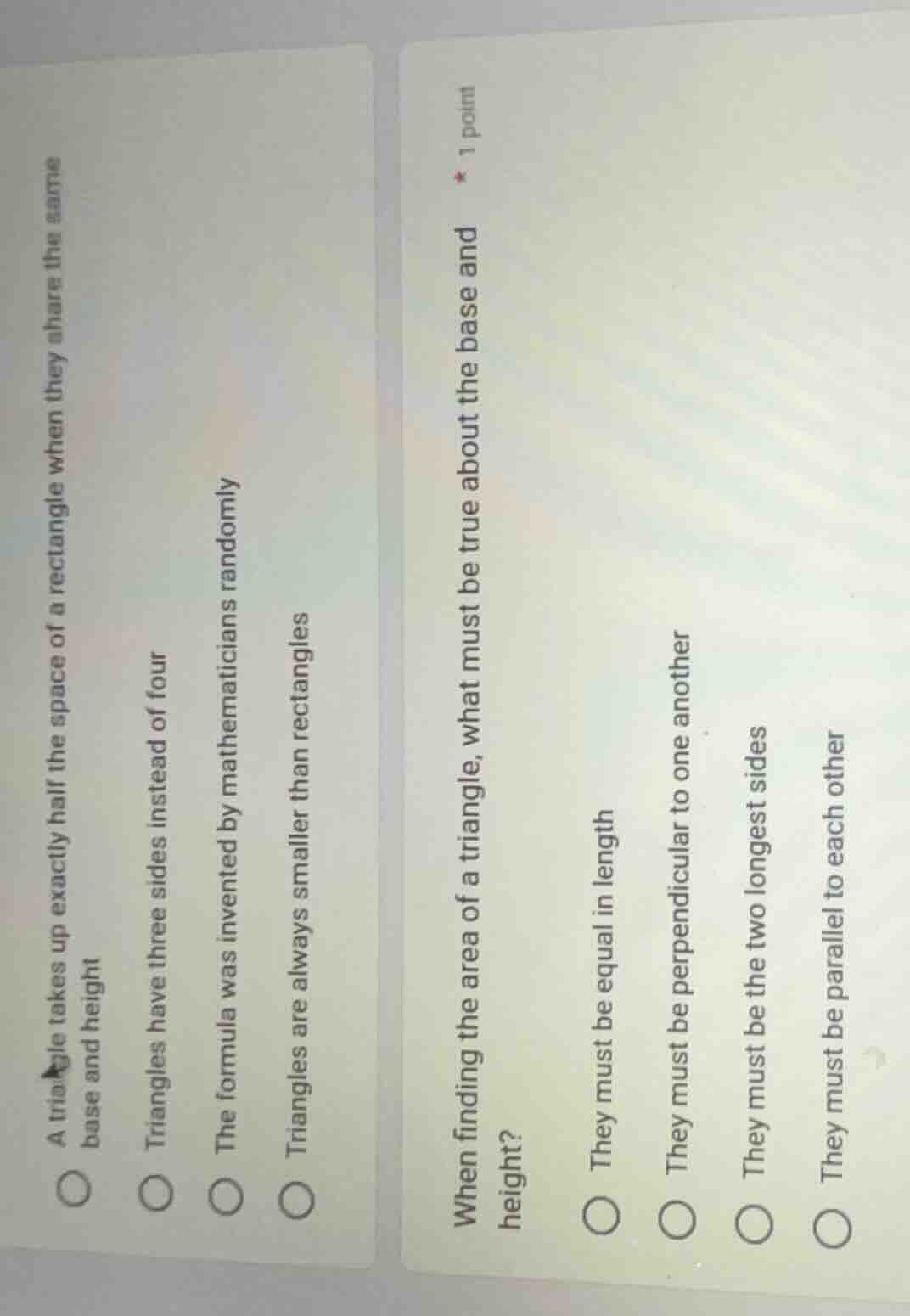
a triangle takes up exactly half the space of a rectangle when they share the same base and height
triangles have three sides instead of four
the formula was invented by mathematicians randomly
triangles are always smaller than rectangles
when finding the area of a triangle, what must be true about the base and height?
- 1 point
they must be equal in length
they must be perpendicular to one another
they must be the two longest sides
they must be parallel to each other
For the first question: The area of a triangle with the same base and height as a rectangle is $\frac{1}{2} \times \text{base} \times \text{height}$, while the rectangle's area is $\text{base} \times \text{height}$, so the triangle is half the rectangle's area. Other options are incorrect: triangles have 3 sides (not a reason for area relation), area formulas are not random inventions, and triangles are not always smaller than rectangles.
For the second question: The height of a triangle is defined as the perpendicular distance from the base to the opposite vertex, so the base and height must be perpendicular to each other. Other options are wrong: they don't need to be equal in length, they aren't the two longest sides, and they can't be parallel.

Snap & solve any problem in the app
Get step-by-step solutions on Sovi AI
Photo-based solutions with guided steps
Explore more problems and detailed explanations
First question: A triangle takes up exactly half the space of a rectangle when they share the same base and height
Second question: They must be perpendicular to one another