QUESTION IMAGE
Question
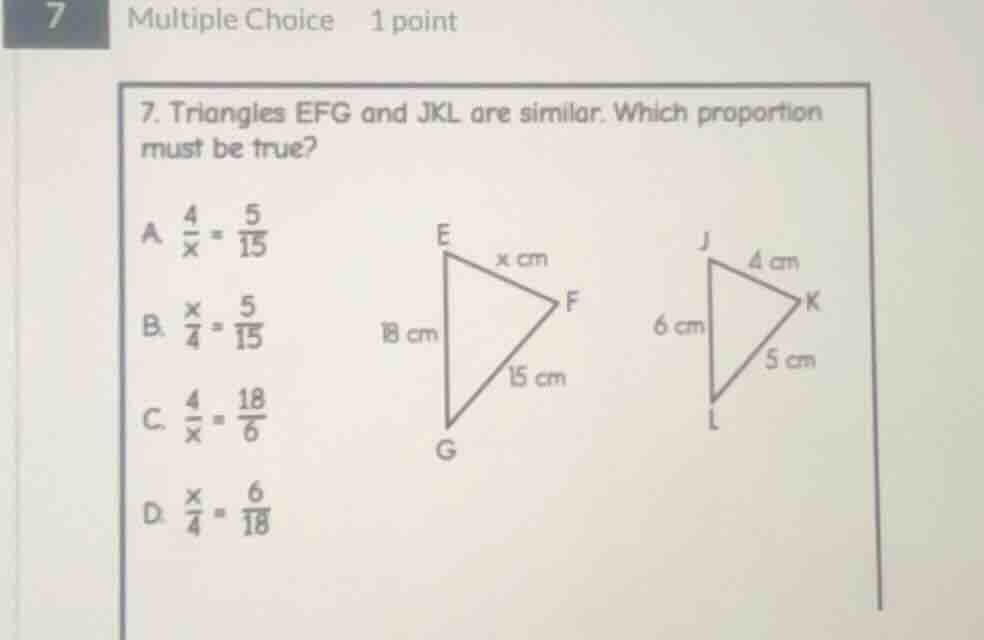
- triangles efg and jkl are similar. which proportion must be true? a. \\(\frac{4}{x}=\frac{5}{15}\\) b. \\(\frac{x}{4}=\frac{5}{15}\\) c. \\(\frac{4}{x}=\frac{18}{6}\\) d. \\(\frac{x}{4}=\frac{6}{18}\\)
Step1: Identify corresponding sides
Since triangles EFG and JKL are similar, their corresponding sides are proportional. Let's identify the corresponding sides:
- In triangle EFG: EG = 18 cm, FG = 15 cm, EF = x cm
- In triangle JKL: JL = 6 cm, JK = 5 cm, JK = 4 cm (Wait, correction: JK is 4 cm? Wait, looking at the diagram: triangle JKL has JL = 6 cm, JK = 4 cm, and KL = 5 cm? Wait, no, the labels: J, K, L. So sides: JL = 6 cm, JK = 4 cm, KL = 5 cm. Triangle EFG: EG = 18 cm, FG = 15 cm, EF = x cm. So corresponding sides: EG corresponds to JL (18 and 6), FG corresponds to KL (15 and 5), EF corresponds to JK (x and 4).
Step2: Set up the proportion
So the ratio of EF to JK should be equal to the ratio of EG to JL, or EF to JK = EG to JL. So \( \frac{x}{4} = \frac{18}{6} \)? Wait, no, wait: EF (x) corresponds to JK (4), EG (18) corresponds to JL (6), FG (15) corresponds to KL (5). So the proportion can be set as \( \frac{EF}{JK} = \frac{EG}{JL} \) or \( \frac{EF}{JK} = \frac{FG}{KL} \). Let's check the options.
Looking at option B: \( \frac{x}{4} = \frac{5}{15} \)? No, wait, FG is 15, KL is 5. So \( \frac{EF}{JK} = \frac{FG}{KL} \) would be \( \frac{x}{4} = \frac{15}{5} \), but 15/5 is 3. Wait, maybe I mixed up. Wait, let's re-express:
Wait, triangle EFG: sides are EG=18, FG=15, EF=x.
Triangle JKL: sides are JL=6, KL=5, JK=4.
So corresponding sides:
EG (18) ↔ JL (6)
FG (15) ↔ KL (5)
EF (x) ↔ JK (4)
So the ratio of similarity is EG/JL = 18/6 = 3, FG/KL = 15/5 = 3, so EF/JK should be x/4 = 3, which is x/4 = 18/6 (since 18/6=3) or x/4 = 15/5 (15/5=3). Wait, let's check the options.
Option B: \( \frac{x}{4} = \frac{5}{15} \)? No, 5/15 is 1/3. Wait, maybe I got the correspondence wrong. Wait, maybe FG (15) corresponds to JK (4)? No, that doesn't make sense. Wait, maybe the other way: triangle JKL is smaller, so the ratio of EFG to JKL is 18/6 = 3, 15/5 = 3, so x/4 = 3, so x=12. Let's check the options.
Option B: \( \frac{x}{4} = \frac{5}{15} \) → x/4 = 1/3 → x=4/3, which is not 12. Wait, no, maybe the correspondence is EF (x) with JL (6), EG (18) with JK (4), FG (15) with KL (5). No, that would be messy. Wait, let's check the options:
Option A: \( \frac{4}{x} = \frac{5}{15} \) → 4/x = 1/3 → x=12. Let's see if that works. If x=12, then check the ratio of sides: 12/4=3, 18/6=3, 15/5=3. Yes, that works. Wait, but option A is \( \frac{4}{x} = \frac{5}{15} \). Wait, 5/15 is 1/3, so 4/x = 1/3 → x=12. Then the ratios: 12/4=3, 18/6=3, 15/5=3. So that's correct. Wait, but let's check the options again.
Wait, maybe I mixed up the correspondence. Let's list the sides:
Triangle EFG:
- EG: 18 cm (vertical side)
- FG: 15 cm (side from F to G)
- EF: x cm (side from E to F)
Triangle JKL:
- JL: 6 cm (vertical side)
- KL: 5 cm (side from K to L)
- JK: 4 cm (side from J to K)
So the vertical sides: EG (18) and JL (6) → ratio 18/6 = 3
The side FG (15) and KL (5) → ratio 15/5 = 3
The side EF (x) and JK (4) → ratio x/4 = 3 → x=12
Now, let's check the options:
Option A: \( \frac{4}{x} = \frac{5}{15} \) → 4/x = 1/3 → x=12. Correct, because 4/12 = 1/3 and 5/15=1/3. So that's a valid proportion.
Wait, but earlier I thought option B, but maybe I made a mistake. Wait, let's re-express:
If we set the ratio of JK (4) to EF (x) equal to the ratio of KL (5) to FG (15), then \( \frac{4}{x} = \frac{5}{15} \), which is option A. Let's verify:
4/x = 5/15 → cross-multiplying: 5x = 4*15 → 5x=60 → x=12. Then check the other ratios: 18/6=3, 15/5=3, 12/4=3. So all ratios are 3, so the triangles are similar. So option A is correct? Wait, but let's c…

Snap & solve any problem in the app
Get step-by-step solutions on Sovi AI
Photo-based solutions with guided steps
Explore more problems and detailed explanations
A. \( \frac{4}{x} = \frac{5}{15} \)