QUESTION IMAGE
Question
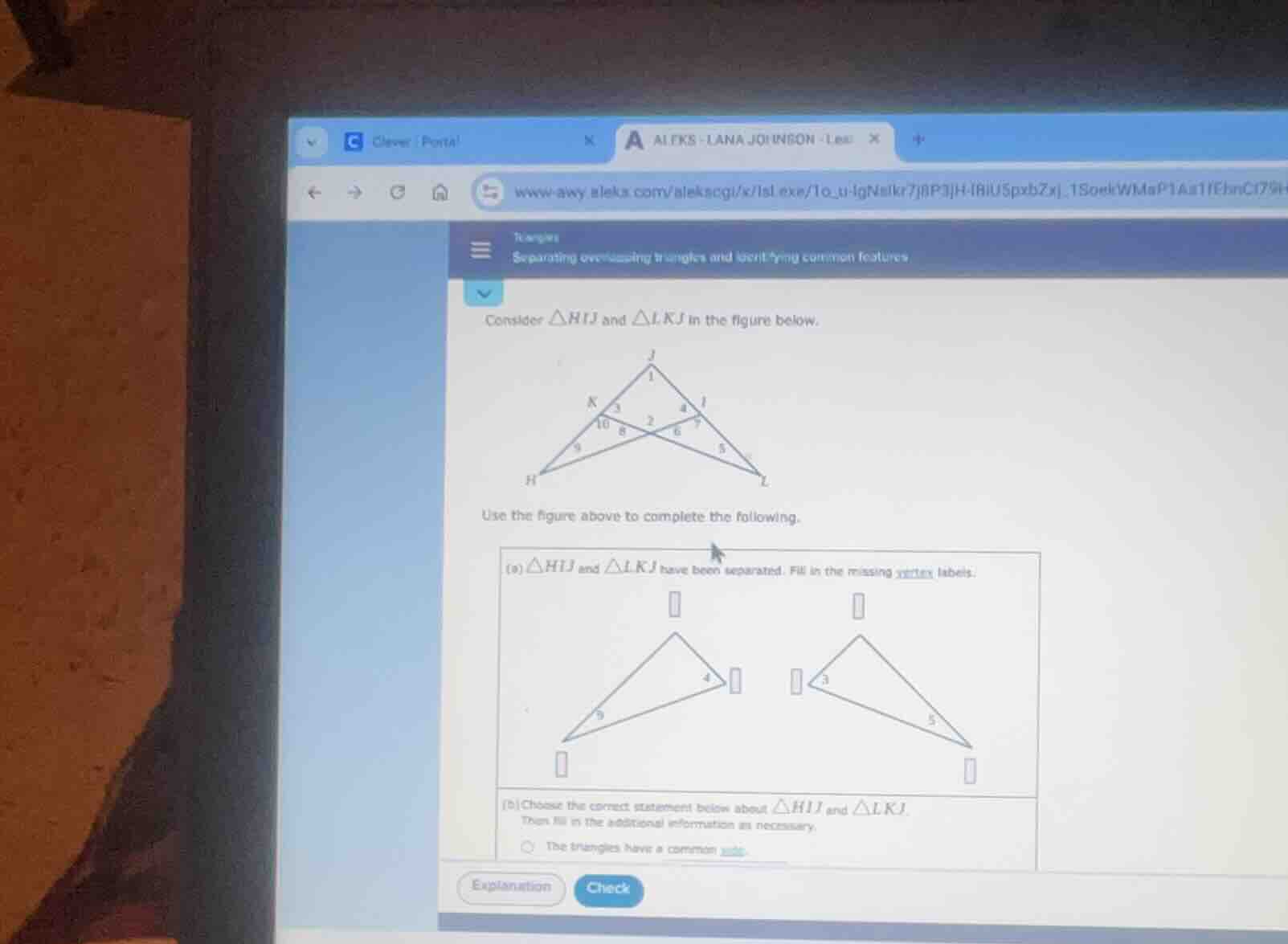
triangles separating overlapping triangles and identifying common features consider $\triangle hij$ and $\triangle lkj$ in the figure below. figure of triangles use the figure above to complete the following. (a) $\triangle hij$ and $\triangle lkj$ have been separated. fill in the missing vertex labels. diagrams of separated triangles with labels to fill (b) choose the correct statement below about $\triangle hij$ and $\triangle lkj$. then fill in the additional information as necessary. $\bigcirc$ the triangles have a common side.
Part (a)
To fill in the missing vertex labels for \(\triangle HIJ\) and \(\triangle LKJ\), we analyze the original figure:
- For \(\triangle HIJ\): The sides are labeled \(9\) (from \(H\) to \(K\)), \(4\) (from \(I\) to \(J\)? Wait, no, looking at the original triangle \(\triangle HIJ\) and the separated one with side \(9\) and \(4\). The vertices should match the original. In the original, \(\triangle HIJ\) has vertices \(H\), \(I\), \(J\). The side labeled \(9\) is from \(H\) to \(K\) (but in the separated triangle, the side \(9\) is from \(H\) to the bottom vertex, and the side \(4\) is from the right vertex. Wait, actually, in the original figure, \(\triangle HIJ\) has sides: \(HJ\) (with segments \(9\) and \(10\)? No, the separated \(\triangle HIJ\) has side \(9\) and \(4\). Wait, let's re - examine.
In the original figure, \(\triangle HIJ\) and \(\triangle LKJ\) share some angles and sides. For \(\triangle HIJ\):
- The vertex at the bottom (with side \(9\)) is \(H\).
- The vertex with side \(4\) is \(I\).
- The top vertex is \(J\).
For \(\triangle LKJ\):
- The vertex with side \(5\) is \(L\).
- The vertex with side \(3\) is \(K\).
- The top vertex is \(J\).
So, for the left - hand ( \(\triangle HIJ\)) separated triangle:
- Top vertex: \(J\)
- Right - hand vertex (with side \(4\)): \(I\)
- Bottom vertex: \(H\)
For the right - hand ( \(\triangle LKJ\)) separated triangle:
- Top vertex: \(J\)
- Left - hand vertex (with side \(3\)): \(K\)
- Bottom vertex: \(L\)
Part (b)
To determine the correct statement about \(\triangle HIJ\) and \(\triangle LKJ\):
- The option "The triangles have a common side" is being considered. Let's check the sides. The side \(KJ\) is a side of both \(\triangle HIJ\) (since \(K\) is on \(HJ\) and \(J\) is a vertex) and \(\triangle LKJ\) ( \(K\) and \(J\) are vertices of \(\triangle LKJ\)). So the triangles share the side \(KJ\), so the statement "The triangles have a common side" is correct.
Final Answers
(a)
For \(\triangle HIJ\) (left triangle):
- Top: \(J\)
- Right: \(I\)
- Bottom: \(H\)
For \(\triangle LKJ\) (right triangle):
- Top: \(J\)
- Left: \(K\)
- Bottom: \(L\)
(b)
The correct statement is "The triangles have a common side" (assuming this is the only option related to common features and it is correct as they share side \(KJ\)).

Snap & solve any problem in the app
Get step-by-step solutions on Sovi AI
Photo-based solutions with guided steps
Explore more problems and detailed explanations
Part (a)
To fill in the missing vertex labels for \(\triangle HIJ\) and \(\triangle LKJ\), we analyze the original figure:
- For \(\triangle HIJ\): The sides are labeled \(9\) (from \(H\) to \(K\)), \(4\) (from \(I\) to \(J\)? Wait, no, looking at the original triangle \(\triangle HIJ\) and the separated one with side \(9\) and \(4\). The vertices should match the original. In the original, \(\triangle HIJ\) has vertices \(H\), \(I\), \(J\). The side labeled \(9\) is from \(H\) to \(K\) (but in the separated triangle, the side \(9\) is from \(H\) to the bottom vertex, and the side \(4\) is from the right vertex. Wait, actually, in the original figure, \(\triangle HIJ\) has sides: \(HJ\) (with segments \(9\) and \(10\)? No, the separated \(\triangle HIJ\) has side \(9\) and \(4\). Wait, let's re - examine.
In the original figure, \(\triangle HIJ\) and \(\triangle LKJ\) share some angles and sides. For \(\triangle HIJ\):
- The vertex at the bottom (with side \(9\)) is \(H\).
- The vertex with side \(4\) is \(I\).
- The top vertex is \(J\).
For \(\triangle LKJ\):
- The vertex with side \(5\) is \(L\).
- The vertex with side \(3\) is \(K\).
- The top vertex is \(J\).
So, for the left - hand ( \(\triangle HIJ\)) separated triangle:
- Top vertex: \(J\)
- Right - hand vertex (with side \(4\)): \(I\)
- Bottom vertex: \(H\)
For the right - hand ( \(\triangle LKJ\)) separated triangle:
- Top vertex: \(J\)
- Left - hand vertex (with side \(3\)): \(K\)
- Bottom vertex: \(L\)
Part (b)
To determine the correct statement about \(\triangle HIJ\) and \(\triangle LKJ\):
- The option "The triangles have a common side" is being considered. Let's check the sides. The side \(KJ\) is a side of both \(\triangle HIJ\) (since \(K\) is on \(HJ\) and \(J\) is a vertex) and \(\triangle LKJ\) ( \(K\) and \(J\) are vertices of \(\triangle LKJ\)). So the triangles share the side \(KJ\), so the statement "The triangles have a common side" is correct.
Final Answers
(a)
For \(\triangle HIJ\) (left triangle):
- Top: \(J\)
- Right: \(I\)
- Bottom: \(H\)
For \(\triangle LKJ\) (right triangle):
- Top: \(J\)
- Left: \(K\)
- Bottom: \(L\)
(b)
The correct statement is "The triangles have a common side" (assuming this is the only option related to common features and it is correct as they share side \(KJ\)).