QUESTION IMAGE
Question
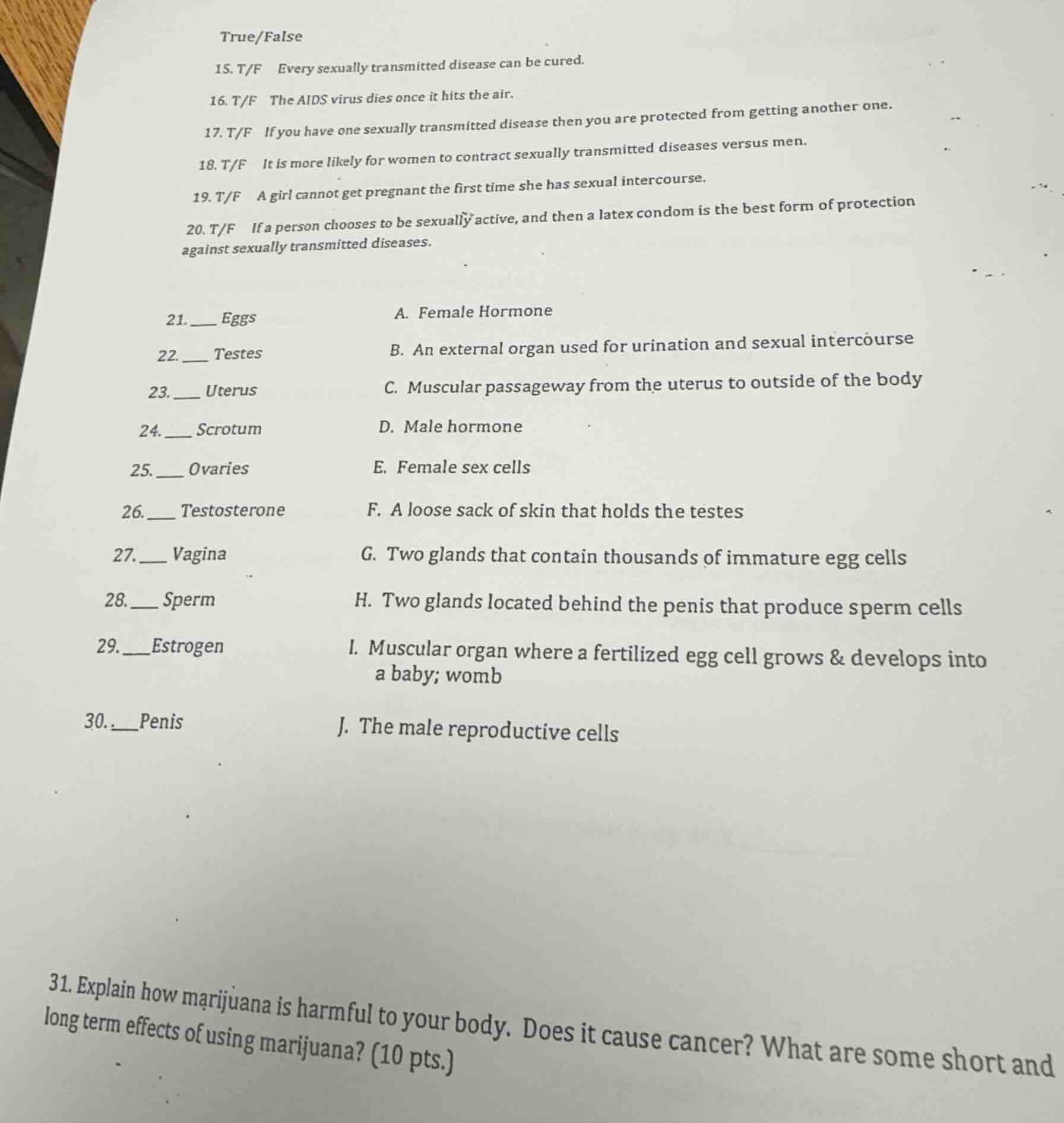
true/false
- t/f every sexually transmitted disease can be cured.
- t/f the aids virus dies once it hits the air.
- t/f if you have one sexually transmitted disease then you are protected from getting another one.
- t/f it is more likely for women to contract sexually transmitted diseases versus men.
- t/f a girl cannot get pregnant the first time she has sexual intercourse.
- t/f if a person chooses to be sexually active, and then a latex condom is the best form of protection against sexually transmitted diseases.
- ___ eggs a. female hormone
- ___ testes b. an external organ used for urination and sexual intercourse
- ___ uterus c. muscular passageway from the uterus to outside of the body
- ___ scrotum d. male hormone
- ___ ovaries e. female sex cells
- ___ testosterone f. a loose sack of skin that holds the testes
- ___ vagina g. two glands that contain thousands of immature egg cells
- ___ sperm h. two glands located behind the penis that produce sperm cells
- ___ estrogen i. muscular organ where a fertilized egg cell grows & develops into a baby; womb
- ___ penis j. the male reproductive cells
- explain how marijuana is harmful to your body. does it cause cancer? what are some short and long term effects of using marijuana? (10 pts.)
True/False Section:
- Many STDs (e.g., HIV, herpes) are incurable, only manageable.
- HIV can survive outside the body for a short time in certain conditions, it does not die instantly on contact with air.
- Having one STD increases susceptibility to others due to tissue damage and compromised immunity.
- Women have more delicate genital tissue and higher surface area exposure, making them more vulnerable to STD transmission.
- Pregnancy can occur during first intercourse if ovulation is occurring.
- Latex condoms are highly effective at reducing STD transmission when used correctly, making them the best barrier protection for sexually active people.
Matching Section:
- Eggs are the female reproductive (sex) cells.
- Testes are the male glands that produce sperm.
- The uterus is the organ where a fertilized egg develops into a fetus.
- The scrotum is the skin sac that holds and protects the testes.
- Ovaries are the female glands that contain immature egg cells.
- Testosterone is the primary male sex hormone.
- The vagina is the muscular passage connecting the uterus to the outside.
- Sperm are the male reproductive cells.
- Estrogen is the primary female sex hormone.
- The penis is the external organ used for urination and intercourse.
Essay Section:
Marijuana harms the body by impairing organ function, mental health, and physical performance. It can increase cancer risk due to carcinogens. Short-term effects are immediate but temporary, while long-term effects are chronic and cumulative.

Snap & solve any problem in the app
Get step-by-step solutions on Sovi AI
Photo-based solutions with guided steps
Explore more problems and detailed explanations
True/False:
- False
- False
- False
- True
- False
- True
Matching:
- E. Female sex cells
- H. Two glands located behind the penis that produce sperm cells
- I. Muscular organ where a fertilized egg cell grows & develops into a baby; womb
- F. A loose sack of skin that holds the testes
- G. Two glands that contain thousands of immature egg cells
- D. Male hormone
- C. Muscular passageway from the uterus to outside of the body
- J. The male reproductive cells
- A. Female Hormone
- B. An external organ used for urination and sexual intercourse
Essay:
Long-term marijuana use harms the body in multiple ways: it damages the respiratory system (causing chronic bronchitis, coughing, and increased lung infection risk), impairs memory, attention, and cognitive function, increases the risk of mental health issues like anxiety, depression, and psychosis (especially in young users), and may negatively impact heart health by raising blood pressure and heart rate.
Marijuana smoke contains many of the same carcinogens as tobacco smoke, and long-term, heavy use is linked to an increased risk of certain cancers, particularly lung, head, and neck cancers, though research is still ongoing about the exact magnitude of risk.
Short-term effects include impaired coordination and judgment, altered perception, increased heart rate, dry mouth, and red eyes. Long-term effects include reduced lung function, persistent cognitive impairment, addiction (in about 9% of users, rising to 17% for those who start as teens), and potential fertility issues in both men and women.