QUESTION IMAGE
Question
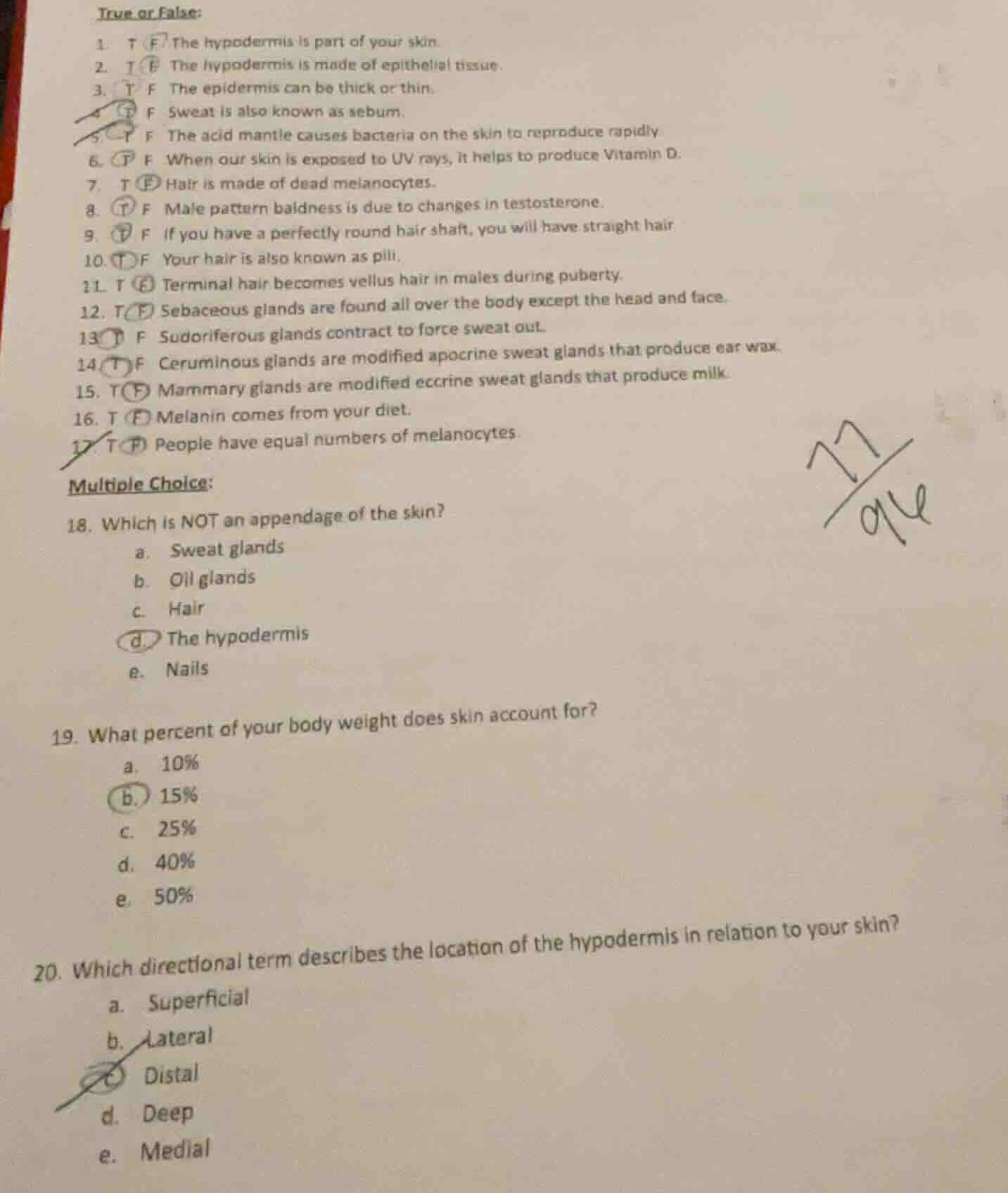
true or false:
- t f the hypodermis is part of your skin.
- t f the hypodermis is made of epithelial tissue.
- t f the epidermis can be thick or thin.
- t f sweat is also known as sebum.
- t f the acid mantle causes bacteria on the skin to reproduce rapidly
- t f when our skin is exposed to uv rays, it helps to produce vitamin d.
- t f hair is made of dead melanocytes.
- t f male pattern baldness is due to changes in testosterone.
- t f if you have a perfectly round hair shaft, you will have straight hair
- t f your hair is also known as pili.
- t f terminal hair becomes vellus hair in males during puberty.
- t f sebaceous glands are found all over the body except the head and face.
- t f sudoriferous glands contract to force sweat out.
- t f ceruminous glands are modified apocrine sweat glands that produce ear wax.
- t f mammary glands are modified eccrine sweat glands that produce milk.
- t f melanin comes from your diet.
- t f people have equal numbers of melanocytes
multiple choice:
- which is not an appendage of the skin?
a. sweat glands
b. oil glands
c. hair
d. the hypodermis
e. nails
- what percent of your body weight does skin account for?
a. 10%
b. 15%
c. 25%
d. 40%
e. 50%
- which directional term describes the location of the hypodermis in relation to your skin?
a. superficial
b. lateral
c. distal
d. deep
e. medial
Question 18
Skin appendages include structures like sweat glands, oil (sebaceous) glands, hair, and nails. The hypodermis (subcutaneous layer) is not an appendage but a layer beneath the dermis, providing insulation and cushioning. So the option that is not a skin appendage is the hypodermis.
The skin typically accounts for about 15% of a person's body weight. This is a standard anatomical fact regarding the skin's contribution to total body mass.
Directional terms: Superficial means closer to the surface, deep means farther from the surface. The hypodermis is located deep to the dermis (part of the skin), so "Deep" describes its location relative to the skin.

Snap & solve any problem in the app
Get step-by-step solutions on Sovi AI
Photo-based solutions with guided steps
Explore more problems and detailed explanations
d. The hypodermis