QUESTION IMAGE
Question
true false
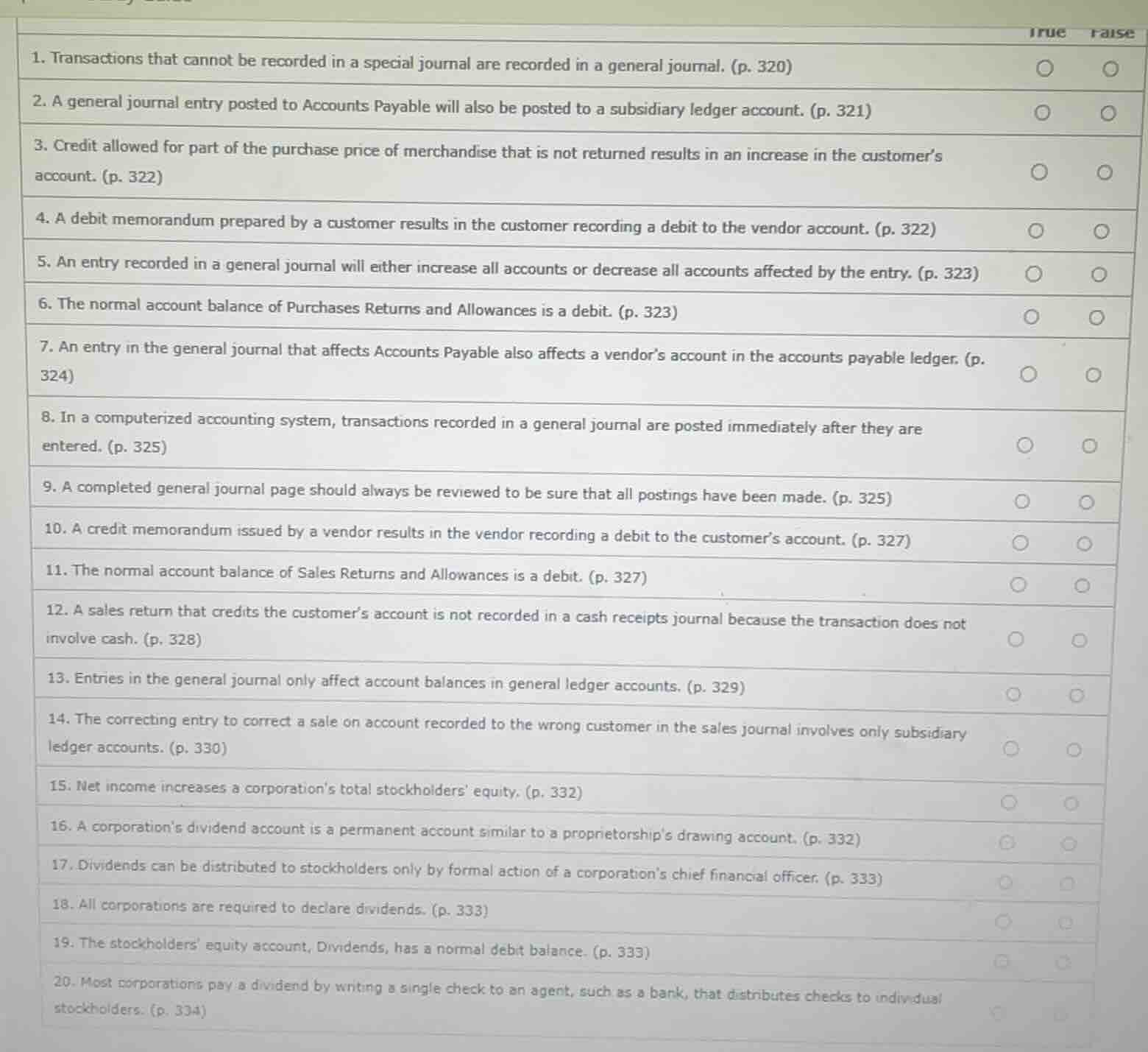
- transactions that cannot be recorded in a special journal are recorded in a general journal. (p. 320)
- a general journal entry posted to accounts payable will also be posted to a subsidiary ledger account. (p. 321)
- credit allowed for part of the purchase price of merchandise that is not returned results in an increase in the customers account. (p. 322)
- a debit memorandum prepared by a customer results in the customer recording a debit to the vendor account. (p. 322)
- an entry recorded in a general journal will either increase all accounts or decrease all accounts affected by the entry. (p. 323)
- the normal account balance of purchases returns and allowances is a debit. (p. 323)
- an entry in the general journal that affects accounts payable also affects a vendors account in the accounts payable ledger. (p. 324)
- in a computerized accounting system, transactions recorded in a general journal are posted immediately after they are entered. (p. 325)
- a completed general journal page should always be reviewed to be sure that all postings have been made. (p. 325)
- a credit memorandum issued by a vendor results in the vendor recording a debit to the customers account. (p. 327)
- the normal account balance of sales returns and allowances is a debit. (p. 327)
- a sales return that credits the customers account is not recorded in a cash receipts journal because the transaction does not involve cash. (p. 328)
- entries in the general journal only affect account balances in general ledger accounts. (p. 329)
- the correcting entry to correct a sale on account recorded to the wrong customer in the sales journal involves only subsidiary ledger accounts. (p. 330)
- net income increases a corporations total stockholders equity. (p. 332)
- a corporations dividend account is a permanent account similar to a proprietorships drawing account. (p. 332)
- dividends can be distributed to stockholders only by formal action of a corporations chief financial officer. (p. 333)
- all corporations are required to declare dividends. (p. 333)
- the stockholders equity account, dividends, has a normal debit balance. (p. 333)
- most corporations pay a dividend by writing a single check to an agent, such as a bank, that distributes checks to individual stockholders. (p. 334)
Brief Explanations
- Special journals handle routine transactions; non-routine ones go to the general journal.
- Accounts Payable is a control account linked to a subsidiary ledger for individual vendors.
- A purchase allowance (no return) reduces the customer's owed amount, decreasing their account.
- A customer's debit memo reduces what they owe the vendor, so they credit the vendor account.
- General journal entries follow double-entry: at least one debit and one credit (increases and decreases).
- Purchases Returns and Allowances is a contra-purchase account, with a normal credit balance.
- Accounts Payable is a control account; entries affecting it must update the corresponding vendor subsidiary account.
- Computerized systems typically post general journal entries immediately upon entry.
- A reviewed general journal page ensures no postings are missed, maintaining accurate ledgers.
- A vendor's credit memo reduces the customer's owed amount, so the vendor credits the customer's account.
- Sales Returns and Allowances is a contra-revenue account, with a normal debit balance.
- Cash receipts journals only track cash inflows; sales returns (no cash) use a general or sales returns journal.
- General journal entries can affect both general ledger control accounts and their related subsidiary ledgers.
- Correcting a wrong customer in sales journal requires adjusting two subsidiary ledger accounts (debit correct, credit incorrect).
- Net income increases retained earnings, which is part of stockholders' equity.
- Dividend accounts are temporary (closed at period-end), unlike permanent equity accounts.
- Dividends require formal action by the corporation's board of directors, not just the CFO.
- Corporations are not required to declare dividends; it is a board decision.
- Dividends reduce equity, so the account has a normal debit balance.
- Most large corporations use an agent (like a bank) to distribute dividend checks to stockholders.

Snap & solve any problem in the app
Get step-by-step solutions on Sovi AI
Photo-based solutions with guided steps
Explore more problems and detailed explanations
- True
- True
- False
- False
- False
- False
- True
- True
- True
- False
- True
- True
- False
- True
- True
- False
- False
- False
- True
- True